
(▼Scroll down for English text)
#paroladartista #intervistaartista #artistinterview #ariannacarossa
Parola d’Artista: Per la maggior parte degli artisti, l’infanzia rappresenta il periodo d’oro in cui iniziano a manifestarsi i primi sintomi di una certa propensione ad appartenere al mondo dell’arte. È stato così anche per te? Racconta.
Arianna Carossa: Penso che tutti i bambini manifestino desideri e propensioni, forse gli artisti se le ricordano perche’ le hanno mantenute o forse per regalare una idea romantica di loro stessi. Comunque io volevo fare il muratore perche’ osservavo i muratori di fronte casa mia che con gesti semplici costruivano, un mattone dopo l’altro qualcosa che prima non esisteva. Quindi, vista la mia propensione per i muri, la mia famiglia mi lascio’ delle pareti vuote in casa dove potessi disegnare quello che volevo. Ho iniziato a fare cose mie a 11 anni ed erano quadri con dipinti acini d’uva tutti separati e su un fondo vuoto.
P.d’A.: Quali studi hai fatto?
A.C.: Dopo le superiori al Liceo Artistico Sperimentale ho frequentato l’accademia Ligustica di Belle arti di Genova.
P.d’A.: Ci sono statti degli incontri importanti durante la tua formazione?
A.C.: La persona che piu’ ha segnato la mia formazione che mi viene in mente e’ Daniele Grosso il mio insegnante professore di Storia dell’arte al Liceo, era cosi’ appassionato e pieno di entusiasmo per quello che raccontava che non avevo bisogno di studiare arrivata a casa, perche’ veramente tracciava dentro di me un sentiero. Era cosi’ preso dal suo racconto che sputava parlando, la sua saliva era forse la mietitura di semi sparsi per l’aula. Quella passione era cosi’ focosa da trasformare davvero l’argomento della lezione in un corpo erotico, quello che ogni insegnante dovrebbe riuscire a fare e non aspettarsi che sia l’oggetto a trasformare loro in corpo erotico.
P.d’A.: Che ruolo ha il disegno in quello che fai?
A.C.: Il disegno mi aiuta a penetrare il soggetto e a riflettere sul processo.
P.d’A.: Come scegli i materiali con cui lavori?
A.C.: Dipende. Naturalmente in base a una sensazione di disconforto. Quello che faccio partendo sempre da cosa sento, viene poi tradotto attraverso un materiale. Alcune altre volte il materiale mi capita tra le mani e cerco di farlo andare nella direzione del mio sentire. Insomma parliamo sempre di relazioni.
P.d’A.: Che importanza ha nel tuo lavoro l’idea di fisicità?
A.C.: E’ imprescindibile il mio corpo sono io, e’ lo strumento piu’ diretto e spontaneo che ho, essendo tridimensionale, di filtrare la realta’. Il corpo mi permette di sentire. Credo che sia soprattutto per questo che in fondo preferisco far sculture invece che dipingere. Sento il mio corpo completamente mischiato e la vertigine e’ piu’ coinvolgente.
P.d’A.: Quando inizia un lavoro ha già un’idea chiara di come si svilupperà?
A.C.: No mai.
P.d’A.: Che tipo di dialogo cerchi con lo spettatore che si trova davanti a quello che fai?
A.C.: A me interessa che l’osservatore possa sentire una intimita’ con il lavoro, per far cio’ il lavoro prodotto deve mantenere degli spazi di apertura e vuoto liberi che possano far circolare il respiro di chi gli sta di fronte. Le relazioni sono scambi di vuoti profondi.
P.d’A.: L’idea di messa in scena nel tuo lavoro ha una qualche importanza?
A.C.: Si certo che ce l’ha, esattamente come al mattino prima di uscire mi vesto non solo in relazione alle condizioni climatiche. Nell’arte la forma e’ sostanza dunque l’aspetto, la scena rivestono una importanza che coopera con la moltitudine di altre parti del lavoro in una sorta di struttura cibernetica.
P.d’A.: Che cosa succede alle opere quando non c’è nessuno che le osserva, l’esistenza di un opera d’arte può prescindere dalla presenza di un osservatore?
A.C.: Si. Io esisto come essere umano senza relazioni? Esisto ma sono parziale.
Pero’ la paperella di Lonzenz muore se non trova la papera mamma vicino, il calore delle relazioni ci respira dentro, altrimenti l’esistenza forse e’ solo oggettiva.
P.d’A.: L’artista dove si pone nei confronti della sua opera?
A.C.: Dipende dalla fase, quando lo strutturo sono ossessivamente dentro quella forma. Ma quando e’ esposto mi trovo di lato, l’accompagno nella sua crescita facendogli spazio e largo per la sua maturazione senza invadere il suo spazio.
P.d’A.: Secondo te il sistema dell’arte così come è ora ha ancora senso?
A.C.: Esistendo, non possiamo non ammeterne un senso. Detto questo a me interessa relativamente, per me il sistema attuale si struttura su una sorta di democratizzazione capitalista acquistandone anche i caratteri di mediocrita’ e non belligeranza. Il sistema appiattisce il lavoro invece che espanderlo, in questo momento storico. D’altro canto se non ne sei riconosciuto non fai parte del tessuto sociale. Allora l’alternativa ad un sistema cosi’ poco elegante e’ provare a non pensarci ed occuparsi unicamente del proprio lavoro cercando di portar avanti la propria ricerca in modo sincero.
P.d’A.: Qual è oggi il ruolo sociale dell’artista?
A.C.: L’artista racconta attraverso quella che dovrebbe essere una rivoluzione estetica la rielaborazione di cio’ che accadra’, bilancia in qualche modo la societa’. Anzi, ribilancia.
Nata a Genova , vive e lavora a Brooklyn, New York. Inizia la sua carriera come pittrice esponendo nel 1999 all’Arc Gallery di Chicago, alla Biennale d’arte contemporanea a San Pietruburgo presso il Manage del Museo Ermitage , alla Biennale degli artisti del Mediterraneo in Tunisia; lavora a Londra con la Dostojesky Foundation. Nel 2005 sposta il focus della sua ricerca sulla scultura trasferendosi poi nel 2010 attraverso il premio dell’ISCP a New York dove attualmente vive.
Nel suo lavoro fa uso di una gamma di tecniche diverse, come la pittura, la scultura la performance, il video.
Nel 2014 esce il libro “The aesthetic of my disappearance “ lanciato dal Moma/PS1.
Partecipa al sessantesimo premio Faenza per la ceramica al museo MIIC,
Espone a Documenta 11 Kunstbalkon a Kassel, al MACRO di Roma, Lower Manhattan Council di New York, Fondazione Antinori, Firenze, Vittoriano a Roma, Museo di Villa Croce a Genova, Museo dellla Miniera di Citta’ del Messico, Istituto Italiano di cultura di Citta del Messico e di New York, Ps1 New York, vince nel 2020 il primo NYFA della citta’ di New York.
English text
Interview to Arianna Carossa
#paroladartista #intervistaartista #artistinterview #ariannacarossa
Parola d’artista:For most artists, childhood is the golden age when the first symptoms of a certain propensity to belong to the art world begin to appear. Was that the case for you too? Tell us.
Arianna Carossa: I think all children manifest desires and propensities, maybe artists remember them because they kept them or maybe to give a romantic idea of themselves. In any case, I wanted to be a bricklayer because I watched the bricklayers in front of my house who with simple gestures built, one brick after another, something that did not exist before. So, given my penchant for walls, my family left me blank walls in the house where I could draw whatever I wanted. I started making things of my own at the age of 11 and they were pictures with grapes painted all separate and on an empty background.
P.d’A.: What studies did you do?
A.C.: After high school at Liceo Artistico Sperimentale, I attended the Ligustica Academy of Fine Arts in Genoa.
P.d.A.: Were there any important encounters during your training?
A.C.: The person who most marked my education that comes to mind is Daniele Grosso my History of Art teacher at high school, he was so passionate and full of enthusiasm for what he was telling that I didn’t need to study when I got home, because he really traced a path within me. He was so engrossed in his tale that he spat talking, his saliva was perhaps the reaping of seeds scattered around the classroom. That passion was so fiery that it really turned the subject of the lesson into an erotic body, what every teacher should be able to do and not expect the object to turn them into an erotic body.
P.d’A.: What role does drawing play in what you do?
A.C.: Drawing helps me to penetrate the subject and reflect on the process.
P.d.A.: How do you choose the materials you work with?
A.C.: It depends. Of course based on a feeling of discomfort. What I do, always starting from what I feel, is then translated through a material.
Some other times the material comes into my hands and I try to make it go in the direction of my feeling. In short, we always talk about relationships.
P.d’A.: How important is the idea of physicality in your work?
A.C.: It is inescapable my body is me, it is the most direct and spontaneous tool I have, being three-dimensional, to filter reality. The body allows me to feel. I think that is mainly why I prefer making sculptures instead of painting. I feel my body completely mixed up and the vertigo is more involving.
P.d’A.: When you start a work do you already have a clear idea of how it will develop?
A.C.: No, never.
P.d’A.: What kind of dialogue do you seek with the spectator who is in front of what you do?
A.C.: I am interested in the viewer being able to feel an intimacy with the work. To do this, the work produced must maintain free spaces of openness and emptiness that can circulate the breath of those in front of it. Relationships are exchanges of deep voids.
P.d’A.: Does the idea of staging have any importance in your work?
A.C.: Yes of course it does, just as in the morning before going out I dress not only in relation to the weather conditions. In art, form is substance, so the appearance, the scene have an importance that cooperates with the multitude of other parts of the work in a kind of cybernetic structure.
P.d.A.: What happens to works of art when there is no one to observe them, can the existence of a work of art be independent of the presence of an observer?
A.C.: Yes. Do I exist as a human being without relationships? I exist but I am partial.
But Lonzenz’s duck dies if it doesn’t find its mother duck nearby, the warmth of relationships breathes in, otherwise existence is perhaps only objective.
P.d’A.: Where does the artist stand in relation to his work?
A.C.: It depends on the phase, when I structure it I am obsessively inside that form. But when it is exposed, I stand to the side, I accompany it in its growth, making room and space for it to mature without invading its space.
P.d’A.: Do you think the art system as it exists now still makes sense?
A.C.: As it exists, we cannot but admit it makes sense. Having said that I am relatively interested in it, for me the current system is structured on a kind of capitalist democratisation, also acquiring the characters of mediocrity and non-belligerence. The system flattens labour instead of expanding it, at this moment in history. On the other hand, if you are not recognised, you are not part of the social fabric. So the alternative to such an inelegant system is to try not to think about it and to only deal with your own work, trying to pursue your research in a sincere manner.
P.d’.A.: What is the social role of the artist today?
A.C.: The artist narrates through what should be an aesthetic revolution the reworking of what will happen, balances society in some way. Indeed, it rebalances.
Born in Genoa, Arianna lives and works in Brooklyn, New York. She began her career as a painter (what school did you attend?). In 1999 she had her first exhibition in the USA at the Arc Gallery in Chicago, was included in the Biennial of Contemporary Art in St. Petersburg, Russia at the Managee Hermitage Museum. In 2000, Carossa had an exhibition at the Biennial of Mediterranean Artists in Tunisia and she worked in London with the Dostojesky Foundation.
In 2005 she shifted the focus of her research on sculpture. In 2010, Carossa won the ISCP award in New York City, which is where she currently lives.
In her work she makes use of a range of different techniques, such as painting, sculpture, performance and video.
In 2014 the book “The aesthetic of my disappearance” was released and launched at Moma/PS1.
Arianna participated in the 60th Faenza prize for ceramics at the MIIC museum,
Documenta 11 Kunstbalkon in Kassel, the MACRO in Rome, the Lower Manhattan Council in New York, Artist’s Alliance New York, the Antinori Foundation in Florence, the Vittoriano in Rome, the Villa Croce Museum in Genoa, Museo della Mina in Mexico City, the Italian Cultural Institute in Mexico and Ps1 Moma museum in New York City. Carossa also won the NYFA award in NYC in 2020.
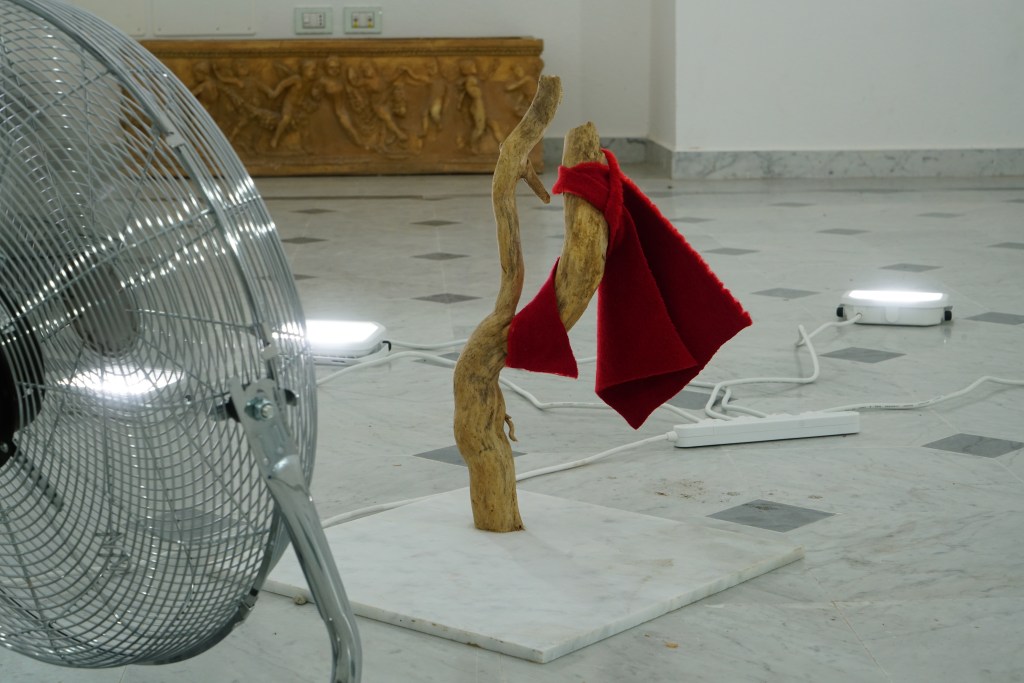
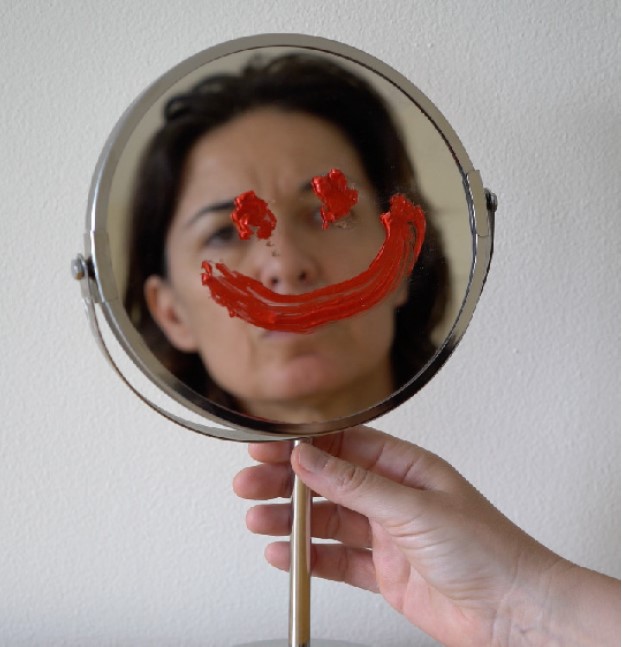
Always smiling , in Collaboration with Gianni Pipoli,
oil on mirror. 2.07 minutes.
https://youtu.be/ZGYAOjf097s
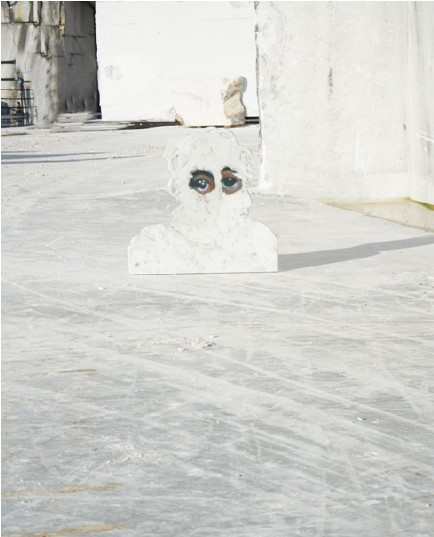
Self portrait of El Greco, oil paint in marble, 50x50x4 cm
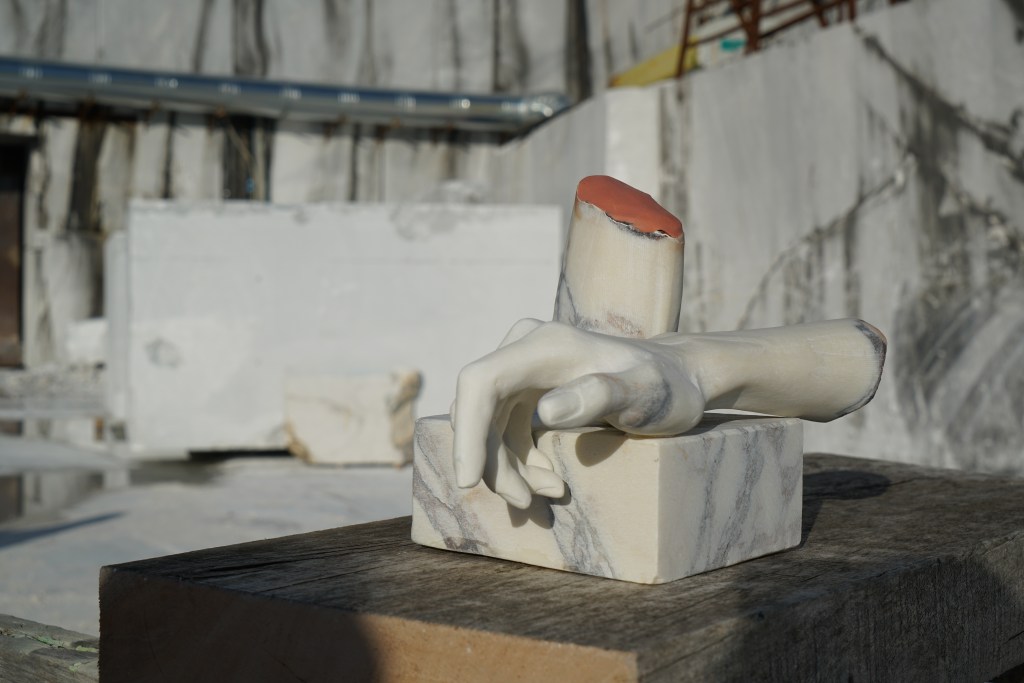
My half blood. 47x17x27 cm plastilina e marmo.
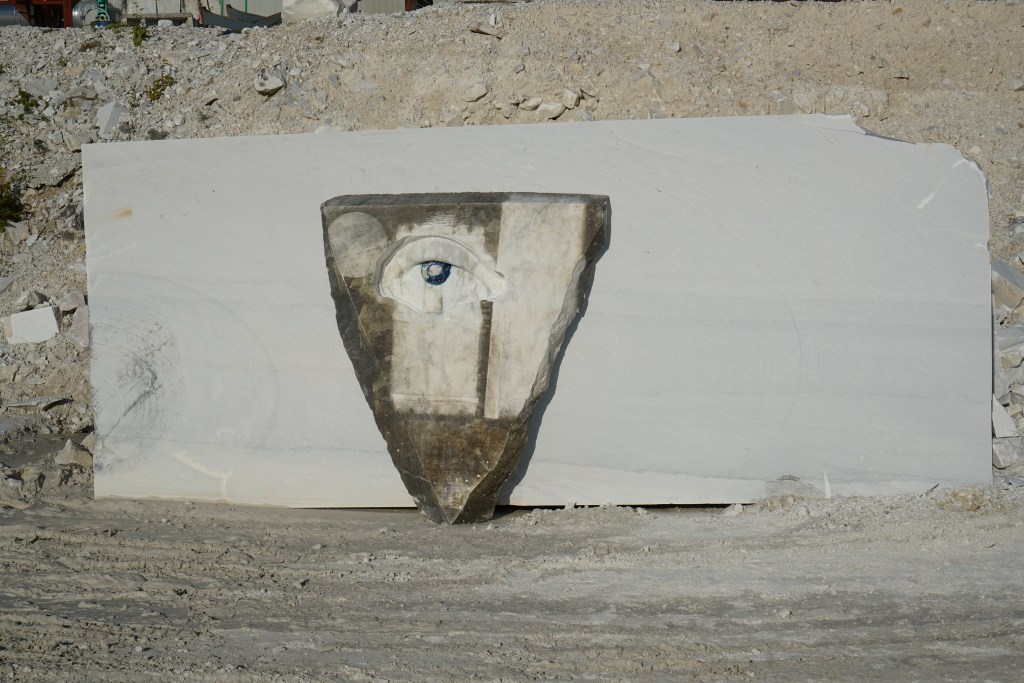

Rodeo, olio e carta su tela, 60×35 cm.
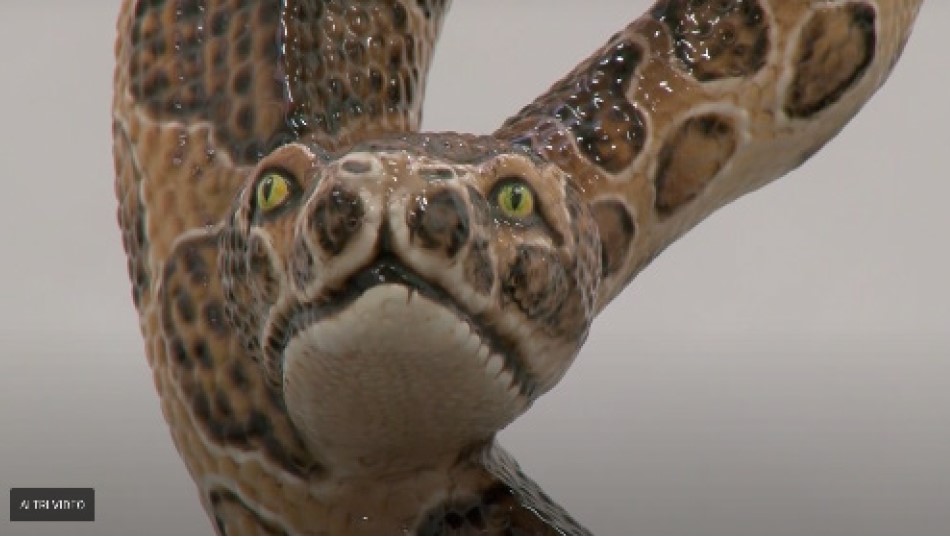
La fune, ceramica smaltata, 55x47x30 cm
 paroladartista.com