
(Scroll down for English text)
#paroladartista #intervistaartista #artistinterview #lucarubegni
Parola d’Artista: Per la maggior parte degli artisti, l’infanzia rappresenta il periodo d’oro in cui iniziano a manifestarsi i primi sintomi di una certa propensione ad appartenere al mondo dell’arte. È stato così anche per te? Racconta.
Luca Rubegni: Certo, fin da piccolo ero attratto dai colori, dagli strumenti da disegno e dalle forme, ma non è mai stata una predilezione. Il processo è avvenuto gradualmente, specialmente in età più matura, ovvero durante gli studi. È una lunga frequentazione, un gioco d’attrazioni.
P.d’A.: Qual è stato il tuo primo amore artistico?
L.R.: In assoluto una scatola di acquerelli regalatami da piccolo. Poi mi piaceva ricopiare immagini di fumetti o figurine, foto di riviste oppure dipingere miniature da collezione. Non avevo ancora preso contatto con quella che chiamiamo arte con la “A” maiuscola. Ho amato prima l’architettura che l’arte da bambino. Amavo giocare tra le rovine di Roma, con tutte quelle colonne, statue, mosaici, etc. Poi è arrivato De Chirico e tutto è cambiato.
P.d’A.: Quali studi hai fatto?
L.R.: Liceo artistico e poi triennale presso l’Accademia di Belle Arti di Firenze, con un anno a Vienna presso l’Università di Arti Applicate e poi magistrale a Brera. Ho mischiato studi di grafica ed incisione con pittura.
P.d’A.: Nel corso della tua formazione ci sono statti degli incontri importanti che hanno contribuito ad orientare le tue scelte?
L.R.: Sicuramente, soprattutto alcuni amici e colleghi che ancora mi porto appresso. Molto però è stato dato dal caso o dal destino, chissà. Più spesso però sono stati i morti, maestri del passato, oppure immagini o dipinti nel quale sono letteralmente inciampato.
P.d’A.: Che importanza ha l’aspetto favolistico nel tuo lavoro?
L.R.: Ogni tanto le leggo, in particolare quelle medio orientali, che sono esteticamente più evocative, ma nel mio lavoro è più l’oggetto ad avere l’importanza. Può darsi che si costruisca una fiaba intorno ad esso, ma non c’è molto sogno. Quando dipingo sono sveglio.
P.d’A.: Che ruolo ha il colore?
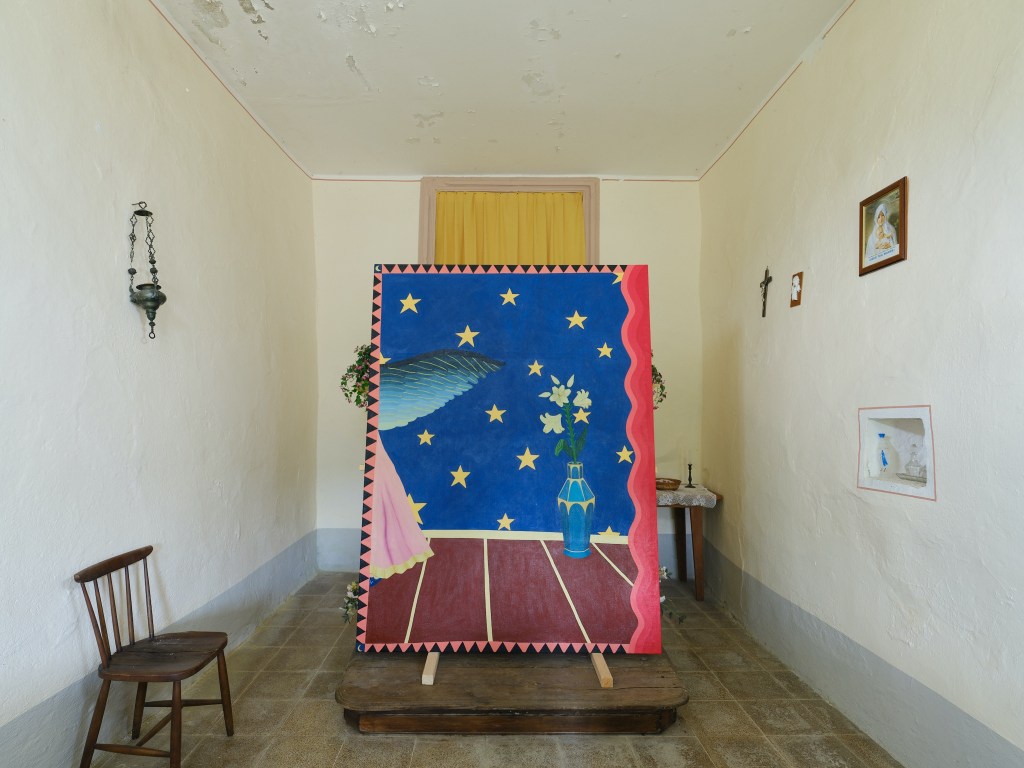
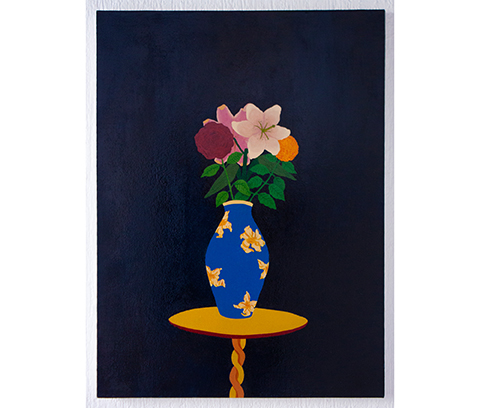
L.R.: Fondamentale, è lui il protagonista. Cerco l’unione fra la scuola fiorentina e quella veneta, disegno e colore hanno lo stesso punto d’importanza, senza uno non esiste l’altro. Anche se chi si prende più meriti è il colore alla fine.
P.d’A.: Lavori su più opere insieme o ti concentri su un lavoro alla volta?
L.R.: Dipende. Alle volte mando avanti due quadri simultaneamente, altre sono concentrato solo su di uno. Non lavoro però come catena di montaggio, ogni dipinto ha i suoi tempi e non riesco ad avere dieci tele aperte nello stesso momento, sarebbe come leggere più libri, alla fine si rischia di non leggere nulla.
P.d’A.: Quando prepari una mostra che importanza attribuisci all’idea di messa in scena?
L.R.: Preferisco che siano gli altri ad occuparsene, io penso a dipingere dei quadri che reputo belli. Certo poi che ogni serie di lavori tende ad avere una coerenza, raccontano una stessa storia, si muovo all’unisono. Ma cerco costantemente di avere uno sviluppo progressivo nel mio lavoro, ogni anno aggiungo o rimuovo qualcosa, come una collezione di moda. Poi rimane sempre il mistero se tutto abbia una coerenza oppure no.
P.d’A.: La vicinanza del tuo linguaggio con quello dell’illustrazione non rischia di essere un pericolo?
L.R.: Se guardo alla pittura inglese o americana trovo una nota “illustrativa” enorme, eppure ciò non ha minimamente inficiato la loro qualità o grandezza. Portrait of an Artist o A Bigger Splash’ di Hockney sono
perfetti come copertine per vinili o libri, ma allo stesso tempo sono dei dipinti meravigliosi, incredibilmente intimi; potrei citare Philip Guston o Matisse, la quale pittura è tranquillamente definibile come illustrativa, e ciò non sarebbe denigrante e comunque nemmeno esatto. No, penso che in Italia abbiamo un problema di definizione da vocabolario con questa parola, l’abbiamo traviata, come la decorazione. Cerchiamo una presunta purezza che non c’è, forse perché vogliamo tutti essere i più bravi della classe.
P.d’A.: La tua pratica artistica quotidiana ti porta verso un percorso spirituale?
L.R.: No, anzi mi tiene a terra. Ammetto però che quando dipingo, affinché un quadro riesca, occorre distaccarsi un po’ da esso, non essere troppo cosciente. Deve intermediari qualche cosa che non so nemmeno io cosa sia.
P.d’A.: Che importanza ha secondo te il sacro nel arte oggi?
L.R.: Nulla, non esiste proprio più. O meglio, potarsi che sopravviva ancora in qualche raro individuo, ma non credo si possa parlare di carattere sacro nell’arte odierna. Gli artisti cercano sempre di santificare loro stessi, di ergersi ad altro; c’è chi cerca di spacciare i propri lavori con un qualche profumo di spiritualità, ma la reputo una presa di coscienza riguardo la debolezza del proprio operato. Una volta sono certo che esistesse il carattere sacro nell’arte, ma parliamo di artisti che erano capaci di cogliere dei segnali che andavano oltre, sapevano ascoltare e che alla fine erano sempre “presenti”, calati in quello che facevano. Se il sacro esiste, ti parla per piccole frasi, qualche tocco di pennello, un’intuizione, nulla di più. Non si può pretende che sia permeato nel tutto, sarebbe da narcisisti pensarlo. Bisogna guardare all’editoria, nessuno pensa al carattere sacro nei libri eppure se ne scrivono di ottimi e spesso hanno molta più profondità rispetto ad un opera d’arte odierna.
P.d’A.: Che importanza hanno le categorie di tempo e spazio nel tuo lavoro?
L.R.: In un’intervista di qualche anno fa, citando Bergson dissi che «la pittura spazializza il tempo», lo inserisce in una dimensione qualitativamente percepibile. Questo avviene solo perché non riusciamo a non rendere fisico il tempo ed il suo fluire.
P.d’A.: Che cosa succede alle opere d’arte secondo te quando nessuno le guarda?
L.R.: Si annoiano e giocano a carte.
Luca Rubegni Nato a Roma nel 1993, vive e lavora a Parigi.
2020 – MFA Accademia di Belle Arti di Brera.
2016/2017 -Studente invitato presso l’Università di Arti Applicate di Vienna.
2017 – BFA Accademia di Belle Arti di Firenze.
PREMI
Premio Marche 2023, finalista (Urbino, 2023)
Premio Combat, finalista sezione pittura (Livorno, 2023)
Premio Artefici del nostro tempo, Vincitore sezione pittura (Venezia, 2023)
MOSTRE PERSONALI
2021 – Tutto è già stato fatto perché manca l’ultima cosa da fare, Osservatorio Futura, curata da
Federico Palumbo (Torino, Italia)
2020 – In Fabula, Galleria La Linea (Montalcino, Italia)
2019 – Le parole che non ti ho detto, Galleria La Linea, curata da Matteo Scuffiotti con un testo di
Omar Galliani (Montalcino, Italia)
2017 – In-concettuale, Hassmann & Liebfrau, curata da Martin Kolsrud, (Vienna, Austria)
MOSTRE COLLETTIVE
2023 – Under RAFFAELLO, mostra curata da Camillo Langone per Premio Marche 2023 (Urbino,
Italia)
2023 – Salon d’été #1, T&L Galerie, curata da Tancredi Hertzog (Parigi, Francia)
2023 – COMBAT PRIZE, Museo Civico Giovanni Fattori ex Granai di Villa Mimbelli
(Livorno,Italie)
2023 – Artefici del nostro tempo, a cura del Museo Civico Ca’ Pesaro di Venezia e Città di Venezia,
ospitata al Padiglione Venezia per la 59° mostra internazionale d’arte della Biennale di Venezia
(Venezia, Italia)
2023 – ICONS REBIRTH, Galleria Arrivada, curata da Andrea Lacarpia (Milano, Italia)
2022 – PERSONALITÀ MULTIPLA, Galleria La Linea (Montalcino, Italia)
2022 – Buona Fortuna Ribelli, Galleria Lunetta11 (Alta Langa, Italia)
2022 – Quedamos? Hello Tiresia (Carrara, Italia)
2021 – Le Forme del Colore, T&L Galerie, curata da Tancredi Hertzog et Mathilde Le Coz, Palazzo
Gallone (Tricase, Italia)
2021 – Abbiamo invitato un po’ di artisti nello spazio, Osservatorio Futura, curata da Francesca
Disconzi, Federico Palumbo & Osservatorio Futura (Torino, Italia)
2021 – Days of Our Lives, Susan Bites, curata da Valentino Russo e Arthur Cordier (L’Aja, Olanda)
2020 – ReA! Art Fair, Ex Cisterne della Fabbrica del vapore (Milano, Italia)
2020 – Vuoto di Senso Senso di Vuoto, Festival Walk in Studio, curata da Luca Rubegni (Milano,
Italia)
2020 – The Town Mouse and The Country House, The Balcony & Susan Bites, curata da Valentino
Russo e Arthur Cordier (L’Aja, Olanda e Rochefort, Belgio)
2020 – Square Project, Ballon Project, libro d’artista collettivo, curata da Valentina Lucia Barbagallo
e Giuseppe Mendolia Calella (Catania, Italia)
2019 – L’orizzonte del mare, 4° edizione Acqua dell’Elba, Accademia di Belle Arti di Brera
(Portoferraio, Italia)
2017 – The Essence 17, Università di Arti Applicate di Vienna, Alteposte (Vienna, Austria)
2015 – Nuovo Mecenatismo, Accademia di Belle Arti di Firenze (Monte Senario, Italia)
English text
Interview to Luca Rubegni
#paroladartista #intervistaartista #artistinterview #lucarubegni
Parola d’Artista: For most artists, childhood is the golden age when the first symptoms of a certain propensity to belong to the art world begin to appear. Was that the case for you too? Tell us.
Luca Rubegni: Of course, from an early age I was attracted to colours, drawing instruments and shapes, but it was never a predilection. The process happened gradually, especially at an older age, during my studies. It is a long association, a game of attractions.
P.d’A.: What was your first artistic love?
L.R.: Absolutely a box of watercolours given to me as a child. Then I liked to copy pictures from comic books or figurines, photos from magazines or paint collectible miniatures. I had not yet made contact with what we call art with a capital ‘A’. I loved architecture before art as a child. I loved playing among the ruins of Rome, with all those columns, statues, mosaics, etc. Then De Chirico came along and everything changed.
P.d’A.: What studies did you do?
L.R.: Liceo artistico and then a three-year degree at the Accademia di Belle Arti in Florence, with a year in Vienna at the University of Applied Arts and then a master’s degree at Brera. I mixed studies in graphics and engraving with painting.
P.d’A.: In the course of your training, were there any important encounters that helped to shape your choices?
L.R.: Definitely, especially some friends and colleagues that I still carry with me. Much however has been given by chance or destiny, who knows. More often, however, it has been the dead, masters of the past, or images or paintings in which I have literally stumbled.
P.d’A.: How important is the fairytale aspect in your work?
L.R.: Every now and then I read them, particularly Middle Eastern ones, which are aesthetically more evocative, but in my work it is more the object that is important. You may build a fairy tale around it, but there is not much dreaming. When I paint, I am awake.
P.d’A.: What role does colour play?
L.R.: Fundamental, he is the protagonist. I seek the union between the Florentine and Venetian schools, drawing and colour have the same point of importance, without one there is no other. Although the one who gets the most credit is colour in the end.
P.d’A.: Do you work on several works together or do you concentrate on one work at a time?
L.R.: It depends. Sometimes I run two paintings at the same time, others I am focused on just one. However, I do not work as an assembly line, each painting has its own time and I cannot have ten canvases open at the same time, it would be like reading several books, in the end you risk not reading anything.
P.d’A.: When you prepare an exhibition, what importance do you attach to the idea of staging?
L.R.: I prefer others to take care of that, I think about painting pictures that I think are beautiful. Of course then each series of works tends to have a coherence, they tell the same story, they move in unison. But I constantly try to have a progressive development in my work, every year I add or remove something, like a fashion collection. Then it always remains a mystery whether everything has a coherence or not.
P.d’A.: Doesn’t the proximity of your language with that of illustration risk being a danger?
L.R.: If I look at English or American painting, I find an enormous “illustrative” note, yet this has in no way affected their quality or greatness. Hockney’s ‘Portrait of an Artist’ or ‘A Bigger Splash’ are
perfect as covers for vinyl or books, but at the same time they are wonderful, incredibly intimate paintings; I could cite Philip Guston or Matisse, whose painting can easily be defined as illustrative, and that would not be disparaging or even accurate. No, I think that in Italy we have a vocabulary definition problem with this word, we have misused it, like decoration. We seek an alleged purity that is not there, perhaps because we all want to be the best in class.
P.d’A.: Does your daily artistic practice lead you towards a spiritual path?
L.R.: No, in fact it keeps me grounded. I admit, however, that when I paint, for a painting to succeed, I have to detach myself from it a little, not to be too conscious. It has to intermediate something that I don’t even know what it is.
P.d’A.: What importance do you think the sacred has in art today?
L.R.: Nothing, it doesn’t really exist any more. Or rather, it may still survive in some rare individuals, but I don’t think we can speak of a sacred character in art today. Artists are always trying to sanctify themselves, to elevate themselves to something else; there are those who try to pass off their work with some scent of spirituality, but I consider this to be an acknowledgement of the weakness of their work. Once upon a time, I am sure that the sacred existed in art, but we are talking about artists who were able to pick up signals that went beyond that, who knew how to listen and who were always ‘present’ in the end, immersed in what they were doing. If the sacred exists, it speaks to you through small phrases, a few touches of the brush, an intuition, nothing more. You cannot pretend that it is permeated in everything, it would be narcissistic to think so. You have to look at publishing, nobody thinks about the sacred character in books and yet they write very good ones and often have much more depth than a work of art today.
P.d’A.: How important are the categories of time and space in your work?
L.R.: In an interview a few years ago, quoting Bergson, I said that “painting spatialises time”, inserts it into a qualitatively perceptible dimension. This only happens because we cannot avoid making time and its flowing physical.
P.d’A.: What happens to works of art in your opinion when no one looks at them?
L.R.: They get bored and play cards.
Luca Rubegni Born in Rome in 1993, lives and works in Paris.
2020 – MFA Academy of Fine Arts of Brera.
2016/2017 – Invited student at the University of Applied Arts Vienna.
2017 – BFA Academy of Fine Arts, Florence.
AWARDS
Marche Prize 2023, finalist (Urbino, 2023)
Combat Prize, painting section finalist (Livorno, 2023)
Artefici del nostro tempo Award, winner painting section (Venice, 2023)
SOLO EXHIBITIONS
2021 – Everything has already been done because the last thing to be done is missing, Osservatorio Futura, curated by
Federico Palumbo (Turin, Italy)
2020 – In Fabula, La Linea Gallery (Montalcino, Italy)
2019 – Le parole che non ti ho detto, Galleria La Linea, curated by Matteo Scuffiotti with a text by
Omar Galliani (Montalcino, Italy)
2017 – In-conceptual, Hassmann & Liebfrau, curated by Martin Kolsrud, (Vienna, Austria)
GROUP EXHIBITIONS
2023 – Under RAFFAELLO, exhibition curated by Camillo Langone for Premio Marche 2023 (Urbino,
Italy)
2023 – Salon d’été #1, T&L Galerie, curated by Tancredi Hertzog (Paris, France)
2023 – COMBAT PRIZE, Museo Civico Giovanni Fattori ex Granai di Villa Mimbelli
(Livorno,Italie)
2023 – Artefici del nostro tempo, curated by the Museo Civico Ca’ Pesaro in Venice and the City of Venice,
hosted at the Venice Pavilion for the 59th International Art Exhibition of the Venice Biennale
(Venice, Italy)
2023 – ICONS REBIRTH, Arrivada Gallery, curated by Andrea Lacarpia (Milan, Italy)
2022 – MULTIPLE PERSONALITY, La Linea Gallery (Montalcino, Italy)
2022 – Good Luck Rebels, Lunetta11 Gallery (Alta Langa, Italy)
2022 – Quedamos? Hello Tiresia (Carrara, Italy)
2021 – Le Forme del Colore, T&L Galerie, curated by Tancredi Hertzog et Mathilde Le Coz, Palazzo
Gallone (Tricase, Italy)
2021 – We invited some artists into space, Osservatorio Futura, curated by Francesca
Disconzi, Federico Palumbo & Osservatorio Futura (Turin, Italy)
2021 – Days of Our Lives, Susan Bites, curated by Valentino Russo and Arthur Cordier (The Hague, The Netherlands)
2020 – ReA! Art Fair, Ex Cisterne della Fabbrica del Vapore (Milan, Italy)
2020 – The Town Mouse and The Country House, The Balcony & Susan Bites, curated by Valentino
Russo and Arthur Cordier (The Hague, Holland and Rochefort, Belgium)
2020 – Square Project, Ballon Project, collective artist’s book, curated by Valentina Lucia Barbagallo
and Giuseppe Mendolia Calella (Catania, Italy)
2019 – L’orizzonte del mare, 4th edition Acqua dell’Elba, Brera Academy of Fine Arts
(Portoferraio, Italy)
2017 – The Essence 17, University of Applied Arts Vienna, Alteposte (Vienna, Austria)
2015 – New Patronage, Florence Academy of Fine Arts (Monte Senario, Italy)

 paroladartista.com