

(▼Scorri verso il basso per la versione Italiana)
#paroladartista #artistinterview #intervistaartista #miyaturnbull
Parola d’Artista: For most artists, childhood is the golden age when the first symptoms of a certain propensity to belong to the art world begin to appear. Was that the case for you too? Tell us.
Miya Turnbull: Yes, ever since I was a child I was always drawing and if you asked me what I wanted to be when I grew up, there was no hesitation for me to say, “I want to be an artist”. My parents were both very nurturing when it came to art making and creativity so I was very fortunate to always have that support growing up and beyond.
Pd’A: Did you, like many, have a first artistic love?
M.T.: My first big art crush was Georgia O’Keefe. My high school teacher introduced me to her paintings and I was very taken with them and her lifestyle and independence. Later in University my next art love was for Cindy Sherman and her amazing, groundbreaking self-portraiture work. I am extremely proud to say I just had the great fortune to be a part of a group exhibit in China called Illusive Masks and both Cindy and I were the only Westerners to be included in the show. Definitely a highlight of my career so far!
Pd’A: What studies did you do?
M.T.: I received a Bachelor of Fine Art (BFA) from the University of Lethbridge (Alberta, Canada) over 20 years ago. I started off doing a combined degree in Biology and Art, then switched to Psychology and Art, then finally switched to Fine Arts completely which was really where my passion was. Since then I always take workshops and classes whenever something interests me.
Pd’A: Were there any important encounters during your formative years?
M.T.: I feel very fortunate that I had the experience of growing up on a farm in rural Canada. We had a lot of freedom and worked hard too. This helped shape my work ethic but also I had the fortune of growing up thinking anything was possible thanks to the path that was paved for me by my family. I was also very lucky to be close to my maternal family who are Japanese Canadian. From an early age, I was exposed to this culture and this helped to broaden my perceptions and experiences.
Pd’A: What importance does it have for you and what idea do you have of the self-portrait?
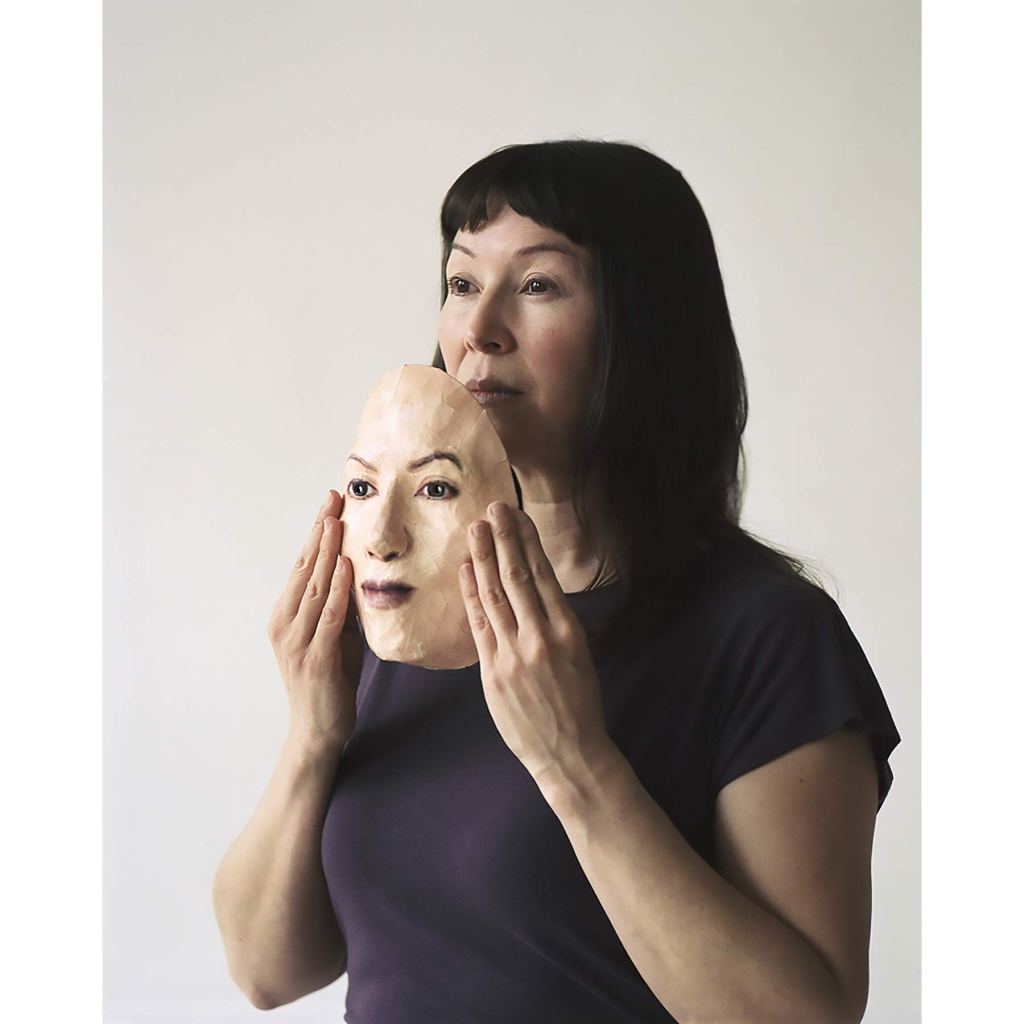
M.T.: The self-portrait is reflective of my own personal experiences and identity and yet others can sometimes see themselves in it too. I find it so interesting that people interpret it in different ways through their own lens and that a personal depiction can sometimes reflect something larger. I also love that I can show we are more alike than we think. For me, making self-portrait is the most important thing to do, since I can only make art about what I know. I can’t make art about something outside of myself, that I don’t understand, so for me this is the most authentic approach. And because we change over time, my artwork also changes and you can see a path that perhaps represents my evolution as a human as well as an artist.
Pd’A: Are you interested in the Japanese tradition of theatre masks Noh?
M.T.: Yes, I am very interested in Japanese masks and theatre. My goal is to one day travel to Japan and see Noh masks and theatre in-person and perhaps learn more about the traditional mask making techniques from a master. Actually right now, the performance style I am most interested in is Butoh, a type of dance/theatre that is very abstract and a bit strange and very expressive. I am extremely inspired by this art form and recently collaborated with a Butoh dancer from Tokyo (Emiko Agatsuma) which has also been a highlight of my career so far.
Pd’A: Can you describe your working process?
M.T.: I don’t usually plan too much as I start a project. My work involves a lot of play which makes it so fun. Once I am in creation mode, that’s when I can envision different variations and then it’s just a matter of trying them out. One idea leads to many other ideas so the process is very important that I just start doing something even if I don’t know how it’ll end up. If I stop to think too much about everything, it actually stops me from creating. When it comes to portraiture and performing with the masks, I set up a video camera so I can see what everything looks like while I am wearing the masks since I can’t often see through them. The video gives me a lot of feedback information and an ‘outside eye’ and then I explore what I thought was interesting further.
Pd’A: Another aspect that seems to me to be central is the dimension of the simulacrum can you talk about it?
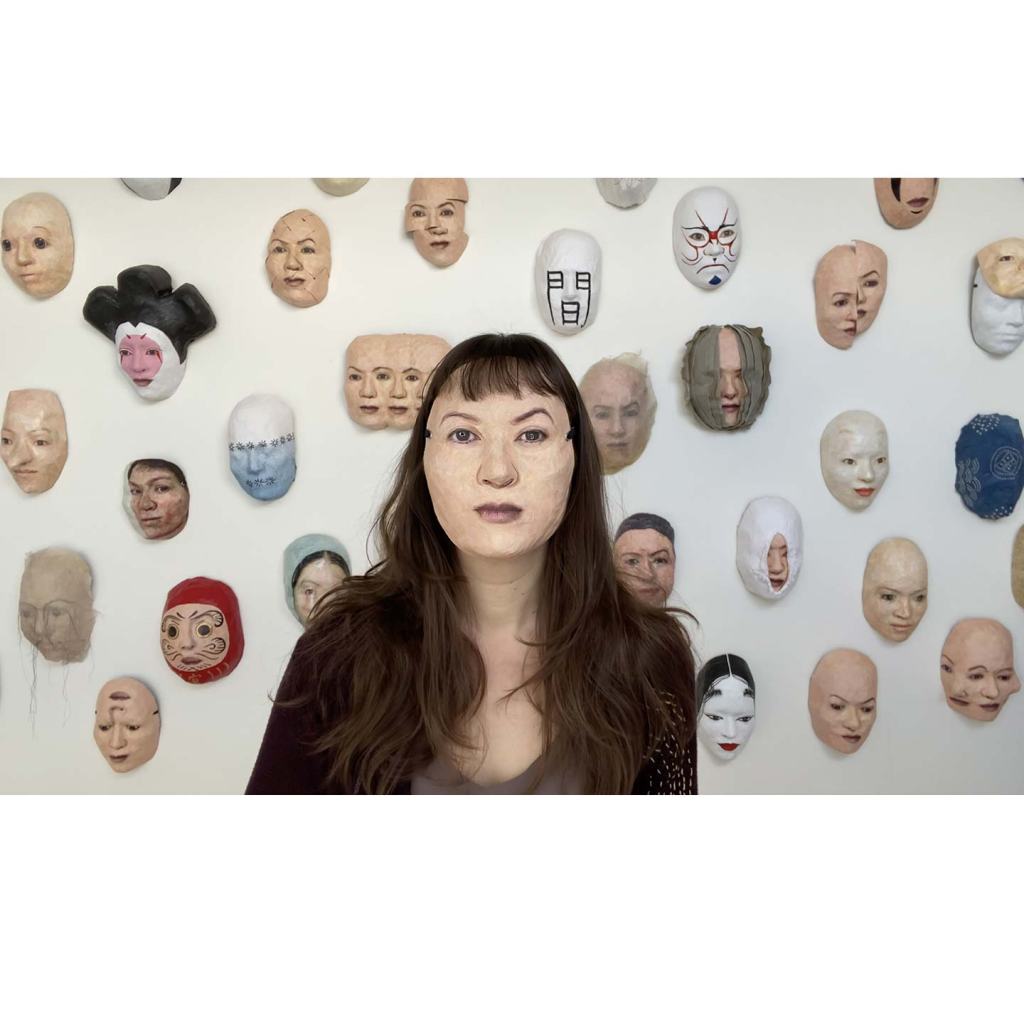
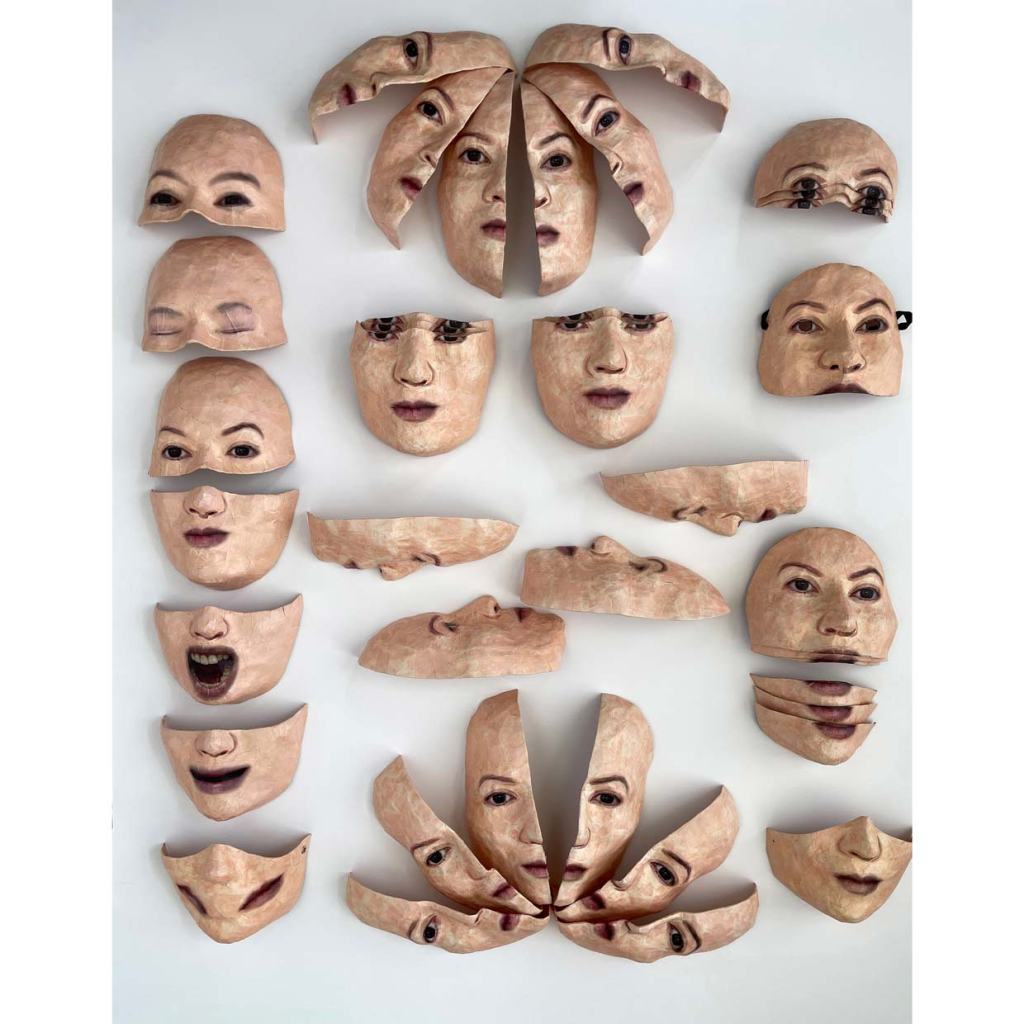
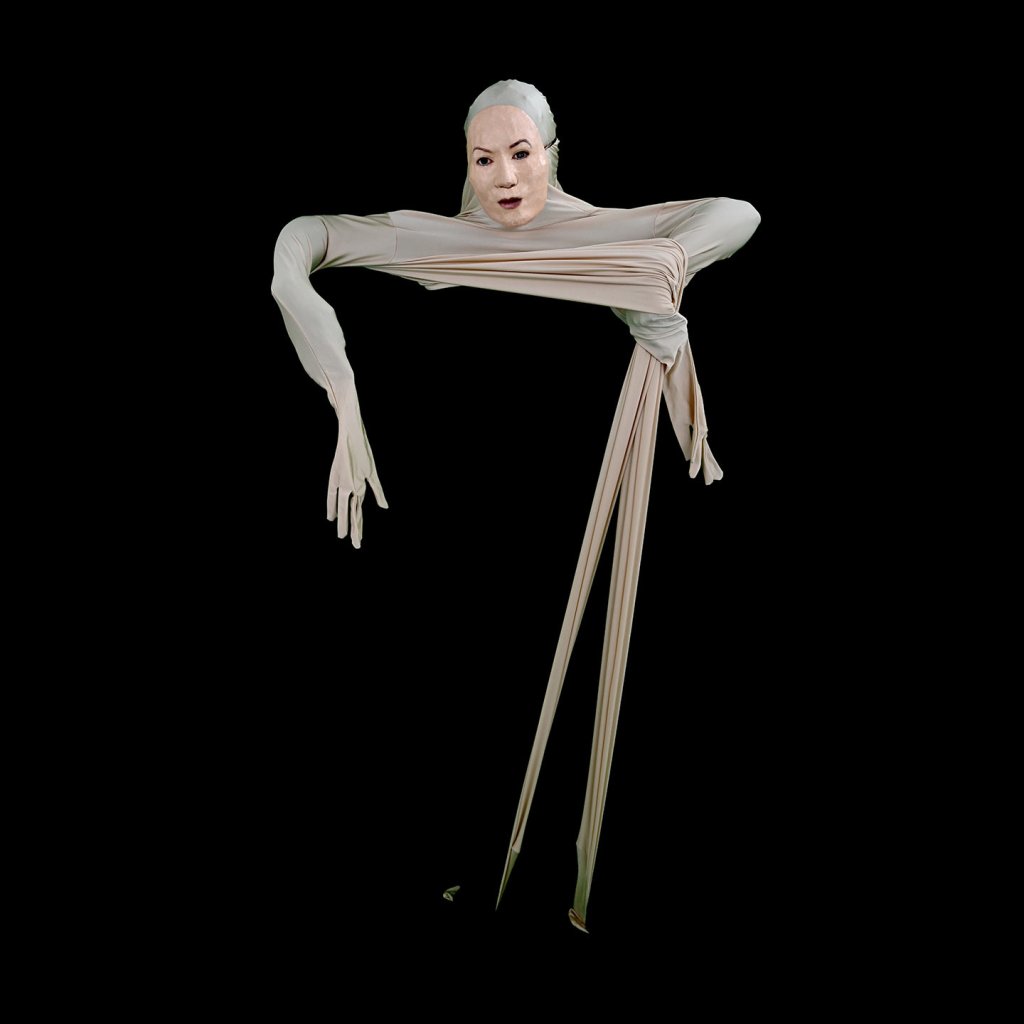
M.T.: The masks and skin suits represent my ‘Self’ in my work. I can do things with these masks and bodies that I can’t do in real life so it’s an important way for me to explore and examine something abstract within myself. I can distort and cut up these things, I can layer them in multiples, I can open them up and add or remove them from my own body. They are very powerful symbols that represent parts of me, not just my body, but much deeper than that.
Pd’A: Are you interested in the fetishist dimension?
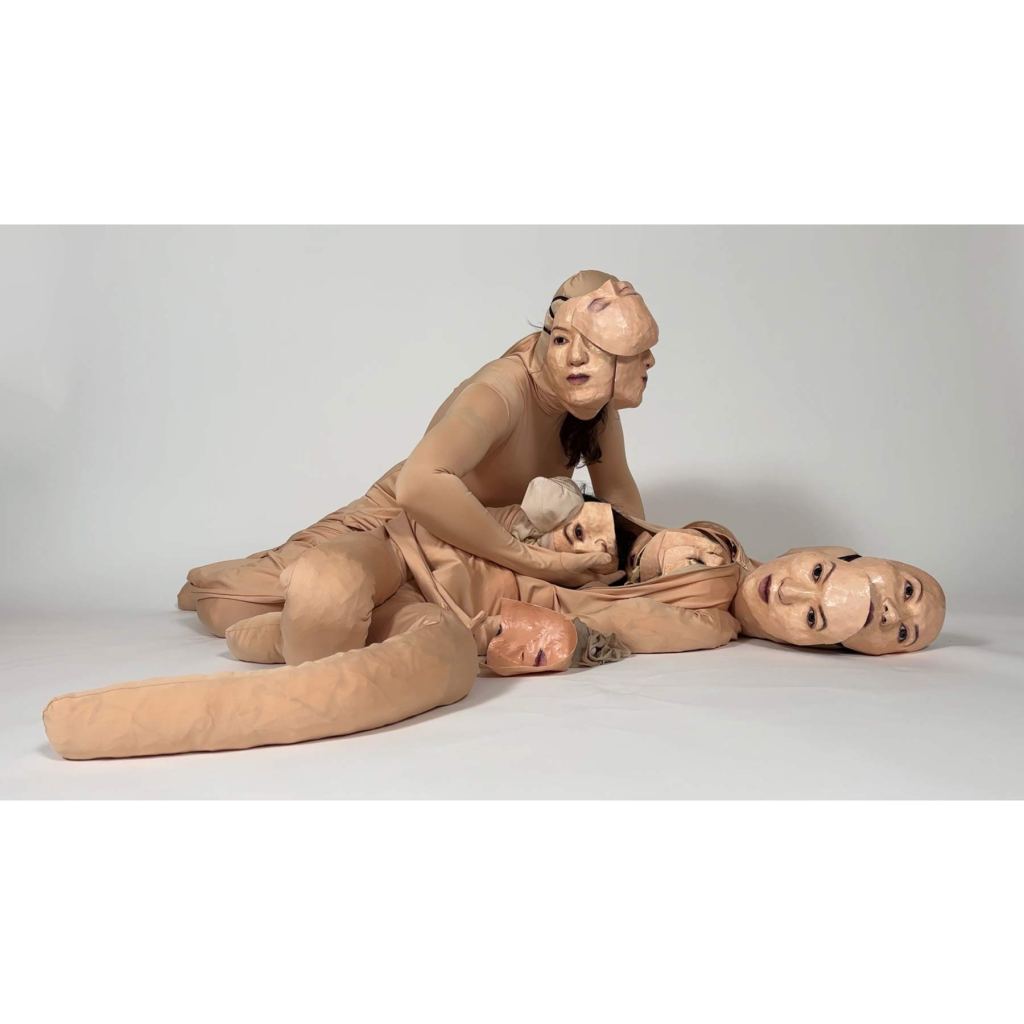
M.T.: No not at all. My most recent work when I am performing with life-sized bodies, which are spandex bodysuits (I call them skin-suits), can perhaps be seen as fetishist but it is simply an intimate self-portrait where I am exploring and examining the insides of these bodies, which also represent myself. They are filled with skin-toned fabric and masks and wigs so it’s quite visceral and I’m getting quite a range of reactions on instagram from these posts which is interesting. It’s funny that just ‘playing’ with fabric and masks can evoke such strong reactions, and it goes to show that my work does indeed represent more than just playing with fabric and masks.
Pd’A: Are you interested in the symbolic aspects that your work calls into question?
M.T.: Yes extremely so. Masks come with such a rich history of representing an archetype or identity. They can be used to disguise one’s self or reveal something completely outside of themselves or from within. We use masks to protect ourselves- whether it’s a medical mask or a mask/facade that we create to hide parts of ourselves that we don’t feel it’s safe to show. Masks also represent transformation. All of these are important aspects that I reference in my work as well as adding in my own meanings.
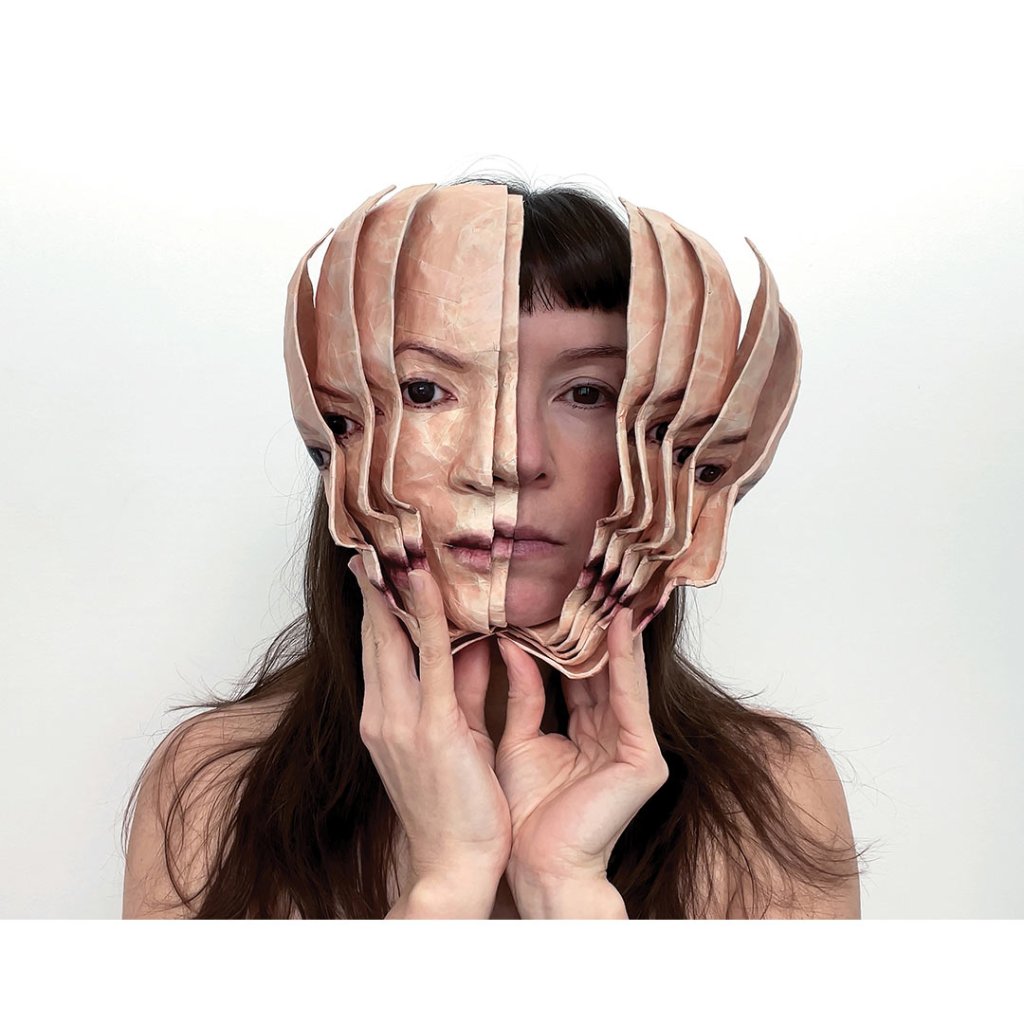
Pd’A: The representation and multiplication of images of your face often contained one inside the other, like shells, also allude to a possible psychological reading. Is this a dimension that interests you?
M.T.: Yes exactly, I am very interested in alluding to the things we might hide about ourselves and what we choose to reveal, whether it’s a conscious decision or not. I also love the reference of layers and multiplicities regarding our identities and experiences in life. What shapes us, what can we let go of, so many things can be represented by layers of the masks.
Pd’A: Do your masks sometimes present deformations of some of their parts such as the mouth, nose, eyes, eyebrows for what purpose?
M.T.: I love the distortions that are created when the facial features of the mask are misaligned with the shape of the mask underneath. This also happens if I change the shape of the mask drastically or even just slightly. We can see where the eyes ‘should’ be but when they are slightly out of place, everything about the face changes- how we perceive it, how we define that face, our ideals of beauty- but it also signifies the tension that’s created when things don’t line up, a metaphor for when we don’t express how we truly feel inside.
Pd’A: You also often make use of the body, which, however, unlike the masks, does not present a marked characterisation. What role do you attribute to it in your work?
M.T.: Working with full body is fairly new to my practice but just in the last few years, I started incorporating these ‘skin suits’ as representation of my body (or self) and I often mask my own body with these suits. Sometimes I stretch or animate or dissect these suits and so the skin suits become like a puppet that I can manipulate. Also, it is very vulnerable for me to show my full body so this was something I knew I had to explore. This in turn opened up so many new ways to embody the masks and perform in real life.
Pd’A: What importance do the categories of time and space have in your work?
M.T.: I play with the concept of time a bit in my video work. I especially love to reverse the video , or speed things up or slow things down, so that my movements become more strange and unnatural looking and distorted. Also taking up more space is something that has started to come into play in my work more recently. My portraits have expanded from just a head shot to a full body shot to now taking up space on an entire stage.
Pd’A: What idea do you have of beauty?
M.T.: I think beauty standards are so ridiculous and usually so unattainable that we should all be challenging them all the time. We place so much emphasis on the face and this has caused many problems in our society and in many individuals that is so unnecessary. Body dysmorphic disorder is a real concern especially as we are bombarded by filters and photoshopped images, AI and plastic surgery. There are so many double-standards out there especially for women; not allowed to age but judged if they get cosmetic surgery, judged if they wear make-up, judged if they don’t, etc. I think natural is the most beautiful and diversity makes the world more interesting.
Pd’A: What is its position in relation to your work?
M.T.: Through my mask work, I love to show that we perceive a face as one way, but that exact same face with just the slightest change all of a sudden becomes perceived very differently. Our brains are hardwired to some aspect to favour symmetry and youth, but we can totally expand our own ideals of beauty and I hope that by showing so many different variations of myself, we can also see beauty in things that are strange and weird. I am also very interested in the beauty and fragility of the human body, and I also think that the human form is so beautiful and at the same time there are so many grotesque aspects to being human, which I think all of this comes through in my work.
Miya Turnbull is a Canadian multi-disciplinary visual artist of Japanese and British/Scottish descent. She works with many different mediums but is primarily a mask-artist, and new to her practice is performance. She focuses on Self Portraits, using her Photo-Mask technique to make life-like variations and representations of her face, often distorting, erasing or manipulating her image as a way to explore identity. Miya has exhibited her masks, photos, and video in galleries across Canada as well as the US, Europe and Asia.
Versione Italiana
Intervista a Miya Turnbull
#paroladartista #artistinterview #intervistaartista #miyaturnbull
Parola d’Artista: Per la maggior parte degli artisti, l’infanzia è l’età d’oro in cui iniziano a comparire i primi sintomi di una certa propensione ad appartenere al mondo dell’arte.. È stato così anche per te? Racconta.
Miya Turnbull: Sì, fin da bambina disegnavo sempre e se mi chiedevano cosa volessi fare da grande, non ho mai esitato a dire: “Voglio fare l’artista”. I miei genitori erano entrambi molto attenti alla creazione di opere d’arte e alla creatività, Quindi sono stata molto fortunata ad avere sempre il loro sostegno.
Pd’A: Come succeed a molti artisti, hai avuto anche tu un primo amore artistico?
M.T.: La mia prima grande cotta artistica è stata Georgia O’Keefe. La mia insegnante di liceo mi ha fatto conoscere i suoi dipinti e ne rimasi molto affascinata, così come dal suo stile di vita e dalla sua indipendenza. Più tardi, durante l’università, il mio successivo amore per l’arte è stato per Cindy Sherman e il suo incredibile e innovativo lavoro sul autoritratto. Sono estremamente orgogliosa di dire che ho appena avuto la grande fortuna di far parte di una mostra collettiva in Cina intitolata “Illusive Masks” e sia io che Cindy siamo state le uniche artiste occidentali a far parte della mostra. Sicuramente un punto culminante della mia carriera fino ad ora!
Pd’A: Quali studi hai fatto?
M.T.: Ho conseguito una laurea in Belle Arti (BFA) presso l’Università di Lethbridge (Alberta, Canada) più di 20 anni fa. Ho iniziato con una laurea combinata in Biologia e Arte, poi sono passata a Psicologia e Arte, infine sono passata alle Belle Arti, che era la mia vera passione. Da allora ho sempre seguito gli workshop e I corsi ogni volta che qualcosa mi interessava.
Pd’A: Ci sono stati incontri importanti durante i tuoi anni formativi?
M.T.: Mi sento molto fortunata ad aver avuto l’esperienza di crescere in una fattoria nel Canada rurale. Avevamo molta libertà e lavoravamo nello stesso tempo. Questo ha contribuito a formare la mia etica del lavoro, ma ho anche avuto la fortuna di crescere pensando che tutto fosse possibile grazie alla strada che mi è stata aperta dalla mia famiglia. Ho avuto anche la fortuna di essere vicino alla mia famiglia materna, che è di origine giapponese-canadese. Fin da piccola sono stata esposta a questa cultura e ciò ha contribuito ad ampliare le mie percezioni ed esperienze.
Pd’A: Che importanza ha per te e che idea ha dell’autoritratto?
M.T.: L’autoritratto riflette le mie esperienze personali e la mia identità, ma a volte anche gli altri possono vedersi in esso. Trovo così interessante che le persone lo interpretino in modi diversi attraverso le loro lenti e che una rappresentazione personale possa a volte riflettere qualcosa di più grande. Mi piace anche poter dimostrare che siamo più simili di quanto pensiamo. Per me, fare autoritratti è la cosa più importante, perché posso fare arte solo su ciò che conosco. Non posso fare arte su qualcosa di esterno a me, che non capisco, quindi per me questo è l’approccio più autentico. E poiché cambiamo nel tempo, anche le mie opere cambiano e si può vedere un percorso che forse rappresenta la mia evoluzione come donna e come artista.
Pd’A: Sei interessata alla tradizione Giapponese delle maschere del Teatro Noh?
M.T.: Sì, sono molto interessata alle maschere e al Teatro Giapponese. Il mio obiettivo è quello di recarmi un giorno in Giappone per vedere di persona le maschere e il teatro Noh e magari imparare di più sulle tecniche tradizionali di creazione delle maschere da un maestro. In questo momento, lo stile di spettacolo che mi interessa di più è il Butoh, un tipo di teatro/danza molto astratto, un po’ strano e molto espressivo. Sono estremamente ispirata da questa forma d’arte e di recente ho collaborato con una danzatrice Butoh di Tokyo (Emiko Agatsuma), il che è stato anche un punto importante della mia carriera finora.
Pd’A: Può descrivere il suo processo di lavoro?
M.T.: Di solito non pianifico molto quando inizio un progetto. Il mio lavoro implica molto il gioco e questo lo rende molto divertente. Una volta che sono in modalità di creazione, posso immaginare diverse varianti e poi si tratta solo di provarle. Un’idea porta a molte altre idee, quindi è molto importante il processo che mi porta a iniziare, a fare qualcosa anche se non so come andrà a finire. Se mi fermo a pensare troppo a tutto, in realtà questo mi impedisce di creare. Quando si tratta di ritrarre e di esibirsi con le maschere, metto una videocamera per vedere come appare tutto mentre indosso le maschere, dato che spesso non riesco a vedere attraverso di esse. Il video mi dà molte informazioni di ritorno e un “occhio esterno” e poi esploro ulteriormente ciò che mi sembra interessante.
Pd’A: Un altro aspetto che mi sembra centrale è la dimensione del simulacro, ne può parlare?
M.T.: Le maschere e gli abiti di pelle rappresentano nel mio lavoro il mio ‘Sé’. Con queste maschere e questi corpi posso fare cose che non posso fare nella vita reale, quindi è un modo importante per me di esplorare ed esaminare qualcosa di astratto dentro di me. Posso distorcere e tagliare queste cose, posso stratificarle in multipli, posso aprirle e aggiungerle o rimuoverle dal mio corpo. Sono simboli molto potenti che rappresentan parti di me, non solo il mio corpo, ma vanno molto più in profondità.
Pd’A: Ti interessa la dimensione feticista?
M.T.: No, per niente. Il mio lavoro più recente, quando mi esibisco con corpi a grandezza naturale, che sono body in spandex (li chiamo pelle abito), può forse essere visto come feticista, ma è semplicemente un autoritratto intimo in cui esploro ed esamino l’interno di questi corpi, che rappresentano anche me stessa. Sono riempiti di tessuti dai toni della pelle, maschere e parrucche, quindi è piuttosto viscerale e sto ricevendo una vasta gamma di reazioni su Instagram da questi post, il che è interessante. È buffo che il solo fatto di “giocare” con stoffe e maschere possa evocare reazioni così forti, e questo dimostra che il mio lavoro rappresenta davvero qualcosa di più di un semplice gioco con stoffe e maschere.
Pd’A: Ti interessano gli aspetti simbolici che il tuo lavoro chiama in causa?
M.T.: Sì, molto. Le maschere hanno una storia così ricca di rappresentazione di un archetipo o di un’identità. Possono essere usate per mascherare se stessi o per rivelare qualcosa di completamente esterno o interno. Usiamo le maschere per proteggerci, che si tratti di una maschera medica o di una maschera/facciata che creiamo per nascondere parti di noi stessi che non riteniamo sicuro mostrare. Le maschere rappresentano anche la trasformazione. Sono tutti aspetti importanti a cui faccio riferimento nel mio lavoro e a cui aggiungo i miei significati.
Pd’A: La rappresentazione e la moltiplicazione delle immagini del tuo volto, spesso contenute una dentro l’altra, come conchiglie, alludono anche a una possibile lettura psicologica. È una dimensione che ti interessa?
M.T.: Sì, esattamente, mi interessa molto alludere alle cose che possiamo nascondere di noi stessi e a ciò che scegliamo di rivelare, che sia una decisione consapevole o meno. Mi piace anche il riferimento agli strati e alle molteplicità delle nostre identità e delle nostre esperienze di vita. Ciò che ci forma, ciò che possiamo lasciare andare, tante cose possono essere rappresentate dagli strati delle maschere.
Pd’A: Le tue maschere presentano a volte deformazioni di alcune loro parti come la bocca, il naso, gli occhi, le sopracciglia a che scopo?
M.T.: Mi piacciono le distorsioni che si creano quando i tratti del viso della maschera sono disallineati rispetto alla forma della maschera sottostante. Questo accade anche se cambio drasticamente la forma della maschera o anche solo leggermente. Possiamo vedere dove “dovrebbero” essere gli occhi, ma quando sono leggermente fuori posto, cambia tutto del volto – come lo percepiamo, come definiamo quel volto, i nostri ideali di bellezza – ma significa anche la tensione che si crea quando le cose non sono allineate, una metafora di quando non esprimiamo ciò che sentiamo veramente dentro.
Pd’A: Tu utilizzi spesso anche il corpo, che però, a differenza delle maschere, non presenta una caratterizzazione marcata. Che ruolo ha nel tuo lavoro?
M.T.: Lavorare con il corpo intero è abbastanza nuovo per me, solo negli ultimi anni ho iniziato a incorporare questi “abiti di pelle” come rappresentazione del mio corpo (o di me stessa) e spesso maschero il mio corpo con questi abiti. A volte li stiro, li animo o li seziono e così gli abiti di pelle diventano come una marionetta che posso manipolare. Inoltre, per me è molto vulnerabile mostrare il mio corpo intero, quindi sapevo di doverlo esplorare. Questo, a sua volta, mi ha aperto tanti nuovi modi di incarnare le maschere e di esibirmi nella vita reale.
Pd’A: Che importanza hanno le categorie di tempo e spazio per te?
M.T.: Nel mio lavoro video gioco un po’ con il concetto di tempo. Mi piace soprattutto invertire il video, o accelerare o rallentare le cose, in modo che i miei movimenti diventino più strani, innaturali e distorti. Anche il fatto di occupare più spazio è un aspetto che ha iniziato a entrare in gioco nel mio lavoro più di recente. I miei ritratti sono passati da una semplice inquadratura della testa a un’inquadratura del corpo intero, fino a occupare lo spazio di un intero palcoscenico.
Pd’A: Che idea hai della bellezza?
M.T.: Penso che gli standard di bellezza siano così ridicoli e di solito così irraggiungibili che dovremmo tutti sfidarli continuamente. Diamo così tanta importanza al viso e questo ha causato molti inutili problemi nella nostra società e a molte persone che. Il disturbo da dismorfofobia corporea è un problema reale, soprattutto perché siamo bombardati da filtri e immagini photoshoppate, AI e chirurgia plastica. Ci sono così tanti doppi standard là fuori, specialmente per le donne: non possono invecchiare, ma vengono giudicate se si sottopongono a chirurgia estetica, se si truccano, se non si truccano, ecc. Penso che il naturale sia il più bello e che la diversità renda il mondo più interessante.
Pd’A: In che posizione ti poni rispetto al lavoro?
M.T.: Attraverso il mio lavoro con le maschere, mi piace mostrare che percepiamo un volto in un modo, ma quello stesso volto, con un minimo cambiamento, viene percepito in modo molto diverso. Il nostro cervello è in qualche modo predisposto a favorire la simmetria e la giovinezza, ma possiamo espandere totalmente i nostri ideali di bellezza e spero che, mostrando così tante varianti di me stessa, possiamo vedere la bellezza anche in cose strane e bizzarre. Sono anche molto interessata alla bellezza e alla fragilità del corpo umano, e penso anche che la forma umana sia così bella e allo stesso tempo ci siano così tanti aspetti grotteschi nell’essere umano, penso che tutto questo emerga nel mio lavoro.
Miya Turnbull è un’artista visiva canadese multidisciplinare di origine giapponese e britannica/scozzese. Lavora con molti mezzi diversi, ma è principalmente un’artista di maschere e la performance è una novità per la sua pratica. Si concentra sugli autoritratti, utilizzando la tecnica della maschera fotografica per creare variazioni e rappresentazioni del suo volto simili alla vita, spesso distorcendo, cancellando o manipolando la sua immagine come un modo per esplorare l’identità. Miya ha esposto le sue maschere, le sue foto e i suoi video in gallerie in tutto il Canada, negli Stati Uniti, in Europa e in Asia.
PH Nanne Springer
 paroladartista.com