

(Scroll down for English text)
#paroladartista #intervistaartista #artistinterview #camillamarinoni
Parola d’Artista: Ciao Camilla, spesso l’infanzia gioca un ruolo importante nella definizione di quello che è l’immaginario di chi in seguito deciderà di intraprendere il cammino dell’arte è stato così anche per te? Racconta?
Camilla Marinoni: Posso dire con certezza che fin da piccolissima trovavo la mia dimensione nel disegno. Era un’attività che mi calmava, un rifugio nella quiete, soprattutto durante la scuola dell’infanzia. Mi sentivo presente a me stessa in un modo che non comprendevo ancora pienamente. Ricordo che amavo copiare dai fumetti o disegnare dal vero, un “vero” che era tutto ciò che potevo cogliere con la tecnica che possedevo allora. Con gli anni, non ho fatto altro che seguire lo stesso desiderio di quando ero bambina: la necessità di sentirmi bene e di raccontarmi attraverso il fare artistico.
P.d’A.: Quale è stato il tuo “primo amore” artistico?
C.M.: Ricordo che alle elementari ero affascinata da Picasso. Non so esattamente perché, ma c’era qualcosa nelle sue forme spezzate e nei volti frammentati che mi attraeva, come se riuscisse a catturare l’essenza delle persone in maniera più autentica di qualsiasi realismo. Amavo molto anche il periodo blu…forse per il mio carattere timido. Più tardi, durante le scuole medie, mi sono innamorata di Raffaello. Il suo equilibrio, la serenità dei suoi volti e la perfezione delle sue composizioni mi sembravano quasi ipnotiche. Era come se ogni linea fosse in armonia con le altre, creando una sorta di quiete interiore. Questo contrasto tra l’energia caotica di Picasso e la calma misurata di Raffaello ha inconsciamente influenzato la mia ricerca artistica. Mi ha spinta a interrogarmi sul confine tra ciò che è visibilmente perfetto e ciò che nasconde una bellezza più profonda e complessa, fatta di frammenti, di tensioni e di delicate vulnerabilità. Fortunatamente, al liceo è arrivato Michelangelo, la cui capacità di esprimere il movimento e l’emozione attraverso la scultura mi ha offerto una nuova prospettiva. Questi tre mondi convivono ancora nel mio lavoro: l’uno spezza, l’altro ricuce, e il terzo trascende.
P.d’A.: Che studi hai fatto?
C.M.: Il mio percorso è stato piuttosto lineare, quasi naturale, come se fosse stato già tracciato in me fin dall’inizio. Ho scelto il liceo artistico, e poi mi sono diplomata in Scultura all’Accademia di Belle Arti di Brera, a Milano, nel 2003. Successivamente, nel 2007, ho conseguito una specializzazione in Arte Sacra Contemporanea. Questo percorso mi ha permesso di esplorare non solo il linguaggio della materia, ma anche il suo legame profondo con il sacro, con l’intangibile che si annida dentro ogni forma fisica.
P.d’A.: Ci sono stati degli incontri importanti nei tuoi anni di formazione?
C.M.: Un’esperienza cruciale nel mio percorso artistico si è svolta nel 2007, proprio alla fine dei miei anni di sutdio, quando ho preso parte al corso TAM (Trattamento Artistico dei Metalli). Era presieduto da Arnaldo Pomodoro e quell’anno aveva la direzione artistica di Nunzio, che mi ha incoraggiato a esplorare il lavoro di artiste come Kiki Smith e Gina Pane: in quei mesi ho iniziato a comprendere l’importanza del corpo come medium di comunicazione e ne è nata la scultura Indossandomi, un’opera che ha segnato l’inizio di un profondo percorso espressivo nonché punto di partenza per il mio approccio alla performance.
P.d’A.: Che importanza hanno nel tuo lavoro l’idea di fisicità e di corpo?
C.M.: Il corpo è il centro di tutto. È il luogo della memoria, delle emozioni, delle storie nascoste. Attraverso la ceramica, i tessuti e altri materiali, esploro il corpo come un campo di battaglia, ma anche come rifugio. Mi interessa la sua fragilità, la sua capacità di trasformarsi e di portare con sé le tracce del tempo e dell’esperienza. Il corpo non è mai solo carne: è anima che si svela, è identità che si frammenta e si ricompone. Nei miei lavori, cerco di rendere visibile quel dialogo tra corpo e mondo, tra interno ed esterno, tra ciò che si mostra e ciò che resta nascosto.
P.d’A.: L’aspetto performativo ha una qualche importanza nel tuo lavoro?
C.M.: La performance è sempre presente nel mio lavoro anche se talvolta lo è in modo sottile.
In diversi casi è un un’azione diretta, singola o collettiva, altre volte va a completare un’installazione.
In generale posso dire che vive semplicemente nel processo, nell’interazione tra me e i materiali. Ogni scultura è, in un certo senso, il residuo di una performance segreta, di un dialogo corporeo che avviene nel momento della creazione. Anche quando non sono io fisicamente a performare, l’azione è intrinseca all’opera: il gesto, il contatto, la tensione tra il fare e il disfare. La performance diventa quindi un atto implicito, che vive nel rapporto tra opera e spettatore.
P.d’A.: Il disegno che importanza e che ruolo ha nel tuo lavoro?
C.M.: Il disegno è una pratica intima, un momento di riflessione e di esplorazione. Spesso resta chiuso nei quaderni che uso, nascosto e abbozzato, a volte più tecnico, perché mi serve per immaginare la scultura che voglio realizzare. Anche se non sempre diventa visibile nel risultato finale, è uno strumento essenziale per dare forma alle idee, per testare movimenti e composizioni. È il primo passo, una sorta di mappa che mi guida nella realizzazione della scultura. In esso, posso essere libera di sperimentare, di creare senza i limiti imposti dalla materia. Il disegno è il mio modo di entrare in contatto con l’essenza di un’idea prima di renderla tangibile.
P.d’A.: Che idea hai del tempo e dello spazio?
C.M.: Il tempo è un’entità fluida, non lineare, che lascia tracce su di noi, sulla nostra pelle e sulle cose. Mi affascina e al contempo mi terrorizza come il tempo trasforma, deforma, consuma. Nei miei lavori, spesso utilizzo materiali che cambiano nel tempo, come il vino che macchia le stoffe, per parlare del tempo come un processo inesorabile ma pieno di significato.
Lo spazio, invece, è il luogo dove avviene l’interazione, dove il corpo può esistere e dialogare. Mi piace pensare ai miei lavori come elementi che si trasformano nello spazio, che lo abitano e lo modificano, in un continuo gioco di tensioni e equilibri.
P.d’A.: Che idea hai della natura?
C.M.: La natura è una forza primordiale che ci modella, ci avvolge e ci rigenera. In essa vedo un riflesso del corpo umano, fragile e indomabile, soggetto alle stesse leggi di trasformazione. Mi affascina, ma mi spaventa anche, poiché è selvaggia, incontrollabile, come il nostro stesso corpo. A volte mi lascio ispirare dalla natura, specialmente quando riesco a riportare il corpo in questo vasto contenitore di cui facciamo parte; altrimenti, mi limito a osservarla, consapevole della distanza tra noi. Ci sono momenti, però, in cui le sue forme organiche e la sua capacità di adattamento si insinuano nel mio lavoro, tracciando una linea tra il tangibile e l’invisibile, tra il movimento silenzioso del mondo naturale e la mia ricerca artistica.
P.d’A.: Qual è la tua idea di bellezza?
C.M.: La bellezza per me risiede nella semplicità, nell’imperfezione, nelle fragilità. Mi interessa ciò che non è evidente, ciò che si rivela solo a chi sa guardare oltre. È una bellezza che si scopre, non che si costruisce, e che richiede uno sguardo attento, paziente e aperto alla complessità di ogni essere e di ogni storia. Non è solo questione di estetica, ma di connessione con ciò che è autentico e nascosto, quel qualcosa che chiede di essere accolto e compreso.
P.d’A.: Ti interessa la dimensione del sacro?
C.M.: Sì, come accennato in precedenza, la dimensione del sacro mi interessa molto. Per me non è legato a un’idea religiosa, ma a qualcosa di intimo e profondo. C’è un senso di sacralità nel corpo, nella sua capacità di portare il peso delle esperienze e delle emozioni. Nelle mie ultime sculture m’interessa esplorare l’erotismo come una dimensione sacra, una connessione con l’intimo, con ciò che è nascosto ma sempre presente. Il sacro è il mistero che abita il mondo, il silenzio che parla di ciò che non possiamo comprendere.
P.d’A.: Quale rapporto ti lega al tuo studio?
C.M.: Il mio studio è il mio rifugio, il luogo dove posso sperimentare, creare e riflettere. È uno spazio sacro, uno luogo dove ritrovarmi, stare bene e iniziare qualcosa di nuovo. Qui posso lasciare che le idee prendano forma senza interferenze, ascoltando i materiali e dialogando con loro. Il mio studio è un luogo di trasformazione, dove ogni lavoro inizia il suo viaggio.
P.d’A.: Secondo te un’ opera d’arte esiste se non c’è nessuno che la guarda?
C.M.: Un’opera d’arte esiste, indipendentemente dall’osservatore. Ha una sua vita autonoma, una sua essenza. Tuttavia, è nel momento in cui viene guardata, osservata e vissuta, che l’opera si completa, che inizia a parlare e a creare un dialogo.
P.d’A.: Dove ti poni nei confronti del tuo lavoro?
C.M.: Mi vedo come una sorta di mediatrice tra materiali, idee e forme.
Il mio lavoro è in continua evoluzione, e cerco di mantenere sempre una mente aperta, pronta a lasciarmi sorprendere. Spesso non so dove mi porterà un lavoro, e questo rende il processo ancora più affascinante. Non cerco il controllo totale, ma piuttosto un dialogo continuo con il lavoro stesso, lasciando che mi guidi.
Camilla Marinoni (1979) è un’artista visiva. Vive e lavora in Italia.
Nel 2003 si diploma in Scultura presso l’Accademia di Belle Arti di Brera di Milano e nel 2007 consegue, presso la stessa accademia, il diploma specialistico in Arte Sacra Contemporanea.
Nel 2007 partecipa al Corso d’eccellenza di Scultura, Gioiello e Design presso il Centro TAM di Pietrarubbia (PU) nelle Marche, presieduto da Arnaldo Pomodoro e con la direzione artistica di Nunzio di Stefano. Qui, attraverso il confronto con Nunzio inizia a focalizzarsi sul corpo come mezzo espressivo con cui far dialogare sculture e installazioni.
Nel 2018 approfondisce la tematica sulla performance e la body art partecipando al workshop “Teoría y practica del Performance Art” presso FactoriaLab di Madrid con l’artista Abel Azcona e nel 2019 al workshop “Free unicorn” presso la GAMeC di Bergamo con l’artista/attrice Chiara Bersani.
Fra le ultime mostre si segnala: [2024] Contextile 2024 – Biennale di Arte Contemporanea Tessile, Guimarães (PT); Erotic Jungle, Galerie Z22, Berlino (DE), Synedokhḗ, StudioDieci, Vercelli; This is the end, Reggia di Monza; [2023] Intus |showcase, Traffic gallery, Bergamo (personale); Camilla Marinoni – La vertigine della forma, MO.CA. Centro per le nuove culture, Brescia (personale); [2022] Bolzano Art Week (con un’installazione vincitrice della call); Luce, Palazzo Costantino e di Napoli, Palermo, Anàstasi – Turbamenti, immersioni, attese, rinascite, Galleria Giovanni Bonelli, Pietrasanta.
È finalista al Premio Paolo VI (2023) e all’Exibart prize (2020 e 2021); è artista segnalata al Combat Prize (2022) e ha ricevuto tre premi all’Arteam Cup (2019 e 2020/2021).
Opere permanenti sono presenti presso la collezione Mercedes Benz (Milano), nel Museo Fondazione Bernareggi (Bergamo), nel Museo Montali (Alba); nel Museo Gianetti (Saronno) e presso alcune chiese della provincia di Bergamo e di Cuneo.
English text
Interview to Camilla Marinoni
#paroladartista #intervistaartista #artistinterview #camillamarinoni
Parola d’Artista: Hi Camilla, childhood often plays an important role in defining what is the imagination of those who later decide to embark on the path of art, was this also the case for you? Tell us about it?
Camilla Marinoni: I can say with certainty that from a very young age, I found my dimension in drawing. It was an activity that calmed me down, a refuge in stillness, especially during kindergarten. I felt present to myself in a way that I did not yet fully understand. I remember that I loved copying from comics or drawing from life, a ‘life’ that was all I could grasp with the technique I possessed at the time. Over the years, I have done nothing but follow the same desire as when I was a child: the need to feel good and to tell my story through making art.
P.d’A.: What was your artistic ‘first love’?
C.M.: I remember being fascinated by Picasso in primary school. I don’t know exactly why, but there was something about his broken forms and fragmented faces that attracted me, as if he could capture the essence of people more authentically than any realism. I also really loved the blue period…perhaps because of my shy nature. Later, during middle school, I fell in love with Raphael. His balance, the serenity of his faces and the perfection of his compositions seemed almost hypnotic to me. It was as if each line was in harmony with the others, creating a kind of inner stillness. This contrast
P.d.A.: What studies did you do?
C.M.: My path was quite linear, almost natural, as if it had already been mapped out in me from the beginning. I chose art school, and then I graduated in Sculpture at the Brera Academy of Fine Arts in Milan in 2003. Later, in 2007, I obtained a specialisation in Contemporary Sacred Art. This path allowed me to explore not only the language of matter, but also its deep connection with the sacred, with the intangible that lurks within every physical form.
P.d’A.: Were there any important encounters during your formative years?
C.M.: A crucial experience in my artistic journey took place in 2007, right at the end of my sutdio years, when I took part in the TAM (Artistic Treatment of Metals) course. It was presided over by Arnaldo Pomodoro and that year had the artistic direction of Nunzio, who encouraged me to explore the work of artists such as Kiki Smith and Gina Pane: in those months, I began to understand the importance of the body as a medium of communication and the sculpture Indossandomi (Wearing Me) was born, a work that marked the beginning of a profound expressive journey as well as the starting point for my approach to performance.
P.d’A.: What importance do the idea of physicality and the body have in your work?
C.M.: The body is the centre of everything. It is the place of memory, of emotions, of hidden stories. Through ceramics, textiles and other materials, I explore the body as a battlefield, but also as a refuge. I am interested in its fragility, its ability to transform and to carry with it the traces of time and experience. The body is never just flesh: it is soul that reveals itself, it is identity that fragments and recomposes itself. In my works, I try to make visible that dialogue between body and world, between inside and outside, between what is shown and what remains hidden.
P.d’A.: Does the performance aspect have any importance in your work?
C.M.: Performance is always present in my work even if sometimes it is in a subtle way.
In several cases it is a direct, single or collective action, other times it complements an installation.
In general I can say that it simply lives in the process, in the interaction between me and the materials. Each sculpture is, in a way, the residue of a secret performance, of a bodily dialogue that takes place in the moment of creation. Even when it is not me physically performing, the action is intrinsic to the work: the gesture, the contact, the tension between making and unmaking. The performance thus becomes an implicit act, which lives in the relationship between work and spectator.
P.d’A.: How important is drawing and what role does it play in your work?
C.M.: Drawing is an intimate practice, a moment of reflection and exploration. It often remains closed in the notebooks I use, hidden and sketched, sometimes more technical, because I need it to imagine the sculpture I want to make. Even if it does not always become visible in the final result, it is an essential tool to give shape to ideas, to test movements and compositions. It is the first step, a sort of map that guides me in the realisation of the sculpture. In it, I can be free to experiment, to create without the limits imposed by the material. Drawing is my way of getting in touch with the essence of an idea before making it tangible.
P.d’A.: What is your idea of time and space?
C.M.: Time is a fluid, non-linear entity that leaves traces on us, on our skin and on things. It fascinates and at the same time terrifies me how time transforms, deforms, consumes. In my works, I often use materials that change over time, like wine that stains fabrics, to speak of time as an inexorable but meaningful process.
Space, on the other hand, is where interaction takes place, where the body can exist and dialogue. I like to think of my works as elements that are transformed in space, that inhabit and modify it, in a continuous play of tension and balance.
P.d’A.: What is your idea of nature?
C.M.: Nature is a primordial force that shapes us, envelops us and regenerates us. In it I see a reflection of the human body, fragile and indomitable, subject to the same laws of transformation. It fascinates me, but also frightens me, because it is wild, uncontrollable, like our own bodies. Sometimes I let myself be inspired by nature, especially when I can bring the body back into this vast container we are part of; otherwise, I just observe it, aware of the distance between us. There are times, however, when its organic forms and adaptability creep into my work, drawing a line between the tangible and the invisible, between the silent movement of the natural world and my artistic research.
P.d’A.: What is your idea of beauty?
C.M.: Beauty for me lies in simplicity, in imperfection, in fragility. I am interested in what is not obvious, what is only revealed to those who know how to look beyond it. It is a beauty that is discovered, not constructed, and that requires an attentive, patient gaze that is open to the complexity of every being and every story. It is not just a question of aesthetics, but of connection with what is authentic and hidden, that something that asks to be welcomed and understood.
P.d’A.: Are you interested in the dimension of the sacred?
C.M.: Yes, as mentioned earlier, the dimension of the sacred interests me a lot. For me it is not linked to a religious idea, but to something intimate and profound. There is a sense of sacredness in the body, in its ability to carry the weight of experiences and emotions. In my latest sculptures I am interested in exploring eroticism as a sacred dimension, a connection with the intimate, with what is hidden but always present. The sacred is the mystery that inhabits the world, the silence that speaks of what we cannot understand.
P.d’A.: What is your relationship with your studio?
C.M.: My studio is my refuge, the place where I can experiment, create and reflect. It is a sacred space, a place where I can find myself, feel good and start something new. Here I can let ideas take shape without interference, listening to the materials and dialoguing with them. My studio is a place of transformation, where every work begins its journey.
P.d’A.: In your opinion, does a work of art exist if there is no one looking at it?
C.M.: A work of art exists, regardless of the observer. It has its own autonomous life, its own essence. However, it is at the moment it is looked at, observed and experienced that the work becomes complete, that it starts to speak and create a dialogue.
P.d’A.: Where do you see yourself in relation to your work?
C.M.: I see myself as a kind of mediator between materials, ideas and forms.
My work is constantly evolving, and I try to always keep an open mind, ready to be surprised. I often don’t know where a work will take me, which makes the process even more fascinating. I do not seek total control, but rather a continuous dialogue with the work itself, letting it guide me.
Camilla Marinoni (1979) is a visual artist. She lives and works in Italy.
In 2003 she graduated in Sculpture from the Brera Academy of Fine Arts in Milan and in 2007 she obtained a specialist diploma in Contemporary Sacred Art at the same academy.
In 2007, he took part in the Course of Excellence in Sculpture, Jewellery and Design at the TAM Centre in Pietrarubbia (PU) in the Marche region, chaired by Arnaldo Pomodoro and under the artistic direction of Nunzio di Stefano. Here, through discussions with Nunzio, he began to focus on the body as an expressive medium with which to create a dialogue between sculptures and installations.
In 2018, he deepened his focus on performance and body art by participating in the workshop ‘Teoría y practica del Performance Art’ at FactoriaLab in Madrid with artist Abel Azcona and in 2019 in the workshop ‘Free unicorn’ at GAMeC in Bergamo with artist/actress Chiara Bersani.
Recent exhibitions include: [2024] Contextile 2024 – Biennial of Contemporary Textile Art, Guimarães (PT); Erotic Jungle, Galerie Z22, Berlin (DE), Synedokhḗ, StudioDieci, Vercelli; This is the end, Reggia di Monza; [2023] Intus |showcase, Traffic gallery, Bergamo (solo show); Camilla Marinoni – La vertigine della forma, MO.CA. Centro per le nuove culture, Brescia (solo show); [2022] Bolzano Art Week (with an installation that won the call); Luce, Palazzo Costantino e di Napoli, Palermo, Anàstasi – Turbamenti, immersioni, attese, rinascite, Galleria Giovanni Bonelli, Pietrasanta.
She is a finalist for the Paul VI Prize (2023) and the Exibart prize (2020 and 2021); she is a recommended artist for the Combat Prize (2022) and has received three prizes at the Arteam Cup (2019 and 2020/2021).
Permanent works can be found in the Mercedes Benz collection (Milan), in the Bernareggi Foundation Museum (Bergamo), in the Montali Museum (Alba); in the Gianetti Museum (Saronno) and in some churches in the province of Bergamo and Cuneo.
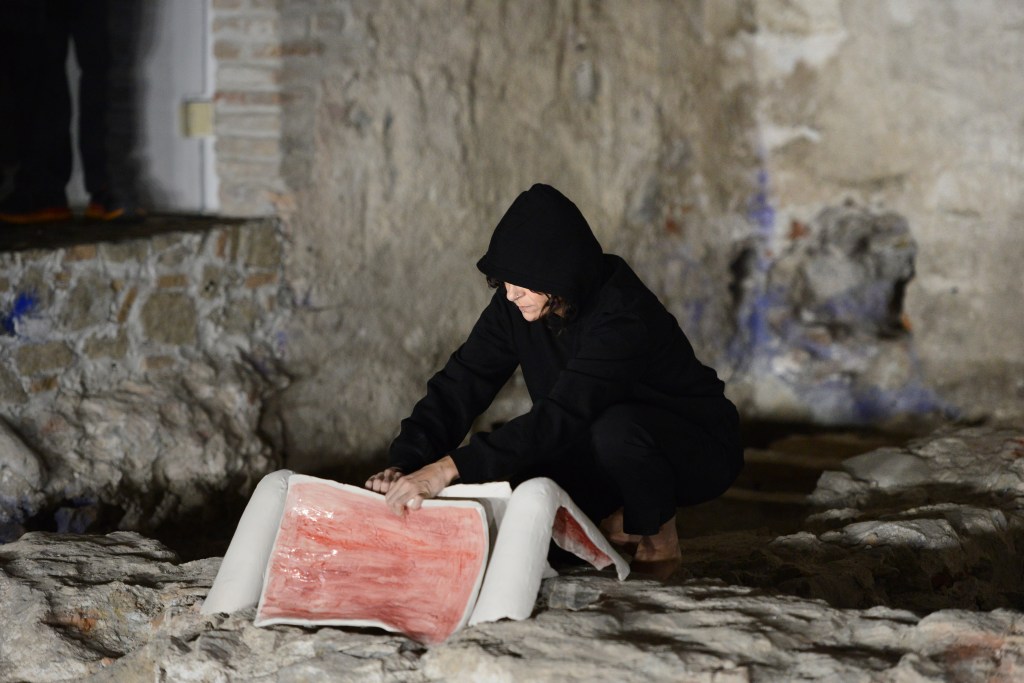
Intallazione realizzata con lenzuola matrimoniali, vino, immagini fotografiche, ceramica e performance site specific
Ph: scatto dalla performance di Michele Alberto Sereni per il Festival CONNEXXION
2022

Nylon, polyestere, ceramica, cotone, vino, tulle, makeup
110x35x30 cm
2024
Ph: Camilla Marinoni
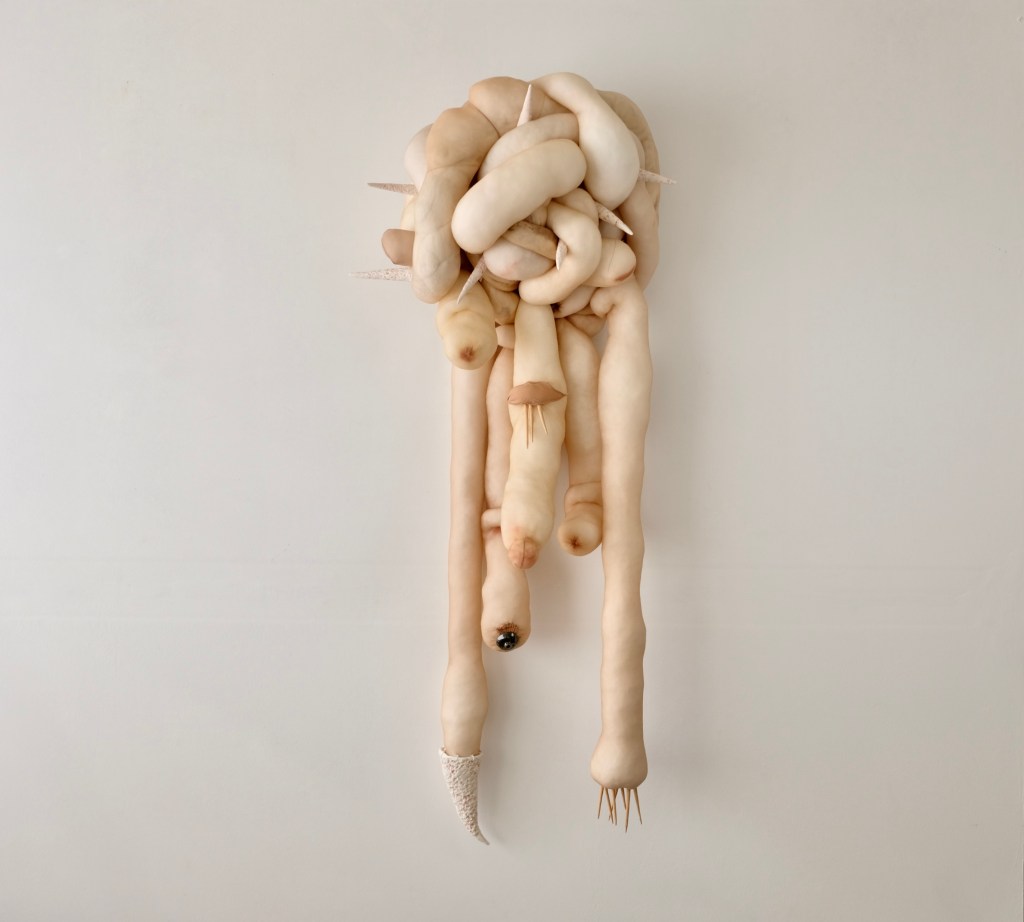
Nylon, polyestere, ceramica, cotone, vino, makeup
125x55x35 cm
2024
Ph: Camilla Marinoni
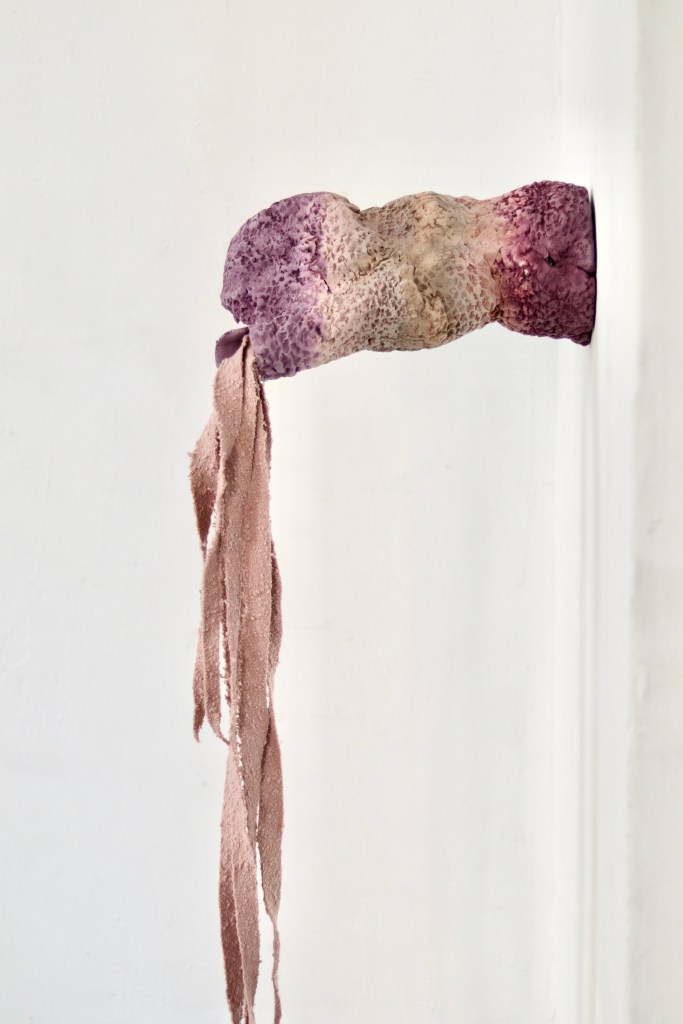
Ceramica, vino, cotone
120x33x13cm
2024
Ph: Camilla Marinoni
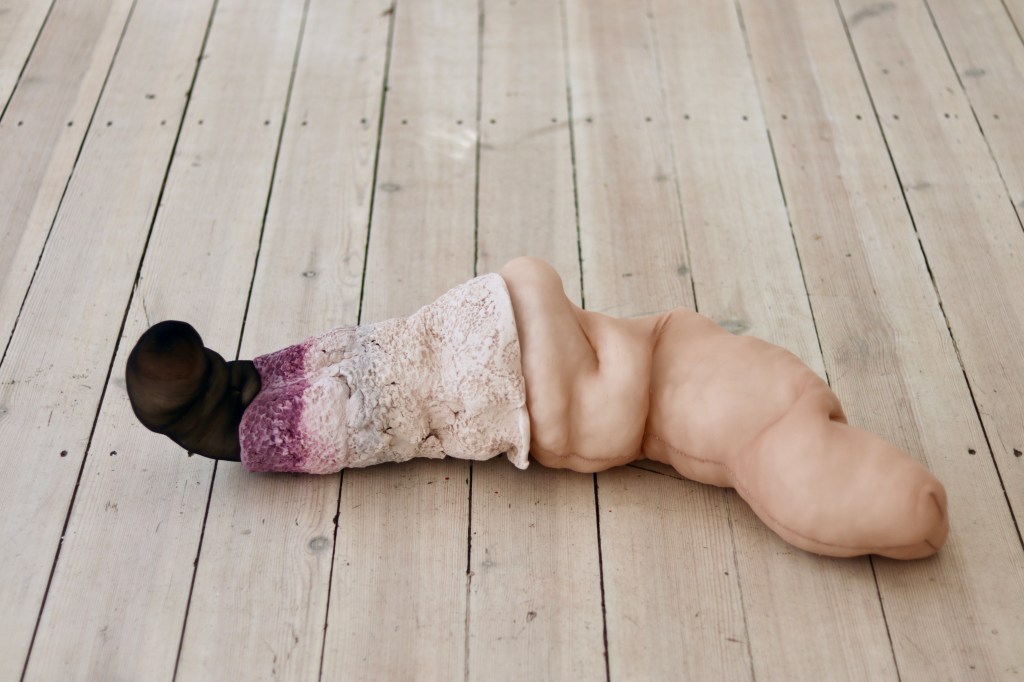
Ceramica, nylon, polyestere, vino, makeup
21x90x30cm
2024
Ph: Camilla Marinoni
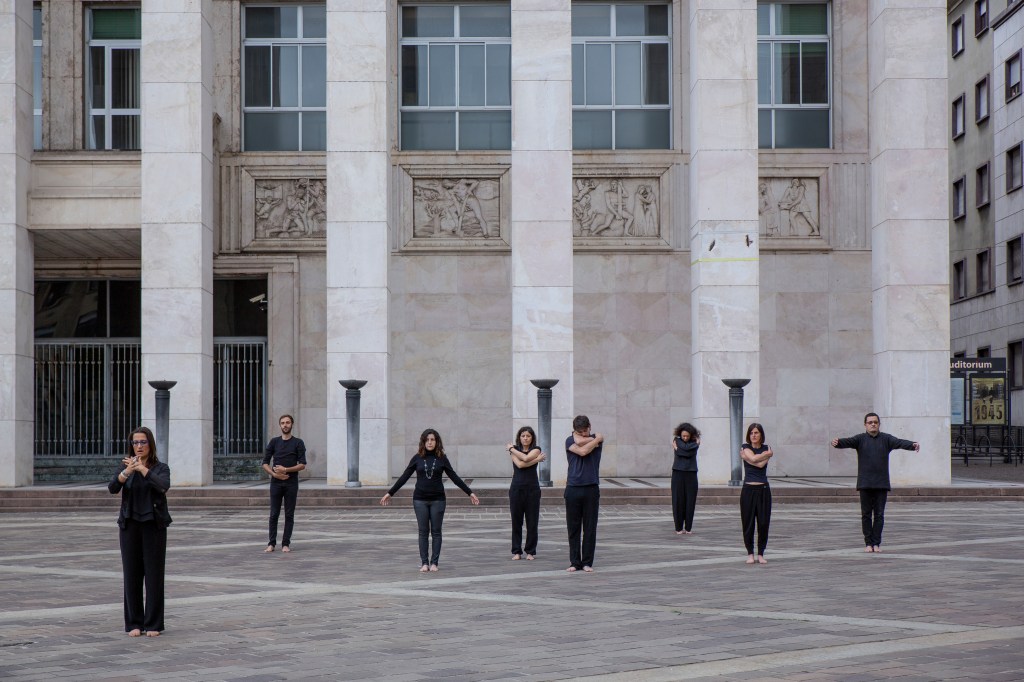
Performance 30’
2018
Ph: Marzo Ronzoni
 paroladartista.com