

(▼Scroll down for English text)
#paroladartista #intervistaartista #artistinterview #matteosuffritti
Parola d’Artista: Ciao Matteo, per la maggior parte degli artisti l’infanzia rappresenta l’età dell’oro quella in cui cominciano a manifestarsi i primi “sintomi” di una certa propensione ad appartenere al mondo dell’arte. E’ stato così anche per te? Racconta?
Matteo Suffritti : Avevo una vicina che chiamavo ingenuamente nonna. Dopo la scuola elementare stavo il pomeriggio da lei. Suo marito era un pittore ed il soggiorno era pieno di cavalletti, tele in preparazione e quadri. L’odore dei colori ad olio e quello pungente della trielina ci avvolgeva e tutto lo spazio era occupato da tavolozze e pennelli. Si poteva dire che passavo i pomeriggi in un atelier. Ma quello che mi affascinava di più era il lavoro di mia “nonna”: spezzava con meticolosa pazienza le foglie secche e le divideva in base alle tonalità, dal marrone più scuro al beige chiaro. Poi realizzava un disegno preparatorio ed infine componeva un collage di foglie in base ai chiaroscuri: erano autentici capolavori. Passavo i pomeriggi a giocare, vedere come realizzava i suoi collage, suonare qualche canzoncina con il pianoforte e ammirare tele sempre nuove e in preparazione. Probabilmente divenni adulto quando scoprii che, in realtà, la vicina non era mia nonna ma una tata e che la mia famiglia la chiamava nonna Rosina semplicemente perchè anziana.
Ora, non so se tutto questo mi è servito come imprinting, ma in quel percorso che si chiama vita ho sempre sentito la necessità di porre al primo posto la creatività, in tutte le sue forme. Ora, invece, mi domando se riuscirò a trasmettere questa necessità alle mie figlie piccole.
P.d’A.: Questa di trasmettere alle tue figlie la necessità creativa é per te una cosa importante?
M.S.: Lo è per molti aspetti e a volte capita anche il contrario. Quando mi contagiano con la loro fantasia, senza filtri e preparazione nella maniera più spontanea. Frequentiamo fondazioni e musei che organizzano laboratori didattici, oppure visitiamo le mostre che possono piacere a entrambi.
Penso sia questa la soluzione migliore per contrastare l’arroganza e l’ignoranza che viviamo quotidianamente nelle nostre città.
Quella di trasmettere ai nostri figli gli strumenti per il bello. Il bello di sporcarsi con l’argilla o con i colori, il bello di vedere delle opere d’arte, il bello di conoscere artisti con culture e provenienze differenti, il bello di viaggiare, visitare, conoscere e capire.
Eppure, quando inizio un mio lavoro le cose cambiano. Non permetto a loro di entrare nel mio mondo (in realtà non lo permetto a nessuno), come se il mio processo creativo avesse bisogno di solitudine.
P.d’A.: In questo percorso verso la solitudine dell’atto creativo ci sono stati degli incontri con persone che hanno avuto una grande importanza nella tua formazione?
Matteo Suffritti: Frequentavo un istituto tecnico della periferia milanese, adatto più a ragazzi pigri e svogliati di cui ne facevo rigorosamente parte. Lì ho trovato alcuni professori che, nonostante le problematiche e lacune della scuola, amavano insegnare e trasmettere la passione per la propria materia, tra cui la fotografia. Quella analogica, fatta di chimici e camera oscura. Fu una magia per un ragazzo di 15 anni.
Ma uscito dalla scuola dovetti far fronte ai miei demoni e alle mie insicurezze, capita…
Fu allora che incontrai la persona più importante che mi diede un mano a superare gli ostacoli. Ricordo ancora l’ultima volta che la vidi: gli lasciai in dono il mio primo quadro. Uno schifo assoluto, ma per me fu di grande importanza.
P.d’A.: Hai frequentato l’Accademia?
M.S.: No e forse avrei voluto. Chissà, magari se l’avessi frequentata avrei potuto intraprendere altre strade, completamente diverse da quella attuale. Ma ho pochi rimpianti, avevo vent’anni e lavoravo già in una fotoincisione. In quel momento pensavo fosse più importante dedicarmi all’attività professionale
P.d’A.: Come è proceduta la tua vicenda artistica?
M.S.: Ti ho già detto che il primo quadro non era un granché, infatti i pennelli li ho abbandonati molto presto. Del resto la mia storia era iniziata con la fotografia, così ripresi la reflex, strutturai una camera oscura nel mio bagno e ricominciai dall’analogico. Da quel bagno ne sono passati di anni e in quel lasso di tempo ho cercato di approfondire la mia ricerca, utilizzando altri strumenti, tecniche e media.
Sono passato al digitale, ai light-box, alle foto-installazioni, per arrivare alle fotoincisioni.
Nel mentre c’è stato l’aspetto più umano, quello fatto di mostre e soddisfazioni ma anche di delusioni e frustrazioni. Sarò franco: non ho mai avuto nessun vincolo da parte di una galleria o pressioni di come arrivare alla fine del mese. La mia fonte di guadagno è rimasta sempre la stessa, quindi mi sono sempre sentito libero di sperimentare o di collaborare con altri artisti.
In altri ambiti, invece, percepisco un malumore diffuso, ma questo fortunatamente non mi riguarda.
P.d’A.: Il fatto di non dover arrivare a fine mese con l’arte ovviamente ti salva da una serie di brutte storie e ti regala una maggiore libertà sul piano delle scelte professionali, con quali artisti ha deciso di collaborare e in che modo?
M.S.: In passato ho avuto modo di conoscere altri artisti collaborando con alcuni collettivi. Ho sempre considerato l’esperienza del collettivo come una possibilità di arricchimento e di incontro, soprattutto in tempi di covid. Durante il lockdown, per esempio, mentre il mondo si fermava, io ed un piccolo gruppo di artisti formavamo un collettivo, capace di progettare delle mostre per il post-lockdown. Passata la bufera e realizzati due progetti espositivi, il collettivo si è sciolto come neve al sole, ma qualcosa è comunque rimasto. La collaborazione con l’artista e performer Alex Sala, per esempio, mi ha dato la possibilità di avvicinarmi e di conoscere il mondo della performance. L’approccio ad un linguaggio così diverso dal mio è stato assolutamente stimolante e gratificante e la collaborazione, oltre ad aver prodotto un’opera firmata da entrambi, è proseguita nel tempo.
P.d’A.: Nei tuo lavori l’articolazione spaziale in moduli o in sagome che ricordano o che evocano in modo molto diretto palazzi, case da dove deriva?
M.S.: Una sera stavo mangiando una pizza in un quartiere popolare di Milano.
Era estate ed i tavoli erano all’esterno, sul marciapiede. Mi guardavo attorno e la via era un susseguirsi di palazzi fatiscenti e spazzatura abbandonata ovunque. Il degrado finiva ad un centinaio di metri, a quel semaforo laggiù, dove c’era la circonvallazione.
Come se quella strada fosse un confine, un muro: da una parte i meno abbienti, gli scarti, quelli che si arrabattano per arrivare alla fine del mese, dall’altra parte semplicemente gli altri. L’abitare umano è qualcosa di complesso e di affascinante, che sta alla base della nostra società.
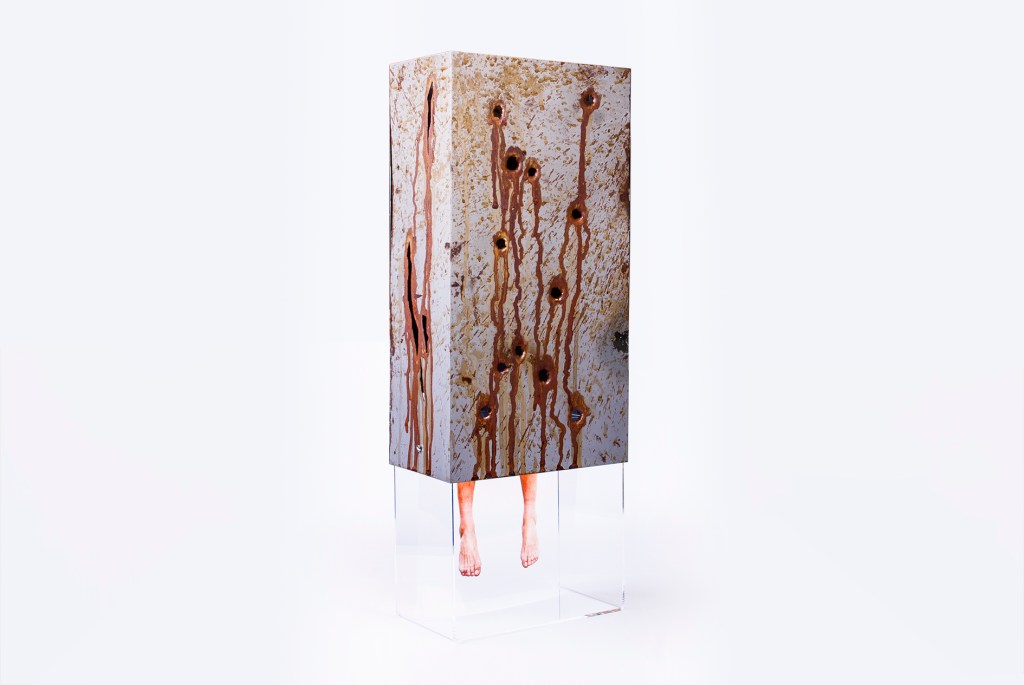
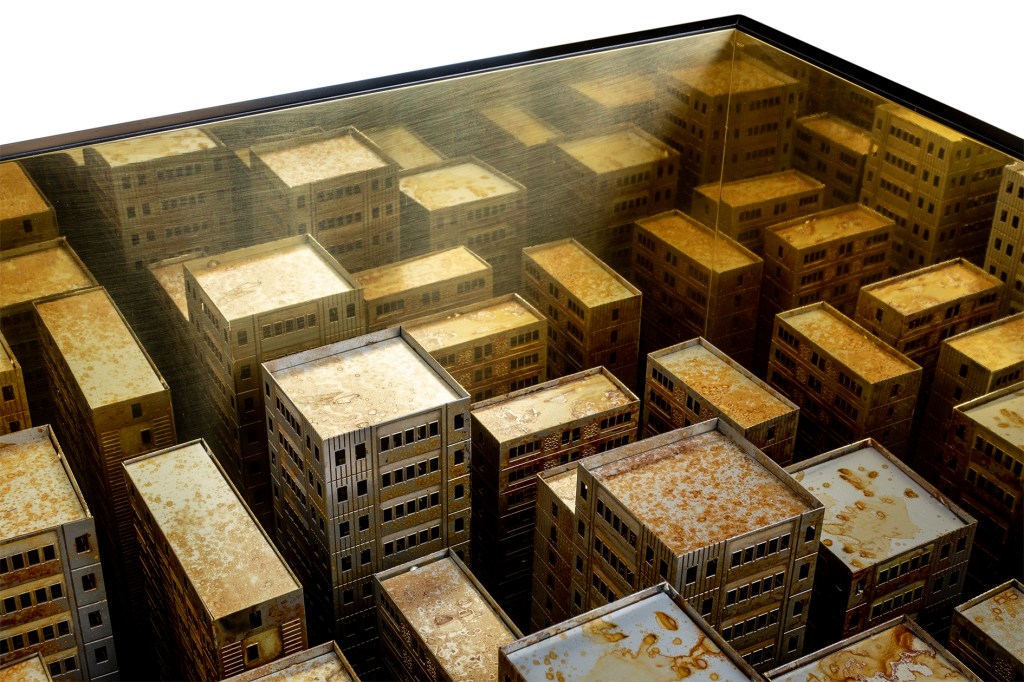
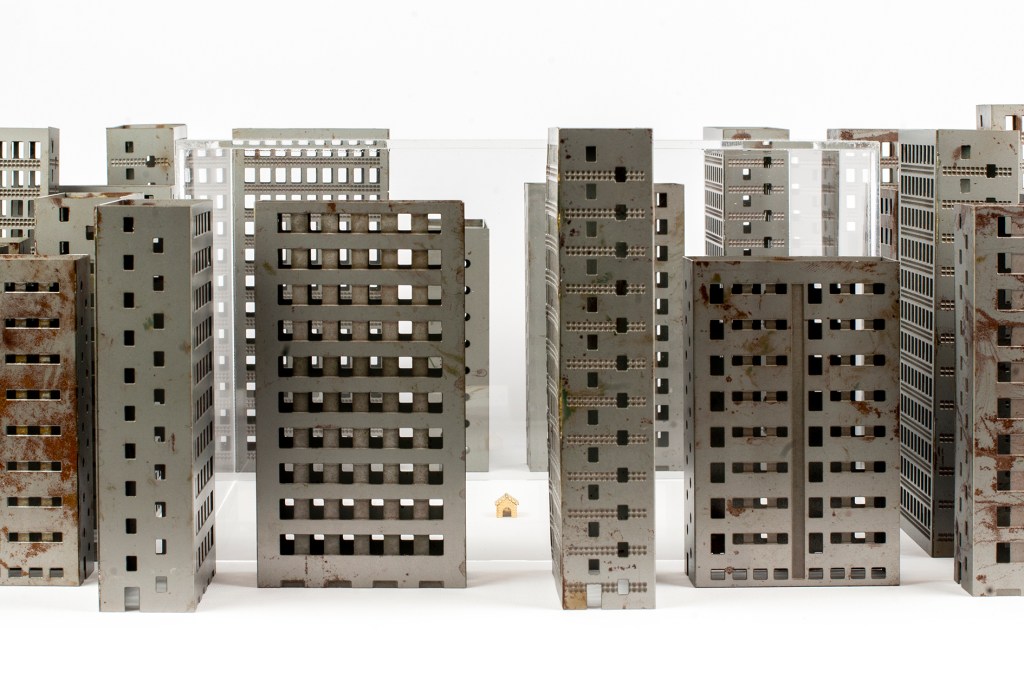
Nei miei lavori accentuo i contrasti sociali o tratto tematiche ambientali, utilizzando metalli poveri e nobili. Avrei potuto utilizzare la fotografia per raccontare un mondo fatto di agglomerati urbani, ma l’ho già fatto in passato ed oggi preferisco utilizzare la fotoincisione per costruire i miei diorami.
P.d’A.: Ti interessa l’idea di messa in scena nel tuo lavoro?
M.S.: Se per esporre i miei lavori dovessi scegliere tra uno spazio neutro ed un luogo carico di significato, sceglierei, onestamente, la seconda opzione.
Per esempio, di recente ho portato i miei moduli abitativi realizzati in fotoincisione alla biennale di Dresda, in una ex mensa di una nota azienda della DDR.
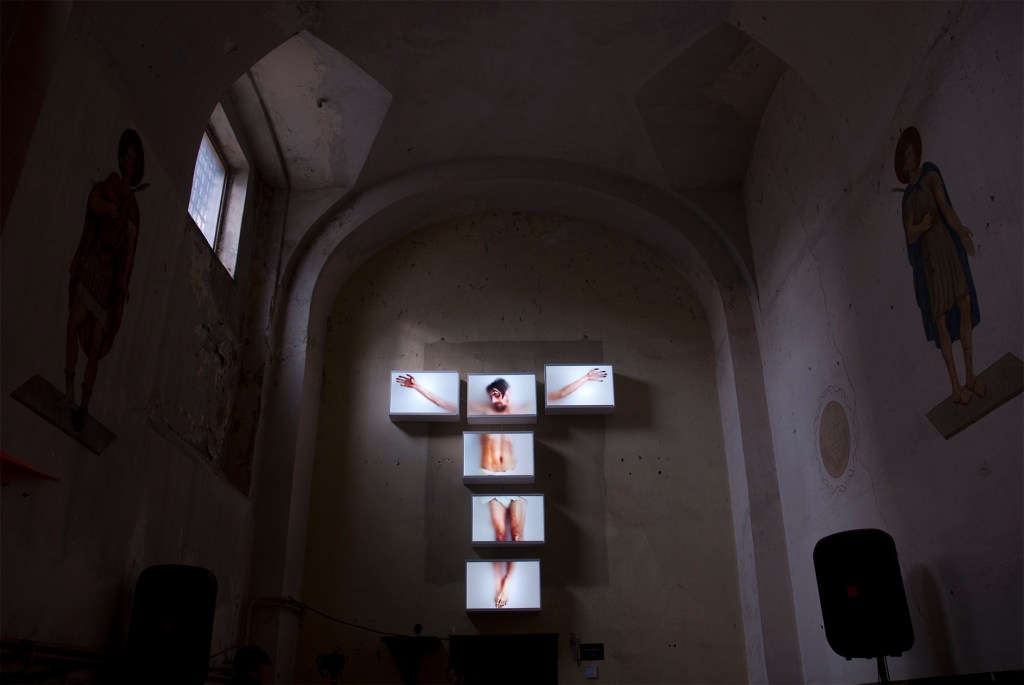
Un’architettura costruita negli anni ’60 con prefabbricati pionieristici e moduli decorativi in calcestruzzo. Sembrava ci fosse un filo conduttore tra lo spazio espositivo ed i miei lavori. Così come mi è capitato di esporre un Cristo crocifisso sezionato all’interno di light-box, nella cappella dell’ ex-carcere di Sant’Agata a Bergamo alta.
Penso che l’opera abbia bisogno di respirare e di connettersi con uno spazio particolare, purtroppo il più delle volte accade al di fuori di un contesto o da una logica commerciale.
P.d’A.: Quando lavori ad un progetto espositivo da dove parti?
M.S.: Lavorando spesso a dei progetti indipendenti e collettivi, il punto di partenza non è altro che il gruppo di persone con cui mi trovo a collaborare. Ogni volta ho un continuo confronto da cui scaturiscono idee, nuovi lavori e amicizie, come ho già accennato.
Mi è capitato di lavorare a dei progetti espositivi in cui le scelte fossero condivise dal gruppo di lavoro, altre volte invece si seguivano delle linee guida di un curatore. Non c’è mai stato uno schema fisso od un ordine, se non quello semplicemente di seguire le regole per comporre una mostra: cosa vogliamo comunicare, come lo vogliamo trasmettere, quale sarà la narrazione e lo spazio espositivo migliore.
Quindi, ci interessa stare anche dietro le quinte, per realizzare personalmente i progetti espositivi. Ovviamente questo può avvenire soltanto con l’aiuto ed il sostegno di curatori, critici, galleristi e associazioni culturali.
P.d’A.: Spesso nei tuoi lavori è presente il corpo umano mi sembra con un’idea di corpo sociale/politico. Che importanza hanno per te questi due aspetti sociale/politico nel tuo lavoro?
M.S.: Cercare di interpretare l’aspetto sociale, nell’epoca in cui viviamo così frenetica e veloce, diventa senz’altro uno spunto interessante su cui lavorare. Soprattutto se lo si considera in un senso più ampio e globale: un villaggio comune che edifica megalopoli divorando suolo e risorse.
La politica, in tutto ciò, rimane lontana dalle esigenze dei cittadini e dalla vita reale, incapace di guidare una macchina che è destinata all’inerzia.
Gli aspetti sociopolitici e le tematiche che ne conseguono, sono senz’altro alla base di molti miei lavori. Quando mi occupavo di fotografia avevo approfondito una ricerca che iniziava dall’architettura di Le Corbusier e terminava con il concetto di social housing. In mezzo c’era un secolo, il ‘900, con le sue guerre, le sue battaglie e le sue conquiste sociali.
English text
Interview to Matteo Suffritti
#paroladartista #intervistaartista #artistinterview #matteosuffritti
Parola d’Artista: Hi Matteo, for most artists childhood represents the golden age when the first ‘symptoms’ of a certain propensity to belong to the art world begin to appear. Was that the case for you too? Do tell?
Matteo Suffritti : I had a neighbour whom I naively called grandma. After primary school, I would stay with her in the afternoons. Her husband was a painter and the living room was full of easels, canvases in preparation and paintings. The smell of oil paints and the pungent smell of trichloroethylene enveloped us and the whole space was occupied by palettes and brushes. You could say that I spent my afternoons in an atelier. But what fascinated me most was the work of my ‘grandmother’: she would meticulously break up the dried leaves and divide them according to shade, from darkest brown to light beige. Then she would make a preparatory drawing and finally compose a collage of leaves according to chiaroscuro: they were true masterpieces. I used to spend my afternoons playing, seeing how he made his collages, playing a few songs on the piano and admiring canvases that were always new and in preparation. I probably became an adult when I discovered that, in fact, the neighbour was not my grandmother but a nanny and that my family called her Grandma Rosina simply because she was old. Now, I don’t know if this has served as an imprinting for me, but in that journey called life I have always felt the need to put creativity, in all its forms, first. Now, however, I wonder if I will be able to transmit this need to my young daughters.
P.d’A.: Is this transmitting the need for creativity to your daughters an important thing for you?
M.S.: It is in many respects, and sometimes the opposite also happens. When they infect me with their imagination, without filters and preparation in the most spontaneous way. We attend foundations and museums that organise educational workshops, or we visit exhibitions that we both enjoy.
I think this is the best solution to counter the arrogance and ignorance that we experience daily in our cities.
That of passing on to our children the tools for the beautiful. The beauty of getting dirty with clay or colours, the beauty of seeing works of art, the beauty of getting to know artists with different cultures and backgrounds, the beauty of travelling, visiting, knowing and understanding.
Yet, when I start my own work, things change. I don’t allow them into my world (actually I don’t allow anyone), as if my creative process needs solitude.
P.d.A.: On this path towards the solitude of the creative act, were there any encounters with people who were of great importance in your education?
M. S.: I attended a technical institute on the outskirts of Milan, which was more suited to lazy and listless boys, and I was strictly part of it. There I found some professors who, despite the school’s problems and shortcomings, loved teaching and transmitting their passion for their subject, including photography. The analogue one, made of chemistry and darkroom. It was magic for a 15-year-old boy.
But out of school I had to face my demons and insecurities, it happens….
It was then that I met the most important person who helped me overcome obstacles. I still remember the last time I saw her: I left her my first painting as a gift. An absolute crap, but it was of great importance to me.
P.d’A.: Did you attend the Academy?
M.S.: No, and maybe I wanted to. Who knows, maybe if I had attended I could have taken other paths, completely different from my current one. But I have few regrets, I was twenty years old and I was already working in a photogravure shop. At that time I thought it was more important to devote myself to professional activity
P.d’A.: How did your artistic career proceed?
M.S.: I have already told you that the first painting was not very good, in fact I abandoned brushes very early on. After all, my story had started with photography, so I took my SLR, set up a darkroom in my bathroom and started again with analogue. Years have passed since that bathroom and in that time I have tried to deepen my research, using other tools, techniques and media.
I moved on to digital, to light-boxes, to photo-installations, to photo-engravings.
In between, there was the more human aspect, the one made up of exhibitions and satisfactions but also of disappointments and frustrations. I will be frank: I have never had any constraints from a gallery or pressure of how to make ends meet. My source of income has always remained the same, so I have always felt free to experiment or collaborate with other artists.
In other areas, however, I perceive a widespread discontent, but this fortunately does not affect me.
P.d’A.: The fact that you don’t have to make ends meet with art obviously saves you from a series of bad stories and gives you more freedom in terms of professional choices, which artists have you decided to collaborate with and how?
M.S.: In the past, I got to know other artists by collaborating with some collectives. I have always considered the experience of the collective as a possibility of enrichment and encounter, especially in times of covid. During the lockdown, for example, while the world came to a standstill, I and a small group of artists formed a collective, which was able to design exhibitions for the post-lockdown period. Once the storm passed and two exhibition projects were realised, the collective melted away like snow in the sun, but something remained. The collaboration with the artist and performer Alex Sala, for example, gave me the opportunity to approach and learn about the world of performance. The approach to a language so different from mine was absolutely stimulating and gratifying, and the collaboration, in addition to having produced a work signed by both of us, has continued over time.
P.d’A.: In your works, the spatial articulation in modules or shapes that recall or evoke buildings, houses in a very direct way, where does it come from?
M.S.: One evening I was eating a pizza in a working-class neighbourhood in Milan.
It was summer and the tables were outside, on the pavement. I looked around and the street was a succession of dilapidated buildings and abandoned rubbish everywhere. The decay ended about a hundred metres away, at that traffic light over there, where the ring road used to be.
As if that street was a border, a wall: on one side the poor, the rejects, those struggling to make ends meet, on the other side simply the others. Human habitation is something complex and fascinating, which lies at the basis of our society.
In my works I accentuate social contrasts or deal with environmental issues, using poor and noble metals. I could have used photography to narrate a world of urban agglomerations, but I have already done that in the past and today I prefer to use photogravure to build my dioramas.
P.d’A.: Are you interested in the idea of staging in your work?
M.S.: If I had to choose between a neutral space and a meaningful place to exhibit my work, I would honestly choose the second option.
For example, I recently took my photogravure housing modules to the Dresden biennale, in a former canteen of a well-known GDR company.
It was an architecture built in the 1960s with pioneering prefabs and decorative concrete modules. There seemed to be a common thread between the exhibition space and my works. Just as I happened to exhibit a sectioned crucified Christ inside light-boxes in the chapel of the former Sant’Agata prison in upper Bergamo.
I think the work needs to breathe and connect with a particular space, unfortunately most of the time it happens outside of a context or commercial logic.
P.d’A.: When you work on an exhibition project, where do you start from?
M.S.: As I often work on independent and collective projects, the starting point is none other than the group of people I work with. Each time I have a continuous confrontation from which ideas, new works and friendships arise, as I have already mentioned.
It has happened that I have worked on exhibition projects where the choices were shared by the working group, at other times we followed the guidelines of a curator. There has never been a fixed scheme or order, other than simply to follow the rules for composing an exhibition: what we want to communicate, how we want to convey it, what will be the best narrative and exhibition space.
Therefore, we are also interested in being behind the scenes, to personally realise the exhibition projects. Of course, this can only happen with the help and support of curators, critics, gallery owners and cultural associations.
P.d.A.: The human body is often present in your work, it seems to me, with a social/political body idea. What importance do these two social/political aspects have for you in your work?
M.S.: Trying to interpret the social aspect, in the era in which we live so hectic and fast-paced, certainly becomes an interesting cue to work on. Especially if we consider it in a broader and more global sense: a common village building megalopolises devouring soil and resources.
Politics, in all this, remains far removed from the needs of citizens and real life, unable to drive a machine that is destined for inertia.
Socio-political aspects and the resulting themes are certainly at the heart of much of my work. When I was involved in photography, I pursued a research that started with Le Corbusier’s architecture and ended with the concept of social housing. In between was a century, the 20th century, with its wars, battles and social achievements.
Intervista a Matteo Suffritti
(▼Scroll down for English text)
#paroladartista #intervistaartista #artistinterview #matteosuffritti
Parola d’Artista: Ciao Matteo, per la maggior parte degli artisti l’infanzia rappresenta l’età dell’oro quella in cui cominciano a manifestarsi i primi “sintomi” di una certa propensione ad appartenere al mondo dell’arte. E’ stato così anche per te? Racconta?
Matteo Suffritti : Avevo una vicina che chiamavo ingenuamente nonna. Dopo la scuola elementare stavo il pomeriggio da lei. Suo marito era un pittore ed il soggiorno era pieno di cavalletti, tele in preparazione e quadri. L’odore dei colori ad olio e quello pungente della trielina ci avvolgeva e tutto lo spazio era occupato da tavolozze e pennelli. Si poteva dire che passavo i pomeriggi in un atelier. Ma quello che mi affascinava di più era il lavoro di mia “nonna”: spezzava con meticolosa pazienza le foglie secche e le divideva in base alle tonalità, dal marrone più scuro al beige chiaro. Poi realizzava un disegno preparatorio ed infine componeva un collage di foglie in base ai chiaroscuri: erano autentici capolavori. Passavo i pomeriggi a giocare, vedere come realizzava i suoi collage, suonare qualche canzoncina con il pianoforte e ammirare tele sempre nuove e in preparazione. Probabilmente divenni adulto quando scoprii che, in realtà, la vicina non era mia nonna ma una tata e che la mia famiglia la chiamava nonna Rosina semplicemente perchè anziana.
Ora, non so se tutto questo mi è servito come imprinting, ma in quel percorso che si chiama vita ho sempre sentito la necessità di porre al primo posto la creatività, in tutte le sue forme. Ora, invece, mi domando se riuscirò a trasmettere questa necessità alle mie figlie piccole.
P.d’A.: Questa di trasmettere alle tue figlie la necessità creativa é per te una cosa importante?
M.S.: Lo è per molti aspetti e a volte capita anche il contrario. Quando mi contagiano con la loro fantasia, senza filtri e preparazione nella maniera più spontanea. Frequentiamo fondazioni e musei che organizzano laboratori didattici, oppure visitiamo le mostre che possono piacere a entrambi.
Penso sia questa la soluzione migliore per contrastare l’arroganza e l’ignoranza che viviamo quotidianamente nelle nostre città.
Quella di trasmettere ai nostri figli gli strumenti per il bello. Il bello di sporcarsi con l’argilla o con i colori, il bello di vedere delle opere d’arte, il bello di conoscere artisti con culture e provenienze differenti, il bello di viaggiare, visitare, conoscere e capire.
Eppure, quando inizio un mio lavoro le cose cambiano. Non permetto a loro di entrare nel mio mondo (in realtà non lo permetto a nessuno), come se il mio processo creativo avesse bisogno di solitudine.
P.d’A.: In questo percorso verso la solitudine dell’atto creativo ci sono stati degli incontri con persone che hanno avuto una grande importanza nella tua formazione?
Matteo Suffritti: Frequentavo un istituto tecnico della periferia milanese, adatto più a ragazzi pigri e svogliati di cui ne facevo rigorosamente parte. Lì ho trovato alcuni professori che, nonostante le problematiche e lacune della scuola, amavano insegnare e trasmettere la passione per la propria materia, tra cui la fotografia. Quella analogica, fatta di chimici e camera oscura. Fu una magia per un ragazzo di 15 anni.
Ma uscito dalla scuola dovetti far fronte ai miei demoni e alle mie insicurezze, capita…
Fu allora che incontrai la persona più importante che mi diede un mano a superare gli ostacoli. Ricordo ancora l’ultima volta che la vidi: gli lasciai in dono il mio primo quadro. Uno schifo assoluto, ma per me fu di grande importanza.
P.d’A.: Hai frequentato l’Accademia?
M.S.: No e forse avrei voluto. Chissà, magari se l’avessi frequentata avrei potuto intraprendere altre strade, completamente diverse da quella attuale. Ma ho pochi rimpianti, avevo vent’anni e lavoravo già in una fotoincisione. In quel momento pensavo fosse più importante dedicarmi all’attività professionale
P.d’A.: Come è proceduta la tua vicenda artistica?
M.S.: Ti ho già detto che il primo quadro non era un granché, infatti i pennelli li ho abbandonati molto presto. Del resto la mia storia era iniziata con la fotografia, così ripresi la reflex, strutturai una camera oscura nel mio bagno e ricominciai dall’analogico. Da quel bagno ne sono passati di anni e in quel lasso di tempo ho cercato di approfondire la mia ricerca, utilizzando altri strumenti, tecniche e media.
Sono passato al digitale, ai light-box, alle foto-installazioni, per arrivare alle fotoincisioni.
Nel mentre c’è stato l’aspetto più umano, quello fatto di mostre e soddisfazioni ma anche di delusioni e frustrazioni. Sarò franco: non ho mai avuto nessun vincolo da parte di una galleria o pressioni di come arrivare alla fine del mese. La mia fonte di guadagno è rimasta sempre la stessa, quindi mi sono sempre sentito libero di sperimentare o di collaborare con altri artisti.
In altri ambiti, invece, percepisco un malumore diffuso, ma questo fortunatamente non mi riguarda.
P.d’A.: Il fatto di non dover arrivare a fine mese con l’arte ovviamente ti salva da una serie di brutte storie e ti regala una maggiore libertà sul piano delle scelte professionali, con quali artisti ha deciso di collaborare e in che modo?
M.S.: In passato ho avuto modo di conoscere altri artisti collaborando con alcuni collettivi. Ho sempre considerato l’esperienza del collettivo come una possibilità di arricchimento e di incontro, soprattutto in tempi di covid. Durante il lockdown, per esempio, mentre il mondo si fermava, io ed un piccolo gruppo di artisti formavamo un collettivo, capace di progettare delle mostre per il post-lockdown. Passata la bufera e realizzati due progetti espositivi, il collettivo si è sciolto come neve al sole, ma qualcosa è comunque rimasto. La collaborazione con l’artista e performer Alex Sala, per esempio, mi ha dato la possibilità di avvicinarmi e di conoscere il mondo della performance. L’approccio ad un linguaggio così diverso dal mio è stato assolutamente stimolante e gratificante e la collaborazione, oltre ad aver prodotto un’opera firmata da entrambi, è proseguita nel tempo.
P.d’A.: Nei tuo lavori l’articolazione spaziale in moduli o in sagome che ricordano o che evocano in modo molto diretto palazzi, case da dove deriva?
M.S.: Una sera stavo mangiando una pizza in un quartiere popolare di Milano.
Era estate ed i tavoli erano all’esterno, sul marciapiede. Mi guardavo attorno e la via era un susseguirsi di palazzi fatiscenti e spazzatura abbandonata ovunque. Il degrado finiva ad un centinaio di metri, a quel semaforo laggiù, dove c’era la circonvallazione.
Come se quella strada fosse un confine, un muro: da una parte i meno abbienti, gli scarti, quelli che si arrabattano per arrivare alla fine del mese, dall’altra parte semplicemente gli altri. L’abitare umano è qualcosa di complesso e di affascinante, che sta alla base della nostra società.
Nei miei lavori accentuo i contrasti sociali o tratto tematiche ambientali, utilizzando metalli poveri e nobili. Avrei potuto utilizzare la fotografia per raccontare un mondo fatto di agglomerati urbani, ma l’ho già fatto in passato ed oggi preferisco utilizzare la fotoincisione per costruire i miei diorami.
P.d’A.: Ti interessa l’idea di messa in scena nel tuo lavoro?
M.S.: Se per esporre i miei lavori dovessi scegliere tra uno spazio neutro ed un luogo carico di significato, sceglierei, onestamente, la seconda opzione.
Per esempio, di recente ho portato i miei moduli abitativi realizzati in fotoincisione alla biennale di Dresda, in una ex mensa di una nota azienda della DDR.
Un’architettura costruita negli anni ’60 con prefabbricati pionieristici e moduli decorativi in calcestruzzo. Sembrava ci fosse un filo conduttore tra lo spazio espositivo ed i miei lavori. Così come mi è capitato di esporre un Cristo crocifisso sezionato all’interno di light-box, nella cappella dell’ ex-carcere di Sant’Agata a Bergamo alta.
Penso che l’opera abbia bisogno di respirare e di connettersi con uno spazio particolare, purtroppo il più delle volte accade al di fuori di un contesto o da una logica commerciale.
P.d’A.: Quando lavori ad un progetto espositivo da dove parti?
M.S.: Lavorando spesso a dei progetti indipendenti e collettivi, il punto di partenza non è altro che il gruppo di persone con cui mi trovo a collaborare. Ogni volta ho un continuo confronto da cui scaturiscono idee, nuovi lavori e amicizie, come ho già accennato.
Mi è capitato di lavorare a dei progetti espositivi in cui le scelte fossero condivise dal gruppo di lavoro, altre volte invece si seguivano delle linee guida di un curatore. Non c’è mai stato uno schema fisso od un ordine, se non quello semplicemente di seguire le regole per comporre una mostra: cosa vogliamo comunicare, come lo vogliamo trasmettere, quale sarà la narrazione e lo spazio espositivo migliore.
Quindi, ci interessa stare anche dietro le quinte, per realizzare personalmente i progetti espositivi. Ovviamente questo può avvenire soltanto con l’aiuto ed il sostegno di curatori, critici, galleristi e associazioni culturali.
P.d’A.: Spesso nei tuoi lavori è presente il corpo umano mi sembra con un’idea di corpo sociale/politico. Che importanza hanno per te questi due aspetti sociale/politico nel tuo lavoro?
M.S.: Cercare di interpretare l’aspetto sociale, nell’epoca in cui viviamo così frenetica e veloce, diventa senz’altro uno spunto interessante su cui lavorare. Soprattutto se lo si considera in un senso più ampio e globale: un villaggio comune che edifica megalopoli divorando suolo e risorse.
La politica, in tutto ciò, rimane lontana dalle esigenze dei cittadini e dalla vita reale, incapace di guidare una macchina che è destinata all’inerzia.
Gli aspetti sociopolitici e le tematiche che ne conseguono, sono senz’altro alla base di molti miei lavori. Quando mi occupavo di fotografia avevo approfondito una ricerca che iniziava dall’architettura di Le Corbusier e terminava con il concetto di social housing. In mezzo c’era un secolo, il ‘900, con le sue guerre, le sue battaglie e le sue conquiste sociali.
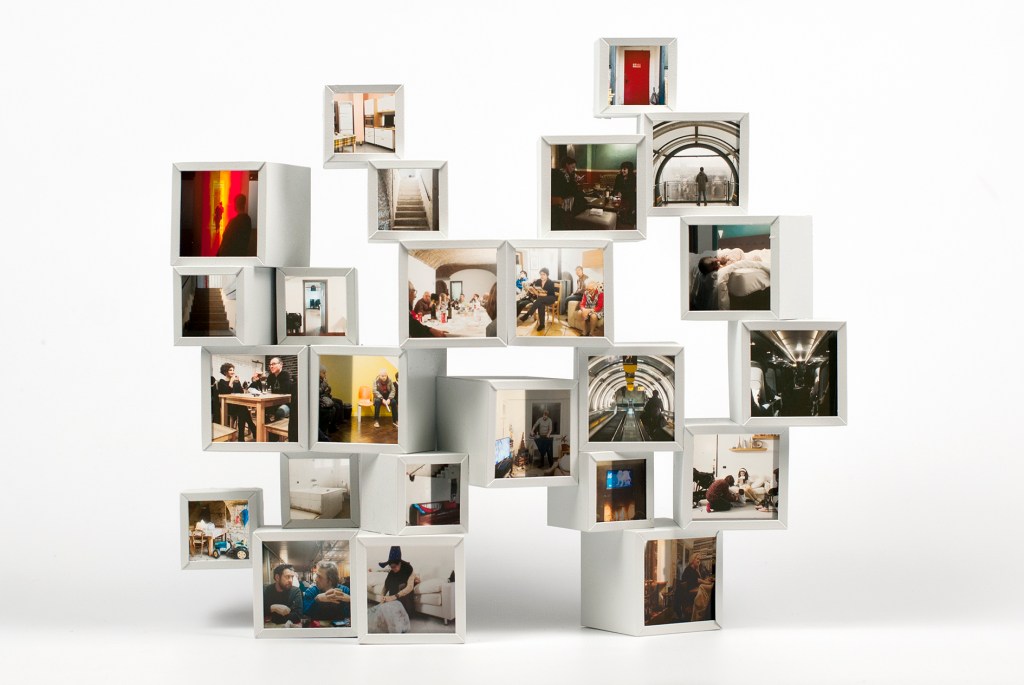
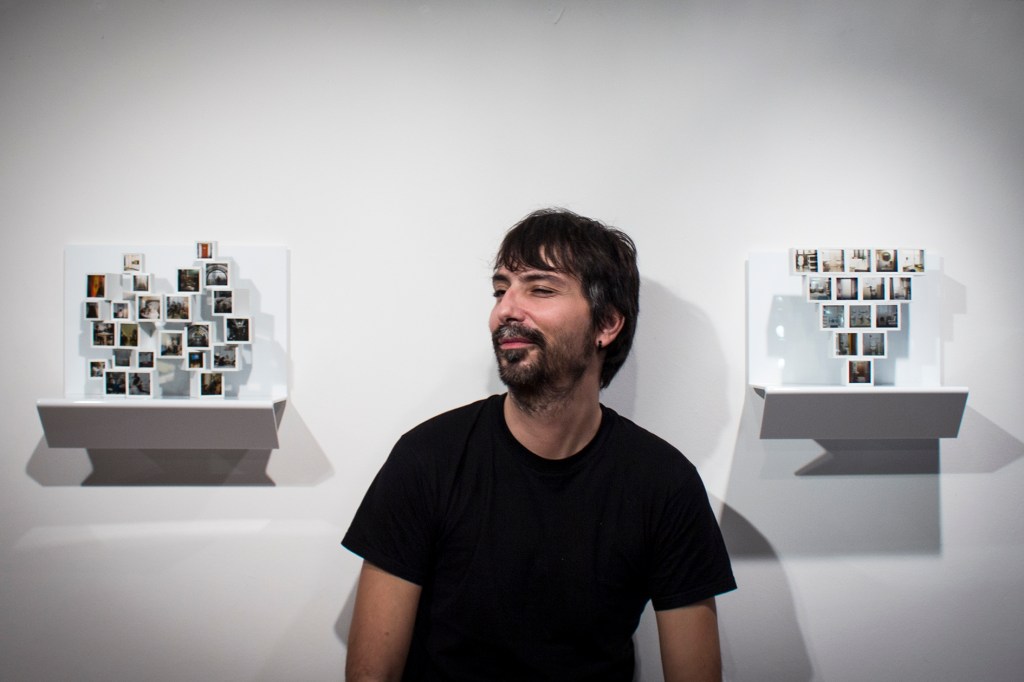
Nato nel 1978, Matteo Suffritti è un artista e fotografo milanese con alle spalle studi di grafica e di tecnica pubblicitaria. Le sue foto-installazioni sono realizzate con materiali diversi (artificiali e naturali) che possono spaziare dal metallo al plexiglass o dall’acqua alla luce. Lo sguardo dei suoi lavori è rivolto principalmente su due filoni. Uno, più introspettivo ed intimo, è composto da ricordi, memorie ed una ricerca più nostalgica, mentre l’altro pone l’attenzione sulle problematiche ambientali e sociali. Infatti, le opere più recenti realizzate con la tecnica della fotoincisione, sono composte da dei micro-mondi antropologici e dalla raffigurazione dei suoi aspetti più critici: diorami di città ormai al collasso, palazzi dorati e baraccopoli in contrapposizione a ville barocche.
Matteo Suffritti ha esposto in mostre collettive e personali.
Vincitore del Premio MarteLive di Roma nel 2011 e dello Special Project di Espoarte nel 2017, ha partecipato a tre edizioni dell’Arteam Cup (Venezia, Alessandria e BonelliLab). Per il Premio Carlo Bonatto Minella ha esposto a Praga e alla Villa Vallero di Rivarolo Canavese (TO). Tra le varie mostre annovera quelle al MVSA di Sondrio, ai Musei Civici di Domodossola, a Palazzo Bastogi di Firenze e alla Biennale di Dresda (Germania).
English text
Interview to Matteo Suffritti
#paroladartista #intervistaartista #artistinterview #matteosuffritti
Parola d’Artista: Hi Matteo, for most artists childhood represents the golden age when the first ‘symptoms’ of a certain propensity to belong to the art world begin to appear. Was that the case for you too? Do tell?
Matteo Suffritti : I had a neighbour whom I naively called grandma. After primary school, I would stay with her in the afternoons. Her husband was a painter and the living room was full of easels, canvases in preparation and paintings. The smell of oil paints and the pungent smell of trichloroethylene enveloped us and the whole space was occupied by palettes and brushes. You could say that I spent my afternoons in an atelier. But what fascinated me most was the work of my ‘grandmother’: she would meticulously break up the dried leaves and divide them according to shade, from darkest brown to light beige. Then she would make a preparatory drawing and finally compose a collage of leaves according to chiaroscuro: they were true masterpieces. I used to spend my afternoons playing, seeing how he made his collages, playing a few songs on the piano and admiring canvases that were always new and in preparation. I probably became an adult when I discovered that, in fact, the neighbour was not my grandmother but a nanny and that my family called her Grandma Rosina simply because she was old. Now, I don’t know if this has served as an imprinting for me, but in that journey called life I have always felt the need to put creativity, in all its forms, first. Now, however, I wonder if I will be able to transmit this need to my young daughters.
P.d’A.: Is this transmitting the need for creativity to your daughters an important thing for you?
M.S.: It is in many respects, and sometimes the opposite also happens. When they infect me with their imagination, without filters and preparation in the most spontaneous way. We attend foundations and museums that organise educational workshops, or we visit exhibitions that we both enjoy.
I think this is the best solution to counter the arrogance and ignorance that we experience daily in our cities.
That of passing on to our children the tools for the beautiful. The beauty of getting dirty with clay or colours, the beauty of seeing works of art, the beauty of getting to know artists with different cultures and backgrounds, the beauty of travelling, visiting, knowing and understanding.
Yet, when I start my own work, things change. I don’t allow them into my world (actually I don’t allow anyone), as if my creative process needs solitude.
P.d.A.: On this path towards the solitude of the creative act, were there any encounters with people who were of great importance in your education?
M. S.: I attended a technical institute on the outskirts of Milan, which was more suited to lazy and listless boys, and I was strictly part of it. There I found some professors who, despite the school’s problems and shortcomings, loved teaching and transmitting their passion for their subject, including photography. The analogue one, made of chemistry and darkroom. It was magic for a 15-year-old boy.
But out of school I had to face my demons and insecurities, it happens….
It was then that I met the most important person who helped me overcome obstacles. I still remember the last time I saw her: I left her my first painting as a gift. An absolute crap, but it was of great importance to me.
P.d’A.: Did you attend the Academy?
M.S.: No, and maybe I wanted to. Who knows, maybe if I had attended I could have taken other paths, completely different from my current one. But I have few regrets, I was twenty years old and I was already working in a photogravure shop. At that time I thought it was more important to devote myself to professional activity
P.d’A.: How did your artistic career proceed?
M.S.: I have already told you that the first painting was not very good, in fact I abandoned brushes very early on. After all, my story had started with photography, so I took my SLR, set up a darkroom in my bathroom and started again with analogue. Years have passed since that bathroom and in that time I have tried to deepen my research, using other tools, techniques and media.
I moved on to digital, to light-boxes, to photo-installations, to photo-engravings.
In between, there was the more human aspect, the one made up of exhibitions and satisfactions but also of disappointments and frustrations. I will be frank: I have never had any constraints from a gallery or pressure of how to make ends meet. My source of income has always remained the same, so I have always felt free to experiment or collaborate with other artists.
In other areas, however, I perceive a widespread discontent, but this fortunately does not affect me.
P.d’A.: The fact that you don’t have to make ends meet with art obviously saves you from a series of bad stories and gives you more freedom in terms of professional choices, which artists have you decided to collaborate with and how?
M.S.: In the past, I got to know other artists by collaborating with some collectives. I have always considered the experience of the collective as a possibility of enrichment and encounter, especially in times of covid. During the lockdown, for example, while the world came to a standstill, I and a small group of artists formed a collective, which was able to design exhibitions for the post-lockdown period. Once the storm passed and two exhibition projects were realised, the collective melted away like snow in the sun, but something remained. The collaboration with the artist and performer Alex Sala, for example, gave me the opportunity to approach and learn about the world of performance. The approach to a language so different from mine was absolutely stimulating and gratifying, and the collaboration, in addition to having produced a work signed by both of us, has continued over time.
P.d’A.: In your works, the spatial articulation in modules or shapes that recall or evoke buildings, houses in a very direct way, where does it come from?
M.S.: One evening I was eating a pizza in a working-class neighbourhood in Milan.
It was summer and the tables were outside, on the pavement. I looked around and the street was a succession of dilapidated buildings and abandoned rubbish everywhere. The decay ended about a hundred metres away, at that traffic light over there, where the ring road used to be.
As if that street was a border, a wall: on one side the poor, the rejects, those struggling to make ends meet, on the other side simply the others. Human habitation is something complex and fascinating, which lies at the basis of our society.
In my works I accentuate social contrasts or deal with environmental issues, using poor and noble metals. I could have used photography to narrate a world of urban agglomerations, but I have already done that in the past and today I prefer to use photogravure to build my dioramas.
P.d’A.: Are you interested in the idea of staging in your work?
M.S.: If I had to choose between a neutral space and a meaningful place to exhibit my work, I would honestly choose the second option.
For example, I recently took my photogravure housing modules to the Dresden biennale, in a former canteen of a well-known GDR company.
It was an architecture built in the 1960s with pioneering prefabs and decorative concrete modules. There seemed to be a common thread between the exhibition space and my works. Just as I happened to exhibit a sectioned crucified Christ inside light-boxes in the chapel of the former Sant’Agata prison in upper Bergamo.
I think the work needs to breathe and connect with a particular space, unfortunately most of the time it happens outside of a context or commercial logic.
P.d’A.: When you work on an exhibition project, where do you start from?
M.S.: As I often work on independent and collective projects, the starting point is none other than the group of people I work with. Each time I have a continuous confrontation from which ideas, new works and friendships arise, as I have already mentioned.
It has happened that I have worked on exhibition projects where the choices were shared by the working group, at other times we followed the guidelines of a curator. There has never been a fixed scheme or order, other than simply to follow the rules for composing an exhibition: what we want to communicate, how we want to convey it, what will be the best narrative and exhibition space.
Therefore, we are also interested in being behind the scenes, to personally realise the exhibition projects. Of course, this can only happen with the help and support of curators, critics, gallery owners and cultural associations.
P.d.A.: The human body is often present in your work, it seems to me, with a social/political body idea. What importance do these two social/political aspects have for you in your work?
M.S.: Trying to interpret the social aspect, in the era in which we live so hectic and fast-paced, certainly becomes an interesting cue to work on. Especially if we consider it in a broader and more global sense: a common village building megalopolises devouring soil and resources.
Politics, in all this, remains far removed from the needs of citizens and real life, unable to drive a machine that is destined for inertia.
Socio-political aspects and the resulting themes are certainly at the heart of much of my work. When I was involved in photography, I pursued a research that started with Le Corbusier’s architecture and ended with the concept of social housing. In between was a century, the 20th century, with its wars, battles and social achievements.
Born in 1978, Matteo Suffritti is a Milanese artist and photographer with studies in graphics and advertising techniques behind him. His photo-installations are made of different materials (artificial and natural) ranging from metal to Plexiglas or from water to light. The focus of his works is mainly on two strands. One, more introspective and intimate, is composed of memories, memoirs and a more nostalgic quest, while the other focuses on environmental and social issues. In fact, the most recent works, created using the photoengraving technique, are composed of anthropological micro-worlds and the depiction of its most critical aspects: dioramas of cities that are now collapsing, gilded palaces and shantytowns as opposed to baroque villas.
Matteo Suffritti has exhibited in group and solo shows.
Winner of the MarteLive Prize in Rome in 2011 and Espoarte’s Special Project in 2017, he has participated in three editions of the Arteam Cup (Venice, Alessandria and BonelliLab). For the Carlo Bonatto Minella Prize, he exhibited in Prague and at Villa Vallero in Rivarolo Canavese (TO). His various exhibitions include those at the MVSA in Sondrio, the Domodossola Civic Museums, Palazzo Bastogi in Florence and the Dresden Biennial (Germany).
Без названия (senza titolo)
eloì, eloì, lemà sabactàni_
La cuccia del cane
Terzo Like
 paroladartista.com