

(Scorre verso il basso per la versione Italiana)
#paroladartista #artistinterview #intervistaartista #elanahezog
Parola d’Artista: For most artists, childhood is the golden age when the first symptoms of a certain propensity to belong to the art world begin to appear. Was that the case for you too? Tell us.
Elana Herzog: My earliest memories of aesthetic experience connect me to my mother, who loved visual arts of all kinds and she encouraged me to look and to make it. I found beauty in the natural world and remember hours of silently looking out a car window at the passing landscape. Although I participated in many artistic projects as a child, It wasn’t until I was in college, however, that I began to think seriously of being an artist.
P.d’A.: What studies did you do?
E.H.: In college, I studied ceramics and painting, and I began a masters degree in ceramics that led me to making sculpture
P.d’A.:Were there any important encounters during your training?
E.H.: Being an artist has always been both a solitary pursuit for me, and a way to connect with others. As a college student I had several teachers who I adored and felt seen and understood by. When I was in graduate school the direction of my work changed and the faculty did not accept what I was doing. I felt challenged to prove myself to them, and I learned that I was very stubborn.
P.d’A.:Are the materials you work with the result of careful research?
E.H.: My research is very intuitive and driven by curiosity. A tactile and visceral relationship to materials has always been central to my work. As time has passed I’ve become increasingly interested in the historical textile industry and its impacts on culture and technology. In the course of my travels I search for materials and local history. I have learned quite a lot about the industry and use it as a lens through which to understand colonial history and migrations.
P.d’A.:Do you catalogue the material you collect to make your works?
E.H.: I would say that I often inventory and sort my materials, but I don’t catalogue them in a systematic way. This would be a great project though. I often sort and re-sort my fabrics into different categories based on color, pattern, technique (weaves or prints), material content (cotton, silk, polyester) etc etc. And then they all get mixed up, and I sort them again!
P.d’A.:Are you interested in the ‘pictorial quality’ of your works?
E.H.: Although I often think of myself as a sculptor, and am focused on materiality, I am very interested in the pictorial and the painterly. I grew up with the language of abstract painting, and I like to use that language to challenge its primacy. I combine it with other languages – social and psychological; I use humor to undermine its authority. Even my three dimensional work is in conversation with modernism and painting.
P.d’A.:What importance does the idea of the body and physicality have for you?
E.H.: All of my work is informed by its relationship to the physical world and the tactile qualities of materials. My use of textile fabrics originated with an interest in their psychologically evocative characteristics. In painting and in life fabric implies the body by both concealing it, and revealing it. I often scale my work so that connects to the scale of domestic objects, and will be experienced in a direct relationship to our bodies. I’m interested in the implication of touch and feel and texture and surface. Although I do not invite viewers to touch my work, I invite them to want to touch it.
P.d’A.:When you start a work do you already have a clear idea of how it will develop?
E.H.: I am fascinated by process and curious about outcomes. I often begin with a strategy; to use a specific process or series of processes and see what happens. The final outcome is a never pre-determined. I respond to what I see happening in front of me as I develop the piece; there are no rules or prohibitions. I often get into trouble; creating problems for myself that I have to solve. Sometimes things move quickly, but there are times when the solution to a piece doesn’t come to me for a long time.
P.d’A.:Do you work on several things simultaneously or do you concentrate on one work at a time?
E.H.: I often work on several pieces at a time, in order to allow them each to develop at their own pace. Of course if I have a deadline all of that changes completely, and adrenaline pushes ideas forward and accelerates the pace of the work! I love both of these ways of working.
P.d’A.:Are you interested in the spiritual/sacred dimension in what you do?
E.H.: I’m interested in the idea of the spiritual as an aspect of human experience. In my view it is a kind of inner feeling; a creation of the human psyche, but not a reflection of a divine power or being. I believe that he divine is an idea that people have about the world. I am interested in both conscious and unconscious processes; rational and the irrational aspects of the human mind. I’m fundamentally a materialist.
P.d’A.:What kind of dialogue do you seek with the viewer in front of your work?
E.H.: I am very open about how the viewer experiences my work; I don’t want to control their response. I hope that they have a visceral response, and that they experience pleasure. I hope that their perception of the world is affected by the experience of seeing my work, I don’t want to control or overdetermine how they experience it or to tell them what to think.
P.d’A.:Does the idea of staging in your work have any importance?
E.H.: i’m not sure what you mean by staging. I do feel that my work needs to be installed with great sensitivity to site. Some pieces are explicitly and intrinsically site responsive and directly related to architecture. Others are more independent of site. Nevertheless, the way that they are installed is always important, because they exist in relation to the space, the architecture and the viewer.
P.d’A.:What happens to the works when there is no one there to observe them, can the existence of a work of art be independent of the presence of an observer?
E.H.: It is an interesting question to ask whether the work exists independently of the viewer. Thinking of it as a an isolated or form is poignant and poetic in a different way than thinking about it as something that we interact with. I think that for me the important question is does the work exist independently of the site? I feel that the work is related to its site in every aspect of its existence whether it sits on the floor or mounts on the wall or attaches to the ceiling. As an artist I conceive it that way and that becomes a part of my relationship to it.
P.d’A.:Where do you think the artist stands in relation to his work?
E.H.: To be perfectly honest, my greatest concern is with my own relationship to the work in its inception. There is a kind of triangulation that occurs between me, the work, and the viewer, that is important to me. as such, it is a form of communication.
On the other hand the work is a practice; a reflection of hours spent in pursuit of an idea, hours of labor, hours of solitude. It externalizes an internal process. It separates me from the world and connects me to it at the same time. When it goes out into the world it takes on a life of its own that is independent of me.
Elana Herzog born 1954, Toronto, Canada; lives and works in New York City. She holds a BA from Bennington College and an MFA from Alfred University. Herzog received a 2017 Guggenheim Fellowship. She was profiled in Sculpture Magazine, Summer 2020 issue. Herzog’s work is currently being exhibited in Elana Herzog; Ripped, Tangled and Frayed at the New Jersey Center for the Visual Arts, Summit, New Jersey.
Herzog has had solo and two person shows at Cathouse Proper, Brooklyn, NY; the Sharjah Art Museum, United Arab Emirates; Western Exhibitions, Chicago, The Boiler (Pierogi), and Smack Mellon, Brooklyn; the Aldrich Museum, Connecticut; Herbert F. Johnson Museum, Cornell University, Ithaca, New York, Diverseworks, Houston, Texas and the Daum Museum of Contemporary Art in Missouri. Her work was recently included in groups shows at Albertz Benda Gallery, New York, Mindy Solomon Gallery, Miami and in Encounters: Women Artists and the Legacies of Modern Art, the inaugural exhibition at the David Rockefeller Creative Arts Center in Sleepy Hollow, New York. Herzog’s work has been exhibited internationally in the Republic of Georgia, Norway, Sweden, Iceland, Canada, Chile and the Netherlands, and she has participated in numerous group shows at institutions such as The Brooklyn Museum, The Museum of Arts and Design and The 8th Floor in New York City, The Tang Museum in Saratoga Springs, New York, The Weatherspoon Museum in Greensboro, North Carolina, and The Kohler Museum in Sheboygan, Wisconsin.
Herzog has received grants from Foundation for Contemporary Art Emergency Grant; the Anonymous Was A Woman Award, the Louis Comfort Tiffany Award, NYFA Fellowships 2007/1999, Lillian Elliot Award; Lambent Fund Fellowship and the Joan Mitchell Award. She has been awarded residencies at Yaddo, MacDowell, Joan Mitchell Center, Fountainhead,
Josef and Anni Albers Foundation, Marie Walsh Sharpe Space Program; LMCC Workspace, Dieu Donne Paper; Wave Hill; Back Apartment Residency, Russia; Søndre Green Farm, Norway; Gertrude Contemporary, Australia.
Testo in Italiano
Intervista a Elana Herzog
#paroladartista #artistinterview #intervistaartista #elanahezog
Parola d’Artista: Per la maggior parte degli artisti, l’infanzia è l’età d’oro in cui iniziano a manifestarsi i primi sintomi di una certa propensione ad appartenere al mondo dell’arte. È stato così anche per te? Racconta.
Elana Herzog: I miei primi ricordi di esperienza estetica mi legano a mia madre, che amava le arti visive di ogni tipo e mi incoraggiava a guardare e a creare. Trovavo la bellezza nel mondo naturale e ricordo ore passate a guardare in silenzio il paesaggio che passava dal finestrino dell’auto. Anche se da bambina ho partecipato a molti progetti artistici, è stato solo all’università che ho iniziato a pensare seriamente di diventare un’artista.
P.d’A.: Quali studi hai fatto?
E.H.: All’università ho studiato ceramica e pittura, e ho iniziato un master in ceramica che mi ha portato a fare scultura.
P.d’A.: Ci sono stati incontri importanti durante la tua formazione?
E.H.: Essere un artista è sempre stato per me sia una ricerca solitaria che un modo per entrare in contatto con gli altri. Quando ero studentessa all’ università ho avuto diversi insegnanti che adoravo e dai quali mi sentivo vista e compresa. Quando mi sono laureata, la direzione del mio lavoro è cambiata e la facoltà non accettava quello che stavo facendo. Mi sono sentita sfidata a dimostrare il mio valore a loro, e ho imparato che ero molto testarda.
P.d’A.: I materiali con cui lavori sono il risultato di un’attenta ricerca?
E.H.: La mia ricerca è molto intuitiva e guidata dalla curiosità. Il rapporto tattile e viscerale con i materiali è sempre stato al centro del mio lavoro. Con il passare del tempo mi sono sempre più interessata all’industria tessile storica e al suo impatto sulla cultura e sulla tecnologia. Nel corso dei miei viaggi vado alla ricerca di materiali e di storia locale. Ho imparato molto sull’industria e la uso come lente per comprendere la storia coloniale e le migrazioni.
P.d’A.: Cataloghi il materiale che raccogli per realizzare le tue opere?
E.H.: Direi che spesso faccio l’inventario e la selezione dei miei materiali, ma non li catalogo in modo sistematico. Questo però sarebbe un grande progetto. Spesso ordino e riordino i miei tessuti in diverse categorie in base al colore, al modello, alla tecnica (trame o stampe), al contenuto del materiale (cotone, seta, poliestere), eccetera eccetera. E poi si confondono tutti, e li riordino di nuovo!
P.d’A.: Ti interessa la “qualità pittorica” delle tue opere?
E.H.: Anche se spesso mi considero una scultrice e mi concentro sulla materialità, sono molto interessata al pittorico e alla pittura. Sono cresciuta con il linguaggio della pittura astratta e mi piace usarlo per sfidare il suo primato. Lo combino con altri linguaggi, sociali e psicologici; uso l’umorismo per minare la sua autorità. Anche il mio lavoro tridimensionale è in dialogo con il modernismo e la pittura.
P.d’A.: Che importanza ha per te l’idea del corpo e della fisicità?
E.H.: Tutto il mio lavoro è informato dalla relazione con il mondo fisico e dalle qualità tattili dei materiali. Il mio uso dei tessuti è nato dall’interesse per le loro caratteristiche psicologicamente evocative. Nella pittura e nella vita il tessuto implica il corpo, sia nascondendolo che rivelandolo. Spesso ridimensiono il mio lavoro in modo che si colleghi alla scala degli oggetti domestici e sia vissuto in un rapporto diretto con il nostro corpo. Mi interessa l’implicazione del tatto, della sensazione, della consistenza e della superficie. Anche se non invito gli spettatori a toccare le mie opere, li invito a volerle toccare.
P.d’A.: Quando inizi un lavoro hai già un’idea chiara di come si svilupperà?
E.H.: Sono affascinata dal processo e curiosa dei risultati. Spesso inizio con una strategia: usare un processo specifico o una serie di processi e vedere cosa succede. Il risultato finale non è mai predeterminato. Rispondo a ciò che vedo accadere davanti a me mentre sviluppo il pezzo; non ci sono regole o divieti. Spesso mi metto nei guai, creandomi dei problemi che devo risolvere. A volte le cose si muovono rapidamente, ma ci sono volte in cui la soluzione di un pezzo non mi viene in mente per molto tempo.
P.d’A.: Lavori su più cose contemporaneamente o ti concentra su un’opera alla volta?
E.H.: Spesso lavoro su più lavori alla volta, per permettere a ciascuno di svilupparsi al proprio ritmo. Naturalmente se ho una scadenza tutto questo cambia completamente, e l’adrenalina spinge le idee in avanti e accelera il ritmo del lavoro! Amo entrambi questi modi di lavorare.
P.d’A.: Ti interessa la dimensione spirituale/sacrale di ciò che fa?
E.H.: Mi interessa l’idea dello spirituale come aspetto dell’esperienza umana. A mio avviso è una sorta di sentimento interiore, una creazione della psiche umana, ma non un riflesso di un potere o di un essere divino. Credo che il divino sia un’idea che le persone hanno del mondo. Mi interessano i processi consci e inconsci, gli aspetti razionali e irrazionali della mente umana. Sono fondamentalmente un materialista.
P.d’A.: Che tipo di dialogo cerchi con lo spettatore davanti alle tue opere?
E.H.: Sono molto interessata a come lo spettatore vive il mio lavoro; non voglio controllare la sua risposta. Spero che abbia una risposta viscerale e che provi piacere. Spero che la loro percezione del mondo sia influenzata dall’esperienza di vedere il mio lavoro, non voglio controllare o sovradeterminare il modo in cui lo vivono o dire loro cosa pensare.
P.d’A.: L’idea della messa in scena nel tuo lavoro ha una qualche importanza?
E.H.: Non sono sicura di capire cosa intendi per messa in scena. Sento che il mio lavoro deve essere installato con grande sensibilità al sito. Alcuni pezzi sono esplicitamente e intrinsecamente sensibili al sito e direttamente collegati all’architettura. Altri sono più indipendenti dal luogo. Tuttavia, il modo in cui vengono installati è sempre importante, perché esistono in relazione allo spazio, all’architettura e allo spettatore.
P.d’A.: Cosa succede alle opere quando non c’è nessuno ad osservarle, l’esistenza di un’opera d’arte può essere indipendente dalla presenza di un osservatore?
E.H.: È interessante chiedersi se l’opera esista indipendentemente dallo spettatore. Pensare a un’opera come a una forma isolata è toccante e poetico in un modo diverso rispetto a pensarla come qualcosa con cui interagiamo. Per me la domanda importante è: l’opera esiste indipendentemente dal luogo? Ritengo che l’opera sia legata al luogo in cui si trova in ogni aspetto della sua esistenza, sia che sieda sul pavimento, sia che sia montata sulla parete o che sia attaccata al soffitto. Come artista la concepisco in questo modo e questo diventa parte del mio rapporto con essa.
P.d’A.: Dove pensi che si trovi l’artista in relazione al suo lavoro?
E.H.: In tutta onestà, la mia più grande preoccupazione riguarda il mio rapporto con l’opera nella sua fase iniziale. C’è una sorta di triangolazione che si verifica tra me, l’opera e lo spettatore, che per me è importante.
D’altra parte, l’opera è una pratica, un riflesso delle ore passate a perseguire un’idea, ore di lavoro, ore di solitudine. Esteriorizza un processo interno. Mi separa dal mondo e mi connette ad esso allo stesso tempo. Quando esce nel mondo, assume una vita propria, indipendente da me.
Elana Herzog, nata nel 1954 a Toronto, Canada, vive e lavora a New York. Ha conseguito una laurea al Bennington College e un MFA alla Alfred University. Herzog ha ricevuto una borsa di studio Guggenheim Fellowship 2017. È stata presentata nella rivista Sculpture Magazine, numero dell’estate 2020. Le opere di Herzog sono attualmente esposte in Elana Herzog; Ripped, Tangled and Frayed al il New Jersey Center for the Visual Arts, Summit, New Jersey.
Herzog ha esposto in mostre personali e bipersonali alla Cathouse Proper, Brooklyn, NY; allo Sharjah Art Museum, Emirati Arabi. Museo d’Arte di Sharjah, Emirati Arabi Uniti; Western Exhibitions, Chicago, The Boiler (Pierogi), e Smack Mellon, Brooklyn; Aldrich Museum, Connecticut; Herbert F. Johnson Museum, Cornell University, Ithaca, New York. University, Ithaca, New York, Diverseworks, Houston, Texas e il Daum Museum of Contemporary Art del Missouri. Arte Contemporanea del Missouri. Il suo lavoro è stato recentemente incluso in mostre collettive presso la Albertz Benda Gallery, New York, Mindy Solomon Gallery, Miami e in Encounters: Women Artists and dell’arte moderna, la mostra inaugurale del David Rockefeller Creative Arts Center di Sleepy Hollow, New York. Center di Sleepy Hollow, New York. Il lavoro di Herzog è stato esposto a livello internazionale nella Repubblica di Georgia, Norvegia, Svezia, Islanda, Canada, Cile e Paesi Bassi. ha partecipato a numerose mostre collettive presso istituzioni come il Brooklyn Museum, il The Museum of Arts and Design e l’8° Museo di Arte e Design. Museum of Arts and Design e The 8th Floor di New York City, il Tang Museum di Saratoga Springs, New York, il We Weber Museum di Saratoga Springs, New York. Saratoga Springs, New York, il Weatherspoon Museum di Greensboro, North Carolina, e il Kohler Museum di Sheboygan, Wisconsin. Museum di Sheboygan, Wisconsin.
Herzog ha ricevuto sovvenzioni dalla Foundation for Contemporary Art Emergency Grant; il premio Anonymous Was Woman Award, il Louis Comfort Tiffany Award, la NYFA Fellowshipships. Anonymous Was A Woman Award, Louis Comfort Tiffany Award, NYFA Fellowships 2007/1999, Lillian Elliot Award, Lambent Fund Fellowship e Joan Mitchell Award. 2007/1999, Lillian Elliot Award; Lambent Fund Fellowship e Joan Mitchell Award. Le sono state assegnate residenze presso Yaddo, MacDowell, Joan Mitchell Center, Fountainhead, Josef and Anni Albers Foundation, Marie Walsh Sharpe Space Program; LMCC Workspace, Dieu Donne Paper; Wave Hill; Back Apartment Residency, Russia; Søndre Green Farm, Norvegia; Gertrude Contemporary, Australia.
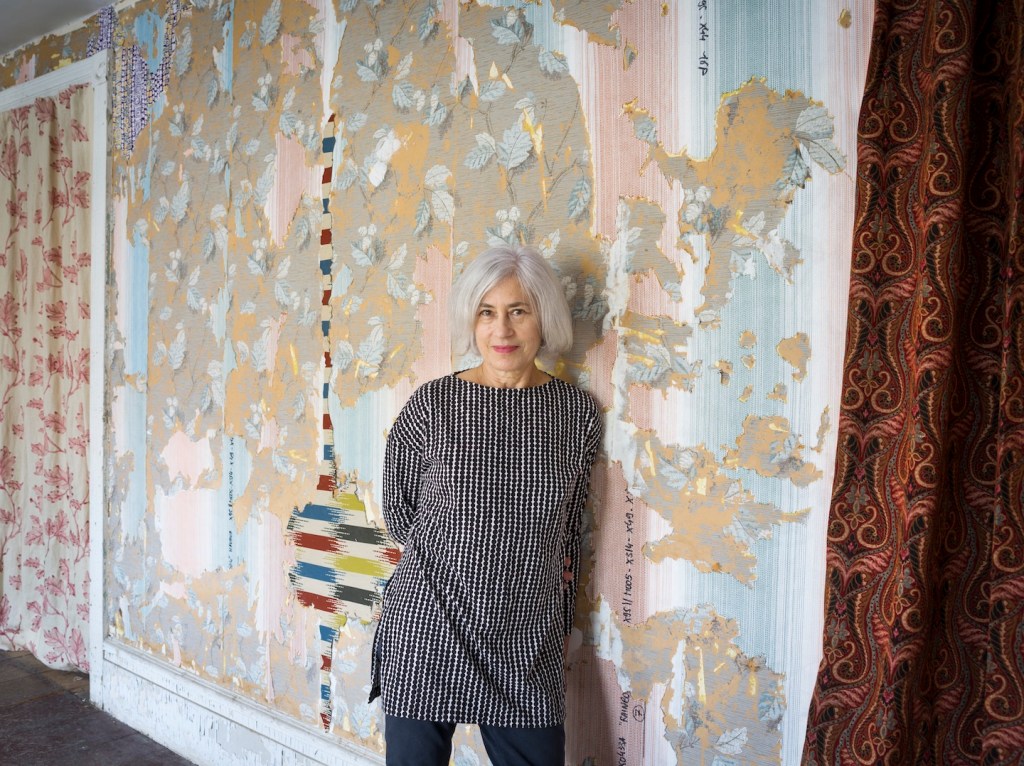
2021, at Fahrenheit 451 House
in Catskill, New York
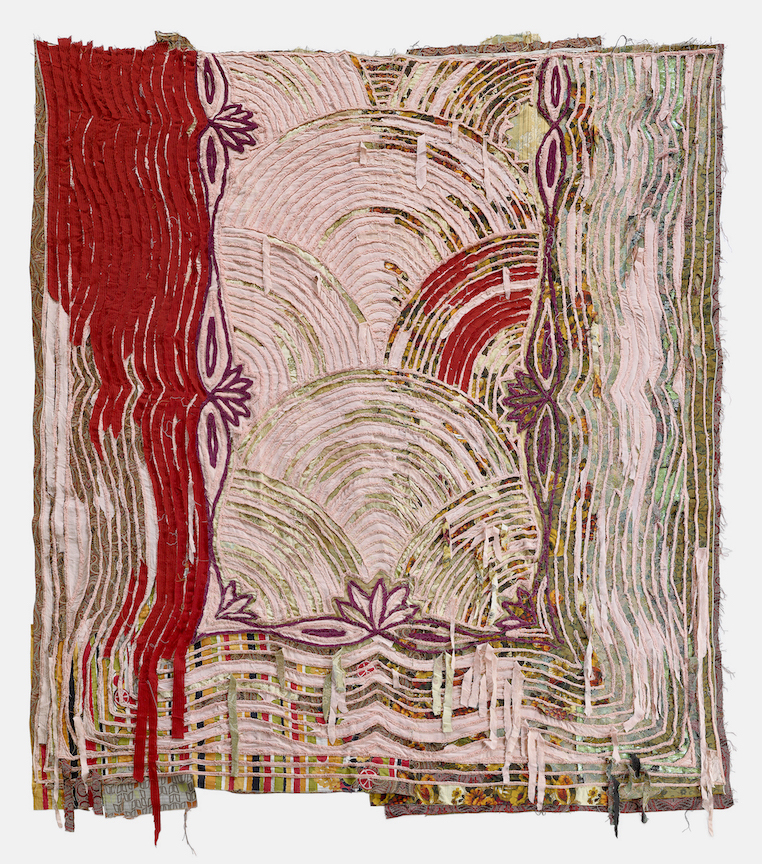
American Pastoral, 2021
Vintage chenille bedspread, mixed
textiles, sewing thread
Approximate dimensions
115 x 92 inches
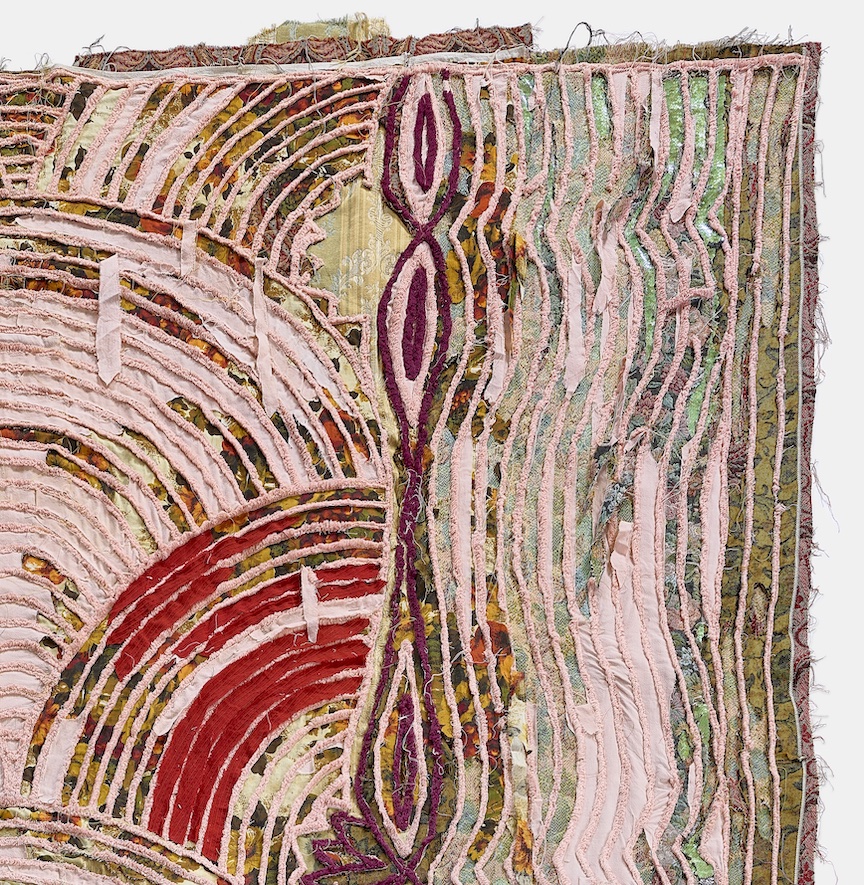
American Pastoral, 2021
Vintage chenille bedspread, mixed
textiles, sewing thread
Approximate dimensions
115 x 92 inches(detail)
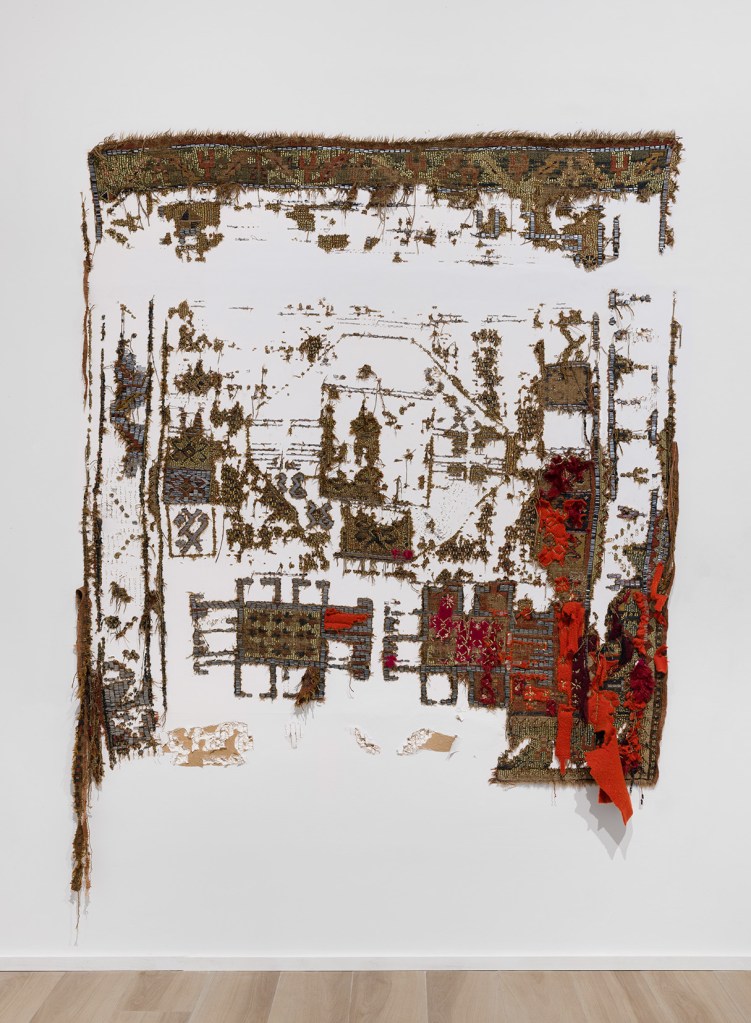
Untitled, from the
series “Civilization and
Its Discontents,” 2004
Wool carpet, mixed fabrics, staples
in gypsum on plywood panel
80 x 68 inches

Untitled, from the
series “Civilization and
Its Discontents,” 2004
Wool carpet, mixed fabrics, staples
in gypsum on plywood panel
80 x 68 inches (detail)
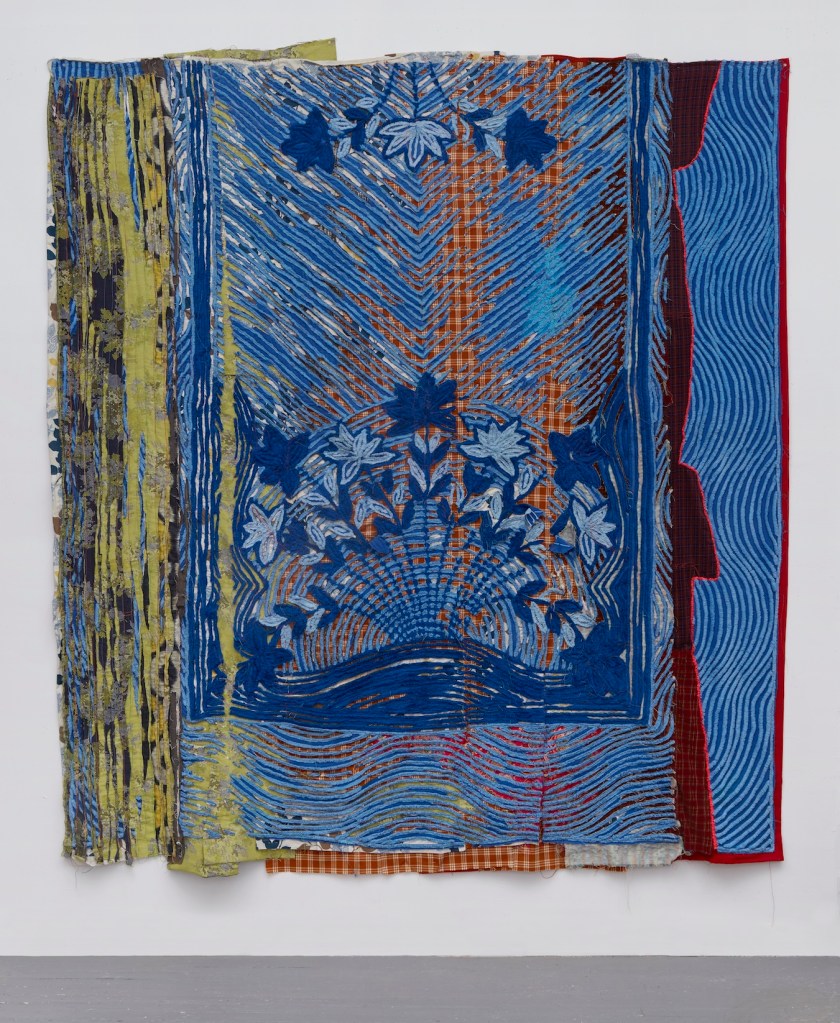
Forget Me Not, 2021,
Vintage chenille bedspread,
mixed textiles, embroidery floss,
sewing thread,
94 x 85 inches (detail)
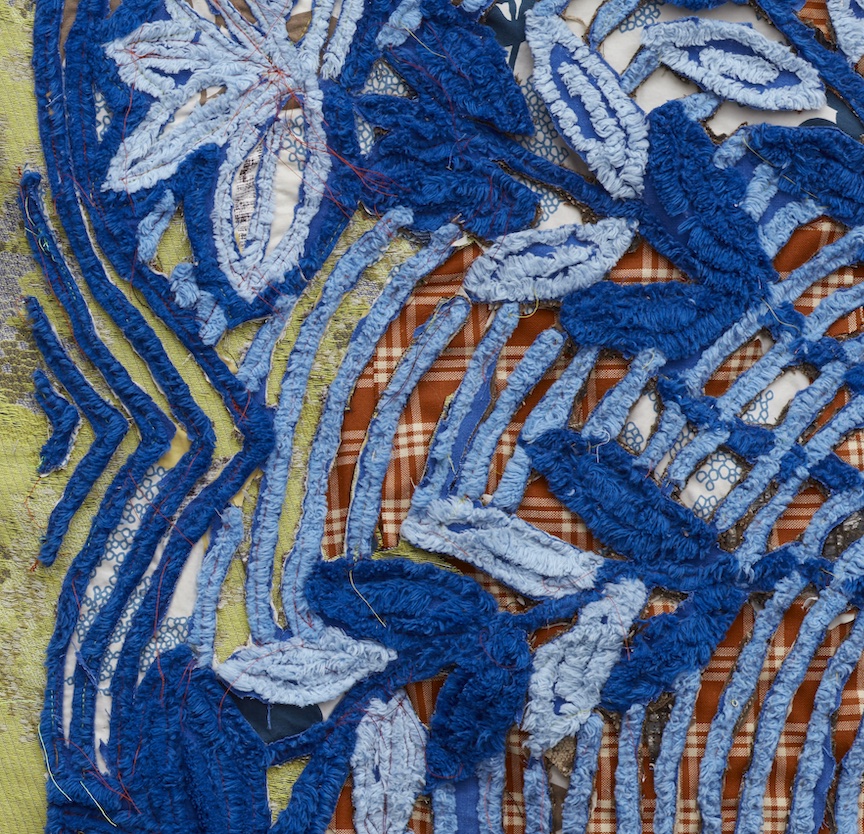
Forget Me Not, 2021,
Vintage chenille bedspread,
mixed textiles, embroidery floss,
sewing thread,
94 x 85 inches (detail)
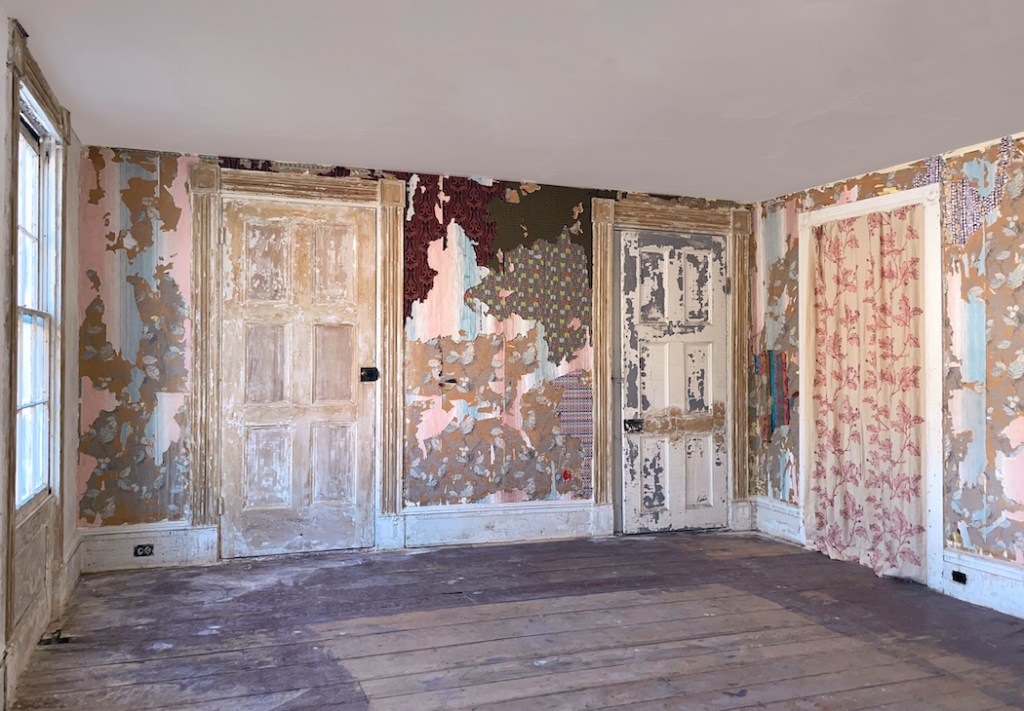
Local Color, 2021
Mixed textiles, hardware, and
adhesives
Installation view at Fahrenheit
451 House, Catskill, NY, 2021
Dimensions variable
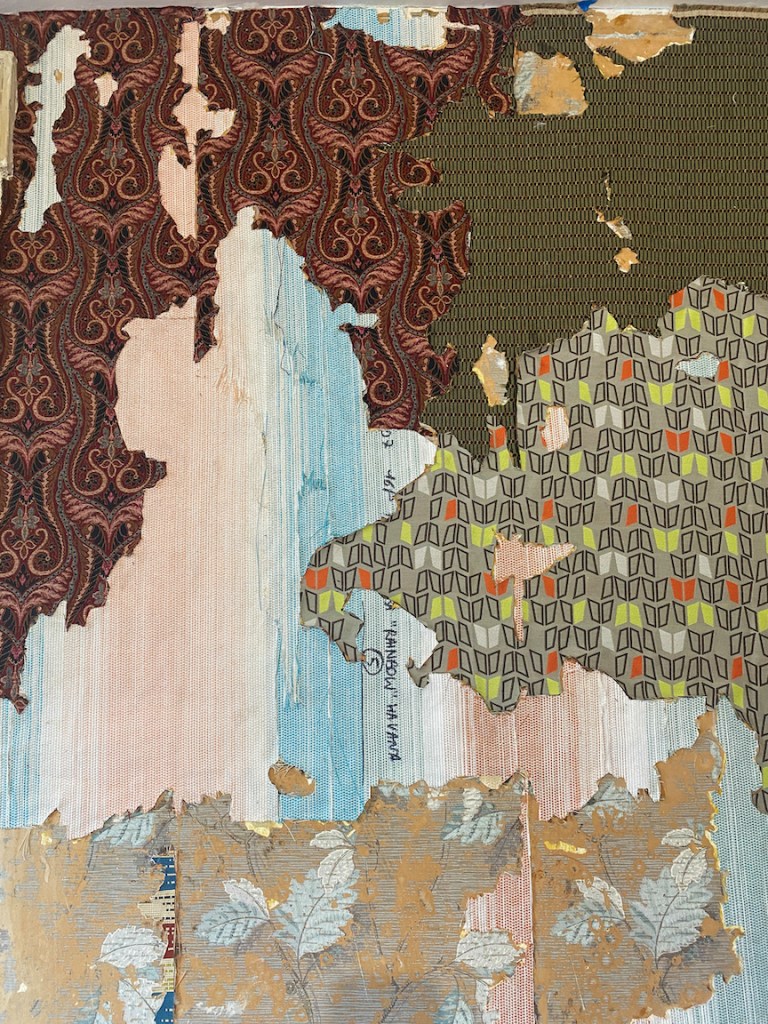
Local Color, 2021
Mixed textiles, hardware, and
adhesives
Installation view at Fahrenheit
451 House, Catskill, NY, 2021
Dimensions variable
(detail)

If a Tree…, 2022
Cut logs, mixed textiles, metal staples,
hardware, nylon cord, and miscellaneous
lumber Installation view at Cathouse
Proper, Brooklyn, NY, 2022
Dinesions variable
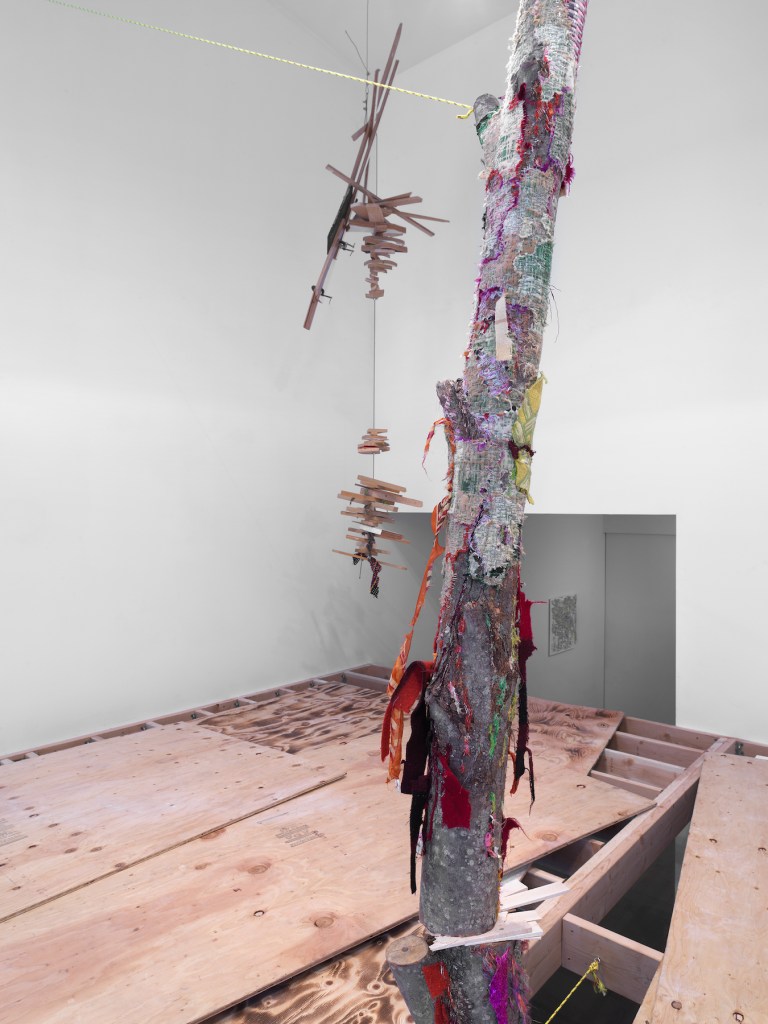
If a Tree…, 2022
Cut logs, mixed textiles, metal staples,
hardware, nylon cord, and miscellaneous
lumber Installation view at Cathouse
Proper, Brooklyn, NY, 2022
Dinesions variable (detail)
 paroladartista.com