
(▼scroll down for English version)
#paroladartista #intervistaartista #artistinterview #concettamodica
Parola d’Artista: Come nasce l’idea del viaggio di un sepalo di pomodoro per diventare stella? Mi sembra che in questo lavoro ci sia un forte aspetto alchemico/simbolico è così? Puoi parlarne?
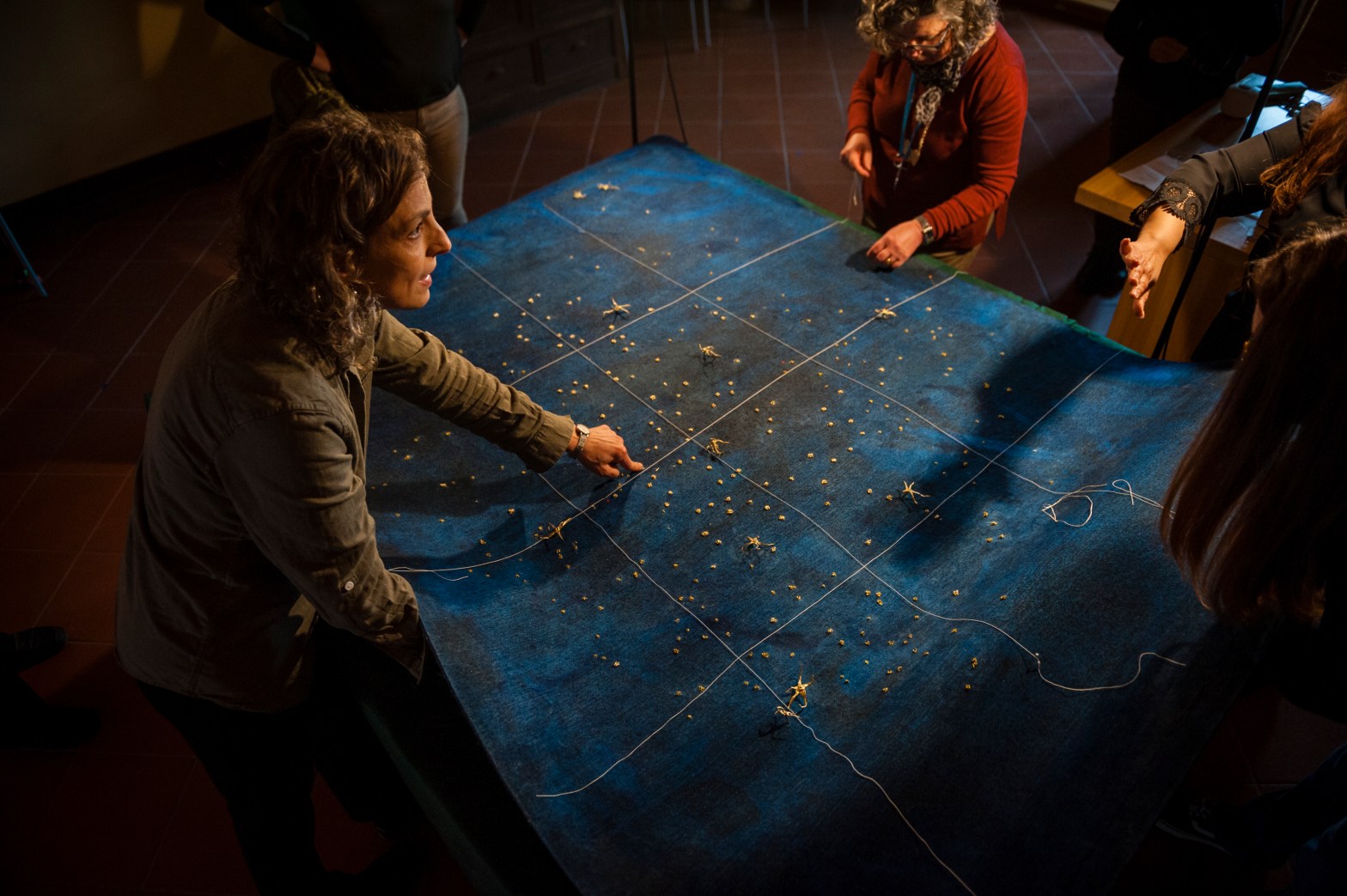
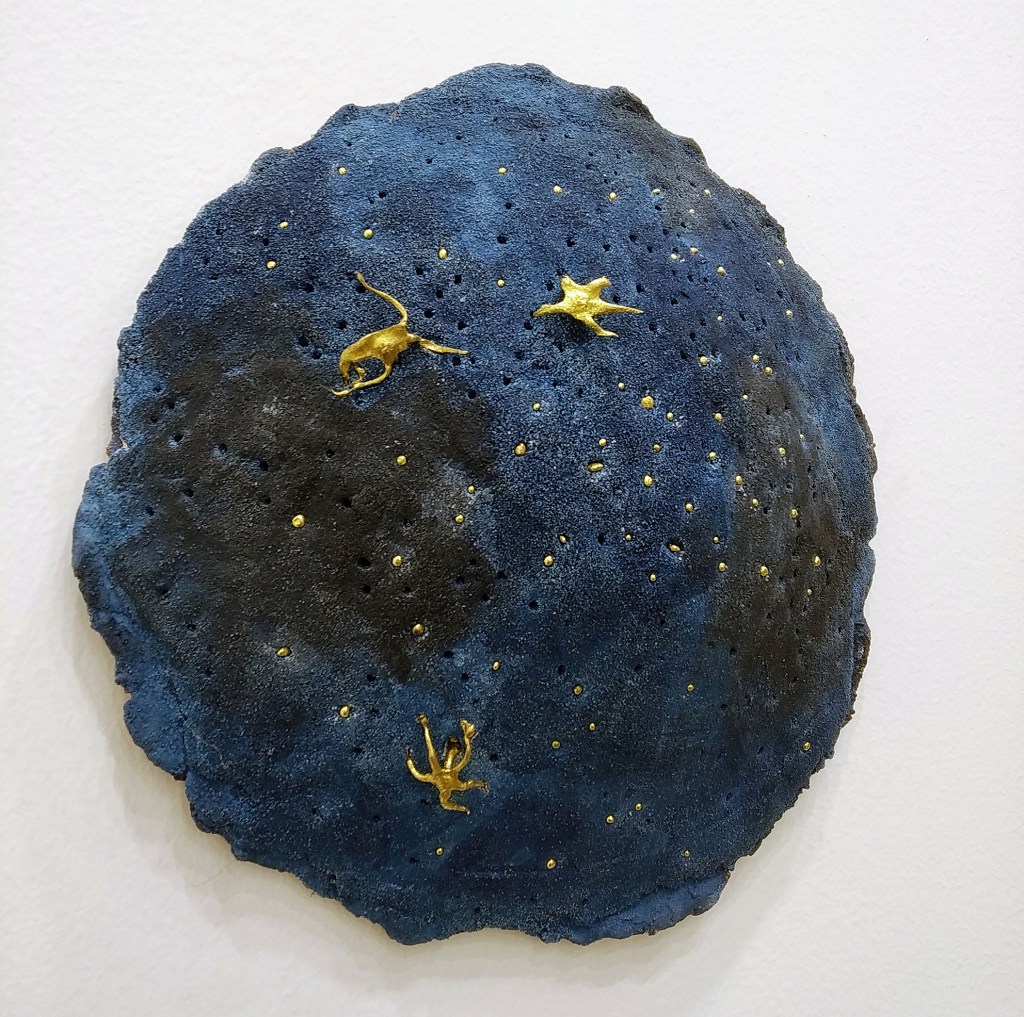
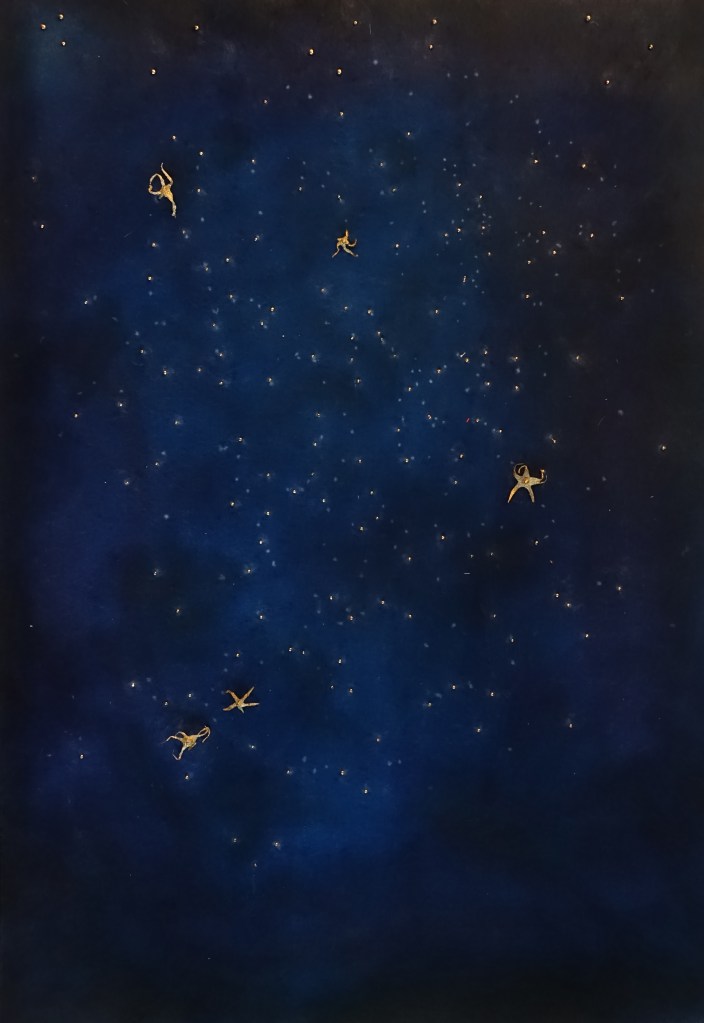
Concetta Modica: Il progetto è nato dopo un invito a un evento collaterale di Manifesta12 curato da Michela Eremita, Grand Tour en Italie e ovviamente l’idea di viaggio era il motivo ispiratore. Si parlava di migrazioni, nuovi tragitti e volevo immaginare un viaggio epico, di trasformazione di conoscenza. In quell’occasione ho elaborato questa metafora che poi mi ha seguito in molti altri lavori. E’ la storia di un sepalo, il picciolo verde da cui pende il pomodoro, e che è a forma di stella. Ho pensato che dalla sua forma un sepalo potesse desiderare di diventare il massimo, completamente diverso da sé, una stella. Ovviamente è un percorso iniziatico che vale per tutti. E’ la storia di un sogno che si avvera, una rinascita e ogni nascita ha bisogno di un suo giorno e un cielo natale da perpetuare. Per questo ho realizzato più mappe stellari, con sepali dorati che disegnano le costellazioni di una notte significativa per qualcuno o per una comunità. E’ proprio a questo che servono le mostre: ci si incontra, ci si confronta con temi, curatrici, altri artisti e artiste e si diventa ricche, il proprio lavoro si interseca e si muove.
P.d’A.: Questi lavori sono una serie e ciascuno è il ritratto di una notte precisa che porta il nome di una santa e alcuni hanno trovato una loro collocazione stabile in luoghi che hanno a che fare con il sacro. Hai in mente un programma preciso o la cosa avanza man mano che le occasioni si presentano? Racconta…
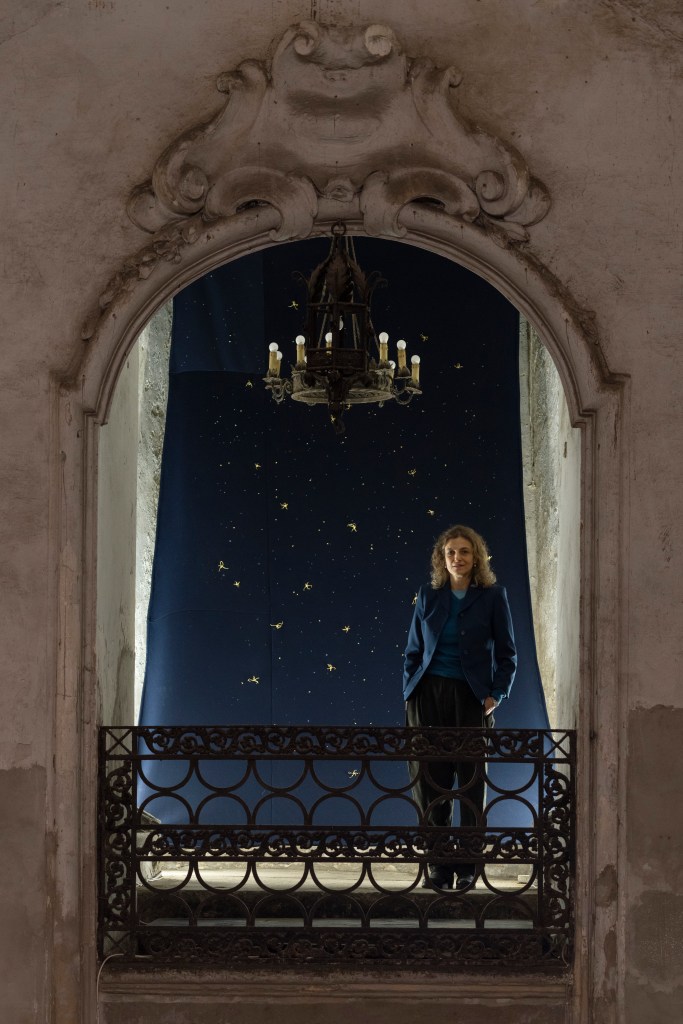
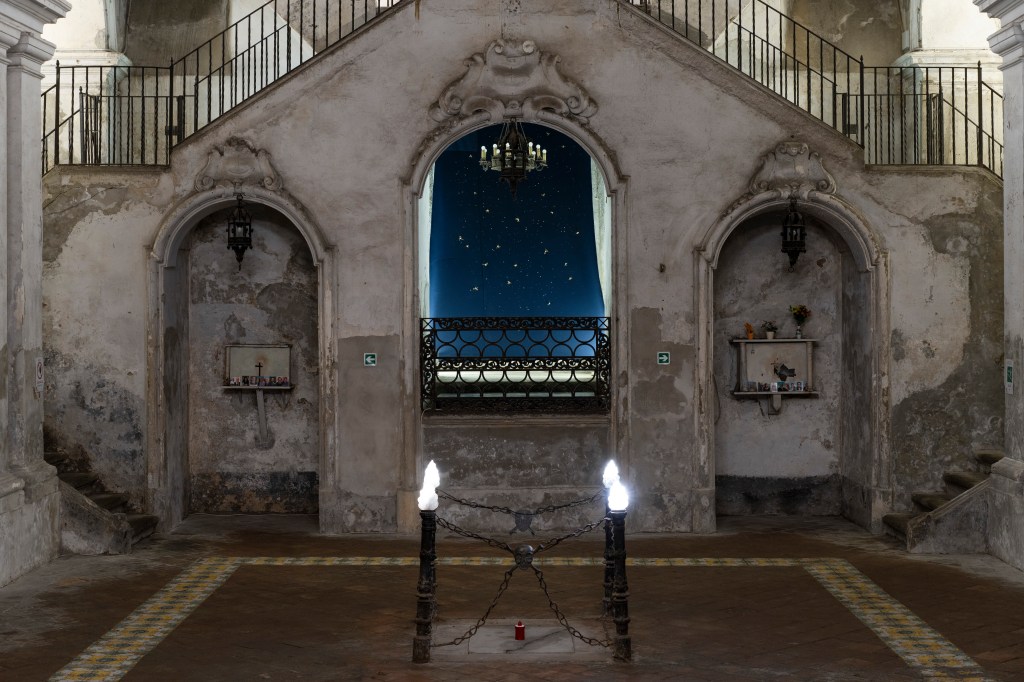
C.M.: Sono tanti ritratti di notti, è uscito anche un libro edito da Gli Ori per la collana I limoni curata da Pietro Gaglianò con 28 notti. Dopo questa pubblicazione sono nati dei lavori più grandi e più complessi con notti legate a delle Sante e a dei luoghi sacri. Ad esempio la collezione del Museo di Arte Sacra di Castelbuono, sulle Madonie presso Palermo, si è arricchita di un drappo di sepali che rappresentano la Notte di sant’Anna, ospitato in modo permanente, esposto di fianco alla cappella intitolata alla santa e decorata nel Settecento con stucchi dei fratelli Serpotta. Il progetto è stato curato da Valentina Bruschi ed ha vinto il Pac21. Più recentemente ho realizzato con i sepali un Drappo nella chiesa Inferiore del complesso delle Anime del Purgatorio ad Arco, a Napoli, a cura di Susanna Ravelli. Il drappo è dedicato ad una notte di santa Patrizia, il cui sangue si scioglie ogni martedì, eppure è meno noto di quello del santo patrono di Napoli che si liquefa una sola volta l’anno! Non ho in mente un programma preciso di luoghi, ma credo che acquistano potenza se si replicano in diversi luoghi e situazioni. Alcuni interventi li penso come opere permanenti. Mi interessano molto le vite delle sante e delle mistiche, le collego a una sorte di protofemminismo. Il tema del sacro nel contemporaneo fa sempre paura, ancor di più quello religioso. Religio deriva da religere, legare, e al di la della fede confessionale, si crea un legame con ciò che non si vede, con un mistero, con l’impossibilità di conoscere fino in fondo da dove veniamo e dove andiamo. Questo legame ci porta a pensieri diversi per ognuno, più narrativi o per immagini, più cinici o più spirituali, ha ispirato la storia dell’Arte Occidentale e credo sia interessante continuare a lavorarci.
P.d’A.: Per quanto riguarda l’idea di ritratto ti vorrei chiedere di spiegare meglio cosa intendi? Si tratta di un ritratto fotografico di quella precisa notte (riferendomi alla collocazione delle stelle) o è un lavoro più basato sulla suggestione?
C.M.: Ritratto, in latino indica l’azione di tirare fuori, prendere un’ immagine dalla realtà. Questa azione dà il senso della scelta. Scelgo date particolari e riproduco quel cielo riportando la posizione esatta delle stelle, inserendo fusioni in bronzo di sepali di pomodoro, dorati con foglia in oro zecchino. Con l’aiuto di programmi e astrofisici possiamo replicare il cielo e le posizioni delle stelle in quel giorno. Si riesce a risalire a notti e cieli anche molto lontani nel tempo. Trovare date significative che raccontano di eventi semplici che hanno influito su grandi cambiamenti. Questo trarre è nello stesso orizzonte epistemologico del ritratto, sia di un volto che di una volta del cielo. Non sempre riesco a riprodurre la posizione esatta delle stelle, ma non mi interessa essere così scientifica o sacrificare la resa artistica per quella astronomica. E’ comunque una geografia che è legata a una storia, una notte che diventa il ritratto di un luogo dove si svolge un evento e spesso con protagonista una donna. Non è una narrazione, ma un’istantanea.
Concetta Modica è nata a Modica, vive a Milano Lavora e studia sul presente e i suoi paradossi in particolare il concetto di epico contemporaneo. Il presente come quel che resta di qualcosa, come relazione con altri artisti, con la materia, con mezzi diversi che hanno sempre a che fare con la scultura. Tra le sue personali: Excoperta alla Gamec di Bergamo a cura di Giacinto di Pietrantonio e Alessandro Rabottini, One more time alla Galleria Umberto di Marino, Quel che resta a cura di Francesca Pasini per La quarta vetrina/Libreria delle donne Milano, Epico/Fragile a cura di Agata Polizzi, Segni per far fiorire vasi a cura di Ilaria Mariotti per Villa Pacchiani, Life is Everything a cura di Francesco Lucifora presso Das weisse haus a Vienna, Trilogia di Orlando a cura di Michela Eremita, progetto in più sedi tra cui Nottilucente, Spazio COSMO e Francesco Pantaleone arte contemporanea sua Galleria di riferimento. Ha partecipato a un evento parallelo di Manifesta 12 e uno di Manifesta 7 E’ cofondatrice del progetto RaccontoDi20. Ha partecipato a mostre in spazi pubblici e privati tra cui: American Academy in Rome, Galleria Biagiotti a Firenze, Vanessa Quang a Parigi, Fondazione Pistoletto a Biella, Fondazione Ratti a Como, Biennale Giovani Artisti del Mediterraneo, SerrOne a Monza, Botkyrka Konsthall a Stoccolma, Docva a Milano, Villa Romana a Firenze, Museo Riso a Palermo, Placentia Arte con cui ha installato un’opera permanente nei giardini Margherita di Piacenza. Tra le principali residenze alle quali ha partecipato: Madeinfilandia Pieve a Presciano (AR), Fondazione Antonio Ratti Como, Raumars Rauma Fìnlandia, Nuovo mecenatismo di Contrada, Contrada della Torre, Siena. Nel 2013 è uscito il suo libro In pasto al presente edito da A+Mbookstore di Milano. Il suo progetto la Notte di Sant’Anna è vincitore del PAC2021 premio di arte contemporanea indetto dal Ministero della Cultura. Nel 2023 ha partecipato alla Biennale di Chengdu ed è uscito il suo libro d’artista “28 notti”nella collana i Limoni per i tipi de “Gli Ori”.
English text
Three questions to Concetta Modica
#paroladartista #intervistaartista #artistinterview #concettamodica
Parola d’Artista: How did the idea of a tomato sepal’s journey to become a star come about? It seems to me that there is a strong alchemical/symbolic aspect to this work, is that right? Can you talk about it?
Concetta Modica: The project was born after an invitation to a Manifesta12 collateral event curated by Michela Eremita, Grand Tour en Italie, and obviously the idea of travel was the inspiration. There was talk of migrations, new routes and I wanted to imagine an epic journey, of transforming knowledge. On that occasion I came up with this metaphor, which then followed me in many other works. It is the story of a sepal, the green stalk from which the tomato hangs, and which is star-shaped. I thought that from its shape a sepal might want to become the ultimate, completely different from itself, a star. Obviously it is an initiatory path that applies to everyone. It is the story of a dream come true, a rebirth, and every birth needs its own day and a natal sky to perpetuate. That is why I have made more star maps, with golden sepals drawing the constellations of a significant night for someone or a community. This is exactly what exhibitions are for: you meet, you confront yourself with themes, curators, other artists and you become rich, your work intersects and moves.
P.d.A.: These works are a series and each one is a portrait of a specific night that bears the name of a saint and some have found their permanent location in places that have to do with the sacred. Do you have a precise programme in mind or does it progress as opportunities arise? Tell us.
C.M.: There are many portraits of nights, and a book published by Gli Ori for the I limoni series edited by Pietro Gaglianò came out with 28 nights. After this publication, larger and more complex works were born with nights linked to saints and sacred places. For example, the collection of the Museum of Sacred Art in Castelbuono, on the Madonie Mountains near Palermo, has been enriched with a drape of sepals representing the Night of Saint Anne, permanently displayed next to the chapel named after the saint and decorated in the 18th century with stucco work by the Serpotta brothers. The project was curated by Valentina Bruschi and won the Pac21. More recently, I made a drape with sepals in the lower church of the Anime del Purgatorio complex in Arco, Naples, curated by Susanna Ravelli. The drape is dedicated to one night of Saint Patrick, whose blood melts every Tuesday, yet it is less well known than that of the patron saint of Naples, which melts only once a year! I do not have a precise programme of locations in mind, but I believe they gain in power if they are replicated in different places and situations. Some interventions I think of as permanent works. I am very interested in the lives of saints and mystics, I connect them to a kind of proto-feminism. The theme of the sacred in the contemporary is always frightening, even more so the religious theme. Religio derives from religere, to bind, and beyond the confessional faith, a bond is created with what is unseen, with a mystery, with the impossibility of knowing fully where we come from and where we are going. This bond leads us to different thoughts for everyone, more narrative or in images, more cynical or more spiritual, it has inspired the history of Western Art and I think it is interesting to continue working on it.
P.d’A.: Regarding the idea of a portrait, I would like to ask you to explain better what you mean? Is it a photographic portrait of that precise night (referring to the placement of the stars) or is it a work more based on suggestion?
C.M.: Portrait in Latin means the action of pulling out, taking an image from reality. This action gives the sense of choice. I choose particular dates and reproduce that sky with the exact position of the stars, inserting bronze castings of tomato sepals, gilded with pure gold leaf. With the help of programmes and astrophysicists, we can replicate the sky and the positions of the stars on that day. We can trace back nights and skies even far in time. Finding significant dates that tell of simple events that affected great changes. This draw is on the same epistemological horizon as the portrait, whether of a face or a sky vault. I cannot always reproduce the exact position of the stars, but I am not interested in being so scientific or in sacrificing artistic rendering for astronomical rendering. It is, however, a geography that is linked to a story, a night that becomes the portrait of a place where an event takes place and often with a woman as the protagonist. It is not a narrative, but a snapshot.
Concetta Modica was born in Modica, lives in Milan She works and studies the present and its paradoxes, in particular the concept of the contemporary epic. The present as what remains of something, as a relationship with other artists, with matter, with different media that always have to do with sculpture. Among his solo exhibitions: Excoperta at Gamec in Bergamo curated by Giacinto di Pietrantonio and Alessandro Rabottini, One more time at Galleria Umberto in Marino, Quel che resta curated by Francesca Pasini for La quarta vetrina/Libreria delle donne Milan, Epico/Fragile curated by Agata Polizzi, Segni per far fiorire vasi curated by Ilaria Mariotti for Villa Pacchiani, Life is Everything curated by Francesco Lucifora at Das weisse haus in Vienna, Trilogia di Orlando curated by Michela Eremita, a project in several venues including Nottilucente, Spazio COSMO and Francesco Pantaleone arte contemporanea his Gallery of reference. He participated in a parallel event of Manifesta 12 and one of Manifesta 7. She is co-founder of the RaccontoDi20 project. She has participated in exhibitions in public and private spaces including: American Academy in Rome, Galleria Biagiotti in Florence, Vanessa Quang in Paris, Fondazione Pistoletto in Biella, Fondazione Ratti in Como, Biennale Giovani Artisti del Mediterraneo, SerrOne in Monza, Botkyrka Konsthall in Stockholm, Docva in Milan, Villa Romana in Florence, Museo Riso in Palermo, Placentia Arte with which she installed a permanent work in the Margherita Gardens in Piacenza. Among the main residencies in which he has participated: Madeinfilandia Pieve a Presciano (AR), Fondazione Antonio Ratti Como, Raumars Rauma Fìnlandia, Nuovo mecenatismo di Contrada, Contrada della Torre, Siena. 2013 saw the publication of his book In pasto al presente published by A+Mbookstore in Milan. His project la Notte di Sant’Anna won the PAC2021 contemporary art prize organised by the Ministry of Culture. In 2023, she participated in the Chengdu Biennial and his artist’s book “28 Nights” was published in the i Limoni series by Gli Ori.



 paroladartista.com