
#paroladartista #intervistaartista #artistinterview #italobressan
Parola d’Artista: Buongiorno Italo, spesso il percorso di un’artista affonda le sue radici nell’infanzia. È stato così anche per te?
Italo Bressan: Come molti ho iniziato a creare molto presto ma, se devo pensare a un ricordo, mi viene in mente un quadro che mi ha molto impressionato da piccolo. Era il Ritratto di Victor Chocquet (1875) di Paul Cezanne visto in riproduzione: un’opera espressionista con incarnati giallo-rossastri, la giacca di un blu molto intenso, i capelli scuri, realizzato con pennellate segniche e vigorose. Era materica e anti-naturalistica… mi ha molto colpito e stimolato. Poi mi ha “mosso” in generale la pittura dei grandi impressionsiti, Monet e Pissaro, certo anche Van Gogh e Gauguin, mentre sul versante del colore Seurat con la sua idea anche scientifica di scomposizione dei dati luminosi. Poi, andando avanti penso ai Fauves, Derain e Vlaminck, e gli espressionsti del Cavaliere Azzurro e del Brücke – Kandinskij, Marc, Kirchner. Poi Delaunay e l’orfismo e infine, fondamentale, Matisse che aveva già intuito il discorso della forma pura e del colore che, da elemento decorativo, può essere in grado di “produrre spazio”. Da quel primo colpo di fulmine, insomma, l’interesse si è strutturato.
Parola d’Artista:Dove è avvenuta la tua formazione?
Italo Bressan:È avvenuta a Milano dove risiedevo a partire dal 1962. Ho frequentato il liceo artistico e l’accademia, anche se ho trovato più formativi, per certi versi, gli esempi pratici della storia dell’arte.
Parola d’Artista:Che clima c’era nel mondo dell’arte in quegli anni e che influsso ha avuto sul tuo lavoro?
Italo Bressan:Vivendo a Milano dagli anni Sessanta, il clima era molto stimolante. C’erano incontri, conoscenze, un ambiente ricchissimo di mostre e gallerie, un’offerta amplissima difficile da enumerare. Ma sopratutto l’atmosfera, qualcosa di non descrivibile…
Parola d’Artista:Chi sono stati i tuoi compagni di strada e quali esperienze importanti hai condiviso con loro?
Italo Bressan:Anche in questo caso è difficile fare un elenco completo. Gli artisti che seguivo erano Rodolfo Aricò, Claudio Olivieri, Mario Raciti e Valentino Vago che erano anche più grandi biograficamente rispetto, per dire, a Gottardo Ortelli, di cui sono stato anche assistente a Brera. Poi Guido Ballo che è stato il mio professore e un riferimento per certi indirizzi storico-artistici e per i corsi che teneva a Brera. Lui ha seguito molto il mio lavoro all’inizio, mi ha coinvolto a livello didattico in Accademia, mi ha aiutato a relazionarmi con le prime gallerie. Tra le giovani generazioni di allora penso a compagni di strada come Davide Benati o Aldo Spoldi, eravamo molto diversi ma respiravamo la stessa aria, condividevamo molte cose tra il finire degli anni Settanta e gli anni Ottanta. C’era tutta una serie di possibilità e di contatti che offriva Milano in quegli anni e devo dire che gli artisti di quell’ambiente li ho conosciuti un po’ tutti…
Parola d’Artista:Nel tuo lavoro che importanza ha il binomio colore/spazio?
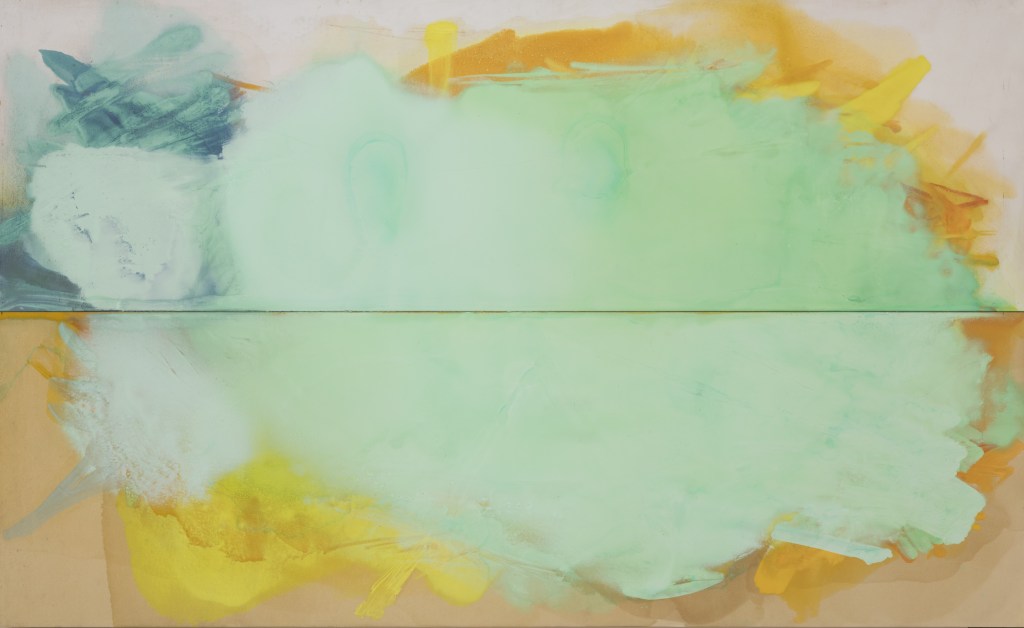
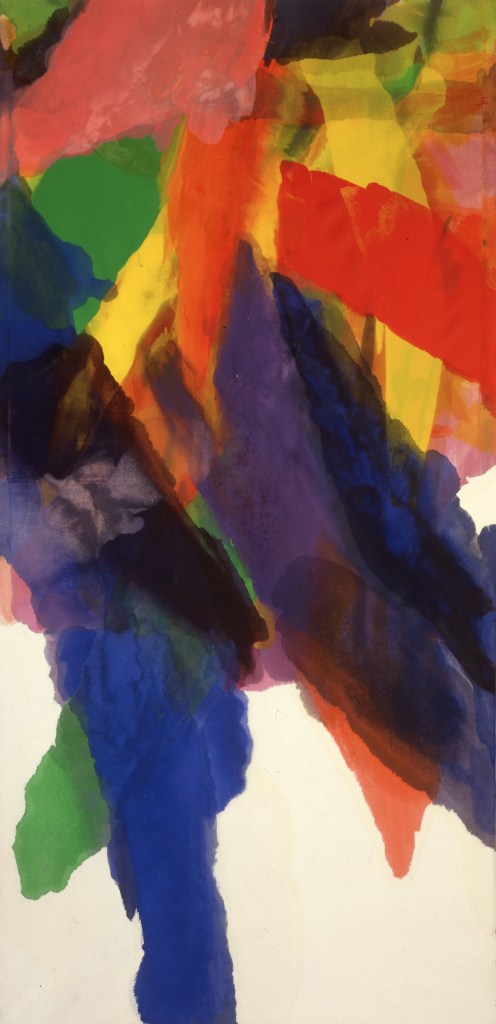
Italo Bressan:Direi che è fondamentale, il mio è un lavoro su forma e colore. Questi due elementi basilari determinano lo spazio della pittura e creano anche dei forti movimenti, delle tensioni. Insomma questo binomio è fondamentale…
Parola d’Artista:Lavori a più dipinti insieme o ti dedichi a un lavoro alla volta?
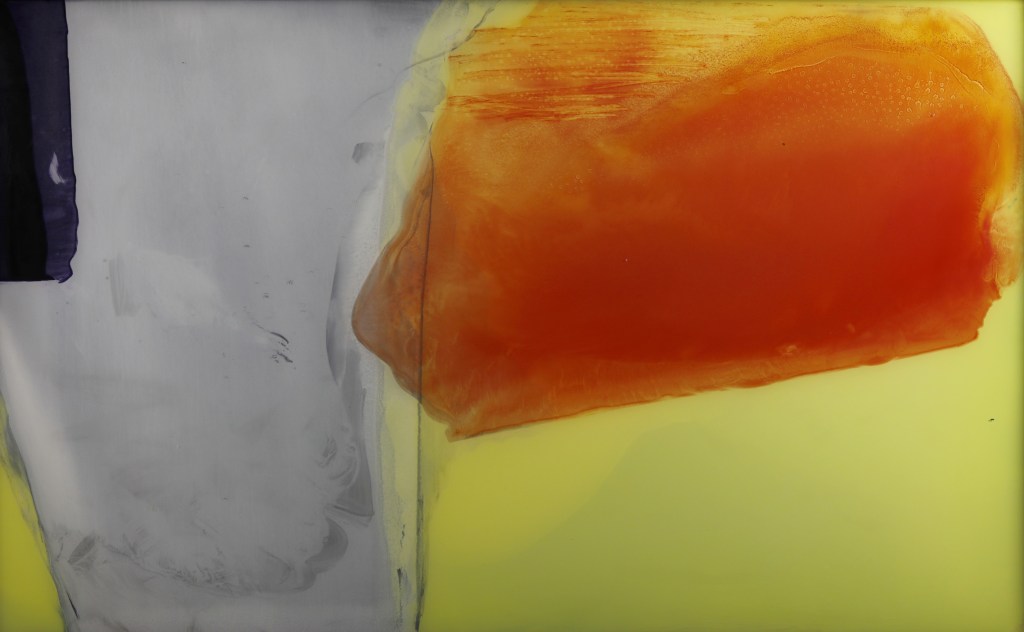
Italo Bressan:Lavoro a più opere contemporaneamente anche per il semplice fatto che, utilizzando una costruzione per velature e dipingendo a olio, ci sono tempi tecnici di asciugatura che non sono eludibili. Ho anche utilizzato gli acrilici ma poi, a un certo punto, sono tornato ai colori a olio. C’è quindi un tempo di attesa relativo alla tecnica stessa e, soprattutto, lavoro in piano, mai frontalmente, perché i miei colori sono sempre molto liquidi. Si allargano sulla superficie, sono fluidi, devono ampliarsi!
Parola d’Artista:Guardando ai tuoi lavori mi sembra di cogliere un’idea di sospensione. Che idea hai del tempo?
Italo Bressan:Credo che il tempo sia infinito, siamo noi a scandirlo sia a livello esistenziale che producendo degli oggetti che considero “presenze”. Queste presenze, a loro volta, diventano immagini, le nostre immagini. Allora io vedo il tempo come una cosa molto dilatata e, contestualmente, considero il tempo “vita delle forme”. Mi spiego: col mio lavoro nel tempo do vita a delle forme e, di conseguenza, a degli oggetti che hanno già conseguentemente una loro struttura formale. Siamo legati a questa dimensione del fluire, è la nostra condizione, vi siamo legati e la scandiamo con la nostra opera.
Mi pare che Marco Neri dicesse che la pittura è tempo che si fa spazio. Sono convinto di questa affermazione, si tratta proprio di un tempo che diventa spazio e che in qualche modo puoi anche misurare, un tempo che si può sviluppare in una struttura più ampia, dai caratteri persino architettonici, che si può abitare e percorrere, come negli ultimi quadri che sto realizzando. Questo può essere un elemento che caratterizza il mio lavoro recente: lo spazio dell’architettura, un’estensione congiunta di spazio e tempo.
Parola d’Artista:Che tipo di relazione cerchi con lo spettatore?
Italo Bressan:Certamente cerco una relazione, come tutti, ma non dai caratteri diretti, preferisco coinvolgere l’osservatore in una visione più mediata che parte sempre dall’immagine. È una cosa naturale, ha una sua normalità questa esigenza di contatto. Vorrei una complicità nella percezione che però deve essere necessariamente molto lenta, perché credo che le immagini della pittura si percepiscano lentamente a differenza di quelle del cinema, per fare un esempio. Lì si ha uno sguardo più veloce, di tipo cinetico. Qui devi, invece, “starci” un po’, e quindi di nuovo l’aspetto del tempo…
Parola d’Artista:Esiste nel tuo lavoro una tensione di tipo spirituale?
Italo Bressan:È essenziale, la tensione spirituale è quella che muove tutto, addirittura mette in moto anche un’energia che ha rapporti con la fisicità, ma sostanzialmente parte tutto da un’esigenza di tipo spirituale. In seguito arrivano tutti gli altri elementi concreti, la possibilità di muoversi, di fare certe azioni per produrre tutto questo: è corpo e mente. Perché in fondo hai da una parte l’immanenza e dall’altra la trascendenza. Poi in questo momento sto vivendo, se posso dare una definizione sul tipo di geometria che c’è nel mio lavoro (perché è molto presente l’elemento geometrico nei miei quadri, in certi tagli, in certe modularità e cesure), mi piace parlare di “sentimento della geometria”, quasi un ossimoro. “Sentimento della geometria” e “trascendenza del colore” sono i due elementi che cerco sempre di fondere assieme. Sono fondamentali e mi appartengono molto.
Parola d’Artista:Che idea hai della natura e che relazione hai con essa?
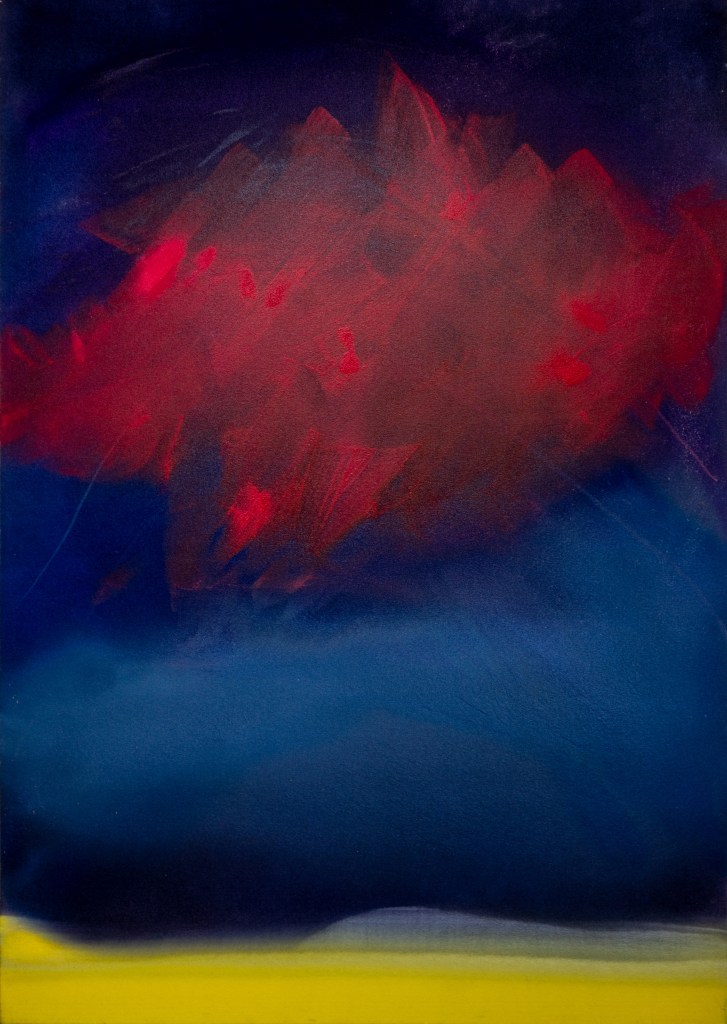
Italo Bressan:La natura è sicuramente un elemento importante della realtà ma proprio oggi riflettevo con alcuni amici artisti di quanto davanti alla sua bellezza ci si senta quasi in difficoltà, come ci fosse un portato talmente grande da inibire lo sguardo. Ormai c’è una fatica e un timore di fronte alla natura, non siamo più abituati ad avere un rapporto vero con essa, ne siamo quasi spaventati. Io cerco di averci un buon rapporto anche se non nascondo le mie difficoltà. Detto questo il mio lavoro è assolutamente anti-naturalistico. Anche se alcune immagini possono sembrare apparentemente molto “evocate”, non credo di citare la natura nello specifico, non è quello che mi interessa. Forse sono più interessato a un’idea di sublime romantico, ma un sublime, appunto, orrorifico che non è accettazione di una bellezza fine a se stessa ma, se mai, visione di un pericolo da distante, secondo la sua definizione tradizionale.
Questo discorso è proprio anti-naturalistico anche se sembra una contraddizione di termini. Non puoi non farti prendere da tutto ciò che è naturale, dall’elemento minerale di una pietra, da una vegetazione, da un cielo azzurro, dalle nuvole, non puoi essere indifferente a tutto ciò ma semplicemente non lo trasporti nel tuo lavoro.
Il problema per me ha a che fare con materia, colore, forma e segno, è tutta un’altra storia. Se c’è evocazione non è mimetica ma evocazione di una memoria che si ricostituisce e sedimenta continuamente.
Italo Bressan nasce a Vezzano, in provincia di Trento, nel 1950. Nel 1962 si trasferisce a Milano, dove
frequenta l’Accademia di Belle Arti di Brera, presso la quale si diploma nel 1974 e dove inizia a insegnare
Pittura nel 1983.
Nel 1992 ottiene la cattedra di Pittura all’Accademia Albertina di Torino e a partire dal 2002 torna a Milano,
all’Accademia di Brera, per ricoprire l’incarico di titolare del corso di Pittura. Attualmente vive e lavora tra
Milano e Trento.
Fin dalla metà degli anni Settanta, la sua ricerca si svolge attorno a una riflessione sugli elementi fondanti
della pittura: forma e colore. La forma si materializza attraverso il colore che è protagonista e costante fulcro
del suo lavoro: dato per stesure sovrapposte e per contrasti cromatici e luminosi, crea un senso di
trasparenza e una suggestione di vibrante sospensione.
Tra il 1985 e il 1987, Bressan indirizza la sua ricerca sulla componente strutturale del dipinto, nel quale si
intravedono, seppur sfuggenti, delle parti di disegno, che vanno a formare una specie di costruzione: solide
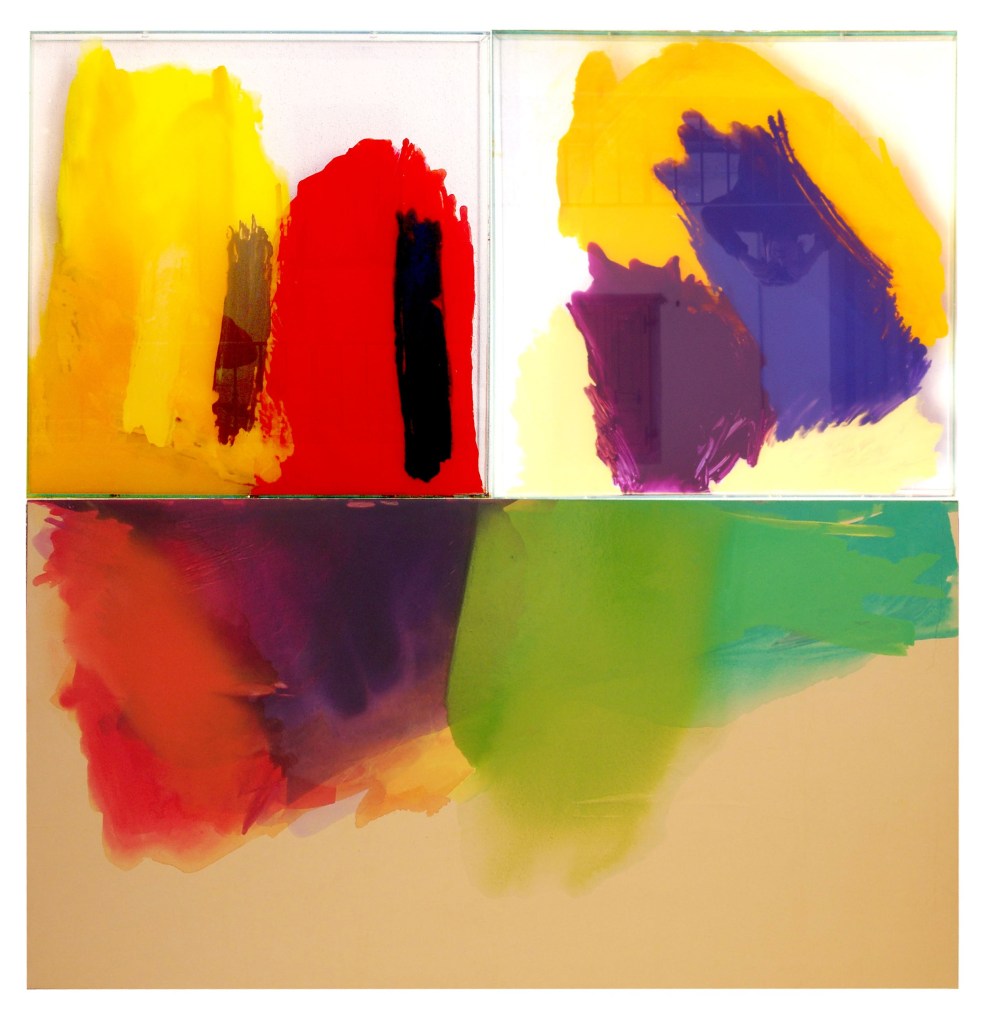
architetture, dai contorni apparentemente inesistenti, evidenziano il mutare del supporto, ottenuto
dall’assemblaggio di tele, tavole o vetri, che rendono ancora più articolato il rapporto dell’opera con lo spazio
e in cui le ombre assumono un ruolo primario. Il disegno è un’attività parallela che l’artista porta avanti in
maniera costante e autonoma rispetto alla produzione pittorica.
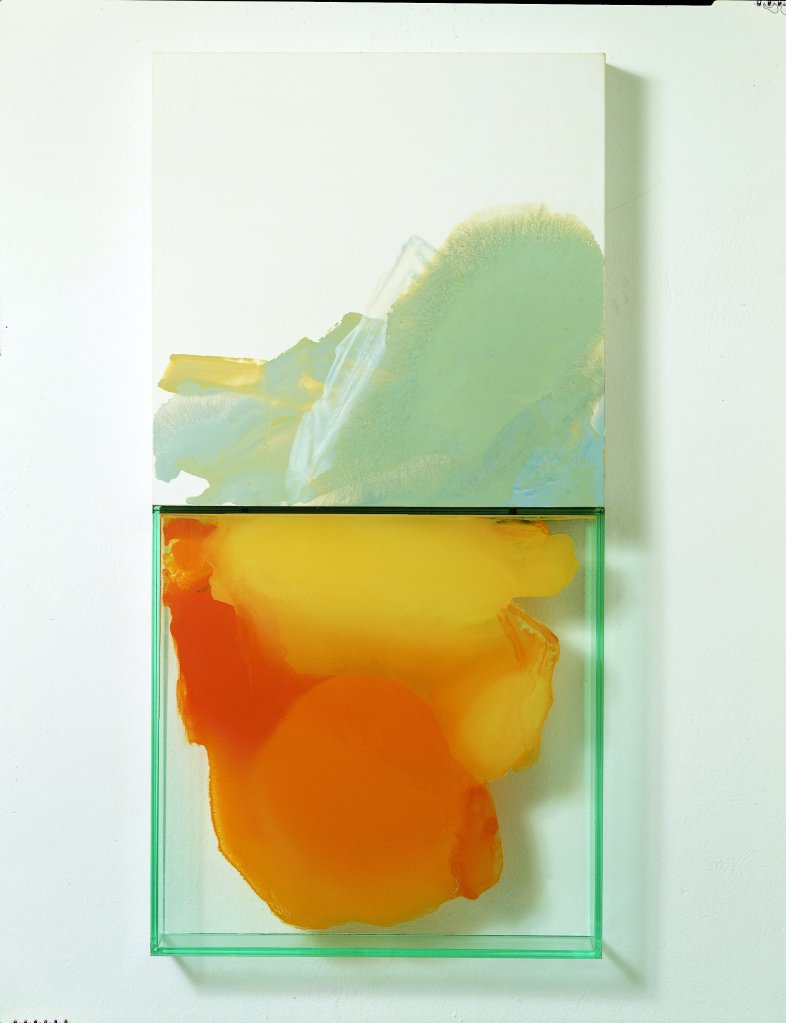
La poetica dell’artista insegue i contrasti tra negativo e positivo, tra sotto e sopra e tra luce e ombra, che
diventano predominanti verso la fine degli anni Novanta, in particolare in quei lavori dove l’utilizzo
contestuale di carta e vetro nel supporto rafforza il contrasto coloristico e il concetto di doppio e di
opposizione.
L’attenzione ai materiali e alla loro interazione definisce tre momenti all’interno della produzione di Bressan e
allo stesso tempo delinea il filo rosso della sua ricerca: dalla pittura su tavola, l’artista passa alla pittura su
vetro, per poi approdare negli ultimi anni all’utilizzo di garze e veli. Dal 2016 in particolare l’uso del tulle, un
materiale a lui caro da sempre, caratterizzerà una serie di opere intitolata Anime, che convogliano riflessioni
e rimeditazioni sulle sue opere precedenti.
Nel corso della sua carriera, l’artista ha esposto in numerose mostre personali e importanti rassegne: , tra
cui Linee della Ricerca in Italia 1960/1980 al Palazzo delle Esposizioni di Roma, l’XI Quadriennale di Roma
(1986) e la 54 a Biennale di Venezia (2011), nel Padiglione Lombardia a Palazzo Te a Mantova, curato da
Vittorio Sgarbi; le sue opere sono state presentate in esposizioni collettive organizzate da prestigiose
istituzioni, come il Kunstverein di Francoforte, il Forum di Amburgo, il Grand Palais di Parigi, la Galleria
Kodama di Osaka, lo Yuzi Paradise di Shangai, l’Istituto di Cultura di Los Angeles, il PAC di Milano,
University of Sidney di Sidney, University Art Museum di Brisbane, il Museo di Arte Contemporanea di
Cavalese, la Galleria Civica di Modena, la Fondazione Bevilacqua La Masa di Venezia, la Galleria Civica e
Palazzo delle Albere di Trento, il Palazzo della Permanente di Milano, la Galleria d’Arte Moderna di Bologna,
la Casa del Mantegna a Mantova. Ha inoltre partecipato a importanti fiere d’arte, tra cui Art Basel nel 1989 e 1992.
Principali Mostre personali:
1973 Studio Occhio, Milano – 1974 Studio Modern Art, Milano –1976 Icaro e la disobbedienza, Galleria
Soligo, Roma -1978 Studio Ennesse, Milano; –1979 Studio Ennesse, Milano; Galleria Plurima 1, Udine –
1981 Studio Ennesse, Milano – 1982 Galleria Zona, Firenze; Studio Tre Architettura, Milano –1983 Galleria
Dossi; Bergamo; Galleria Lorenzelli, Milano –1985 Galleria Pero, Milano –1986 Galleria Mèta, Bolzano;
Galleria Rossanaferri, Modena –1987 IV Festival Arte- Musica-Teatro, Villa Faraldi (IM) – 1988 Galleria
Stevens, Padova; Galleria Rossanaferri, Modena; Galleria Peccolo, Livorno; Antonio Violetta & Italo
Bressan, Studio G7, Bologna; Valente Arte Contemporanea, Finale Ligure; Galerie Dohmen, Frankfurt –
1989 Galleria 2 E, Suzzara (MN); Forum ’89-Valente Arte Contemporanea, Hamburg; Studio Fornaresio,
Torino – 1990 Galerie Am See, Zug; Galleria Paola Stelzer, Trento; Galleria Mèta, Bolzano; Profili, Raccolta
del Disegno Contemporaneo, Galleria Civica, Modena –1991 Decouvertes’91 Grand Palais, Valente Arte,
Paris – 1992 Galerie Kreiter Kuhnt, Mainz – 1993 Galerie Zellweger, Basel; Galleria Montrasio, Monza –
1996 Italo Bressan Galleria Civica d’Arte Contemporanea, Trento; Galleria Il Salto del Salmone, Torino –
1997 Galerie Nothburga, Innsbruck – 1998 Galerie Untermturm, Stuttgard – 2000 Galleria Arte 92, Milano;
Galleria d’arte Il Cenacolo, Trento – 2001 Università degli Studi, Facoltà di Economia, Trento – 2004
Galleria Arte 92, Milano; Palazzo Libera, Villa Lagarina (TN) – 2005 Frankfurter Westend Galerie, Frankfurt
am Main – 2008 Italo Bressan espone per Camelot, Milano – 2009 Galleria Goethe, Bolzano – 2015 Nuovi
Alfabeti, a cura di C. Cerritelli, Studio Masiero, Milano – 2016 Arclinea, Bruxelles; Trasognata visione,
Galleria Disegno, Mantova – 2017 Anime, MAG Museo Alto Garda, a cura di Daniela Ferrari, Riva Del Garda
– 2018 Il tempo – le forme, a cura di Gabriele Lorenzoni Castello di Kastelbel (BZ) – 2019 Della luce
nell’ombra, a cura di Claudio Cerritelli, Biblioteca dell’Accademia di Brera, Milano. – 2020 Galleria Monopoli, Milano. – 2022 Galleria Paolo Tonin TO; – 2023 Galleria Disegno Mantova; Sentimento della geometria, trascendenza del colore, La seconda luna, Laives (Bz).
English version
Interview to Italo Bressan
#paroladartista #intervistaartista #artistinterview #italobressan
Parola d’Artista: Good morning Italo, often the path of an artist is rooted in childhood. Was that the case for
you?
Italo Bressan: Like many, I started creating at a very early age, but if I have to think of a memory, I think of a
painting that impressed me a lot as a child. It was Paul Cezanne’s Portrait of Victor Chocquet (1875)
seen in reproduction: an expressionist work with reddish-yellow complexions, the jacket of a very intense blue
intense, dark hair, painted with vigorous, sign-like brushstrokes. It was textural and anti-naturalistic… I was
impressed and stimulated me a lot. Then I was ‘moved’ in general by the painting of the great impressionists, Monet and
Pissaro, certainly also Van Gogh and Gauguin, while on the colour side Seurat with his even scientific idea of
scientific idea of breaking down light data. Then, moving on, I think of the Fauves, Derain and Vlaminck, and the
expressionists of the Blue Rider and the Brücke – Kandinsky, Marc, Kirchner. Then Delaunay and Orphism and
finally, and crucially, Matisse who had already grasped the discourse of pure form and colour which, from a
decorative element, can be able to ‘produce space’. From that first stroke of lightning, in short,
the interest has been structured.
Parola d’Artista: Where did your training take place?
Italo Bressan:It took place in Milan where I lived from 1962. I attended art school and the academy, although
although I found the practical examples of art history more formative in some ways.
Parola d’Artista:What was the climate in the art world in those years and what influence did it have on your work?
Italo Bressan:Living in Milan since the 1960s, the climate was very stimulating. There were encounters, acquaintances, an environment full of exhibitions and galleries, a very wide range that is difficult to enumerate. But above all the atmosphere, something that cannot be described…
Parola d’Artista:Who were your fellow travellers and what important experiences did you share with them?
Italo Bressan:Again, it is difficult to make a complete list. The artists I followed were Rodolfo Aricò, Claudio Olivieri, Mario Raciti and Valentino Vago, who were even greater biographically than, say, Gottardo Ortelli, whose assistant I also was at Brera. Then Guido Ballo who was my professor and a reference for certain art-historical directions and for the courses he held at Brera. He followed my work a lot at the beginning, he involved me didactically in the Academy, he helped me relate to the first galleries. Among the younger generations of that time I think of fellow travellers like Davide Benati or Aldo Spoldi, we were very different but we breathed the same air, we shared many things between the late 1970s and the 1980s. There was a whole series of possibilities and contacts that Milan offered in those years and I must say that I got to know the artists of that environment a little bit…
Parola d’Artista:How important is the combination of colour and space in your work?
Italo Bressan:I would say it is fundamental, mine is a work on form and colour. These two basic elements determine the space of the painting and also create strong movements, tensions. In short, this combination is fundamental…
Parola d’Artista:Do you work on several paintings together or do you dedicate yourself to one work at a time?
Italo Bressan:I work on several works at the same time also for the simple fact that, using a glaze construction and painting in oils, there are technical drying times that cannot be avoided. I have also used acrylics but then, at some point, I returned to oil paints. So there is a waiting time relative to the technique itself and, above all, I work flat, never frontally, because my colours are always very liquid. They spread over the surface, they are fluid, they have to expand!
Parola d’Artista:Looking at your works, I seem to get an idea of suspension. What is your idea of time?
Italo Bressan:I believe that time is infinite, it is we who mark it both on an existential level and by producing objects that I consider ‘presences’. These presences, in turn, become images, our images. So I see time as something very dilated and, at the same time, I consider time the ‘life of forms’. Let me explain: with my work in time, I give life to forms and, consequently, to objects that already consequently have their own formal structure.
We are bound to this dimension of flowing, it is our condition, we are bound to it and we scan it with our work.
I think Marco Neri said that painting is time that becomes space. I am convinced of this statement, it is really a matter of time that becomes space and that you can even measure in some way, a time that can develop into a larger structure, even architectural in character, that you can inhabit and walk through, as in the latest paintings that I am making. This may be an element that characterises my recent work: the space of architecture, a joint extension of space and time.
Parola d’Artista:What kind of relationship do you seek with the viewer?
Italo Bressan:Certainly I seek a relationship, like everyone else, but not a direct one, I prefer to involve the viewer in a more mediated vision that always starts with the image. It is a natural thing, this need for contact has its own normality. I would like a complicity in perception, which however must necessarily be very slow, because I believe that the images of painting are perceived slowly unlike those of cinema, to give an example. There you have a faster, kinetic type of gaze. Here, on the other hand, you have to ‘stay there’ for a while, and so again the aspect of time…
Parola d’Artista:Is there a spiritual tension in your work?
Italo Bressan:It is essential, the spiritual tension is what moves everything, it even sets in motion an energy that has relations with physicality, but basically everything starts from a spiritual type of need. Then come all the other concrete elements, the possibility of moving, of doing certain actions to produce all this: it is body and mind. Because basically you have immanence on one side and transcendence on the other. Then in this moment I am living, if I can give a definition on the type of geometry that there is in my work (because the geometric element is very present in my paintings, in certain cuts, in certain modularities and caesuras), I like to speak of “feeling of geometry”, almost an oxymoron. “Feeling of geometry” and “transcendence of colour” are the two elements that I always try to fuse together. They are fundamental and belong to me a lot.
Parola d’Artista: What idea do you have of nature and what relationship do you have with it?
Italo Bressan:Nature is certainly an important element of reality, but just today I was reflecting with some artist friends on how much in front of its beauty one almost feels in difficulty, as if there were such a great burden that it inhibits one’s gaze. By now there is a fatigue and fear in the face of nature, we are no longer used to having a real relationship with it, we are almost frightened of it. I try to have a good relationship with it even if I don’t hide my difficulties. Having said that, my work is absolutely anti-naturalistic. Even though some images may seem very ‘evocative’, I don’t think I mention nature specifically, that’s not what interests me. Perhaps I am more interested in an idea of the romantic sublime, but a sublime that is, in fact, horrific, which is not an acceptance of beauty for its own sake but, if anything, a vision of danger from afar, according to its traditional definition.
This discourse is precisely anti-naturalistic even if it seems a contradiction in terms. You cannot help but be taken in by all that is natural, by the mineral element of a stone, by vegetation, by a blue sky, by clouds, you cannot be indifferent to all that, but you simply do not bring it into your work.
Italo Bressan was born in Vezzano, in the province of Trento, in 1950. In 1962 he moved to Milan, where he
attended the Brera Academy of Fine Arts, from which he graduated in 1974 and where he began teaching painting in 1983. Painting in 1983. In 1992, he obtained the chair of Painting at the Accademia Albertina in Turin and returned to Milan in 2002, at the Brera Academy, to hold the chair of the Painting course. He currently lives and works between Milan and Trento. Since the mid-1970s, his research has revolved around a reflection on the fundamental elements of painting: form and colour. Form is materialised through colour, which is the protagonist and constant focus of his work: given by superimposed layers and by chromatic and luminous contrasts, it creates a sense of transparency and a suggestion of vibrant suspension. Between 1985 and 1987, Bressan directed his research into the structural component of the painting, in which one glimpses, albeit fleeting, of drawing parts, which form a kind of construction: solid architectures, with apparently non-existent contours, highlight the changing support, obtained by the by the assembly of canvases, boards or glass, which further articulate the work’s relationship with space and in which shadows assume a primary role. Drawing is a parallel activity that the artist pursues in constant and autonomous manner with respect to pictorial production. a, Laives (Bz). The artist’s poetics pursue the contrasts between negative and positive, between below and above and between light and shadow, which become predominant towards the end of the 1990s, particularly in those works where the contextual use of contextual use of paper and glass in the support reinforces the colouristic contrast and the concept of double and opposition. The focus on materials and their interaction defines three moments within Bressan’s production and Bressan’s production and, at the same time, outlines the red thread of his research: from painting on wood, the artist moves on to painting on glass, and then glass, before moving in recent years to the use of gauze and veils. Since 2016 in particular the use of tulle, a material material that has always been dear to him, will characterise a series of works entitled Anime, which convey reflections and reconsiderations of his previous works. Over the course of his career, the artist has exhibited in numerous solo shows and important exhibitions: , including including Linee della Ricerca in Italia 1960/1980 at the Palazzo delle Esposizioni in Rome, the 11th Rome Quadriennale (1986) and the 54th Venice Biennale (2011), in the Padiglione Lombardia at Palazzo Te in Mantua, curated by Vittorio Sgarbi; his works have been presented in group exhibitions organised by prestigious institutions, such as the Kunstverein in Frankfurt, the Forum in Hamburg, the Grand Palais in Paris, the Gallery Kodama in Osaka, the Yuzi Paradise in Shanghai, the Institute of Culture in Los Angeles, the PAC in Milan, University of Sidney in Sidney, University Art Museum in Brisbane, the Museum of Contemporary Art in Cavalese, the Galleria Civica in Modena, the Fondazione Bevilacqua La Masa in Venice, the Galleria Civica and Palazzo delle Albere in Trento, the Palazzo della Permanente in Milan, the Galleria d’Arte Moderna in Bologna, the Casa del Mantegna in Mantua. He has also participated in major art fairs, including Art Basel in 1989 and 1992.
Main solo exhibitions:
1973 Studio Occhio, Milano – 1974 Studio Modern Art, Milano –1976 Icaro e la disobbedienza, Galleria
Soligo, Roma -1978 Studio Ennesse, Milano; –1979 Studio Ennesse, Milano; Galleria Plurima 1, Udine –
1981 Studio Ennesse, Milano – 1982 Galleria Zona, Firenze; Studio Tre Architettura, Milano –1983 Galleria
Dossi; Bergamo; Galleria Lorenzelli, Milano –1985 Galleria Pero, Milano –1986 Galleria Mèta, Bolzano;
Galleria Rossanaferri, Modena –1987 IV Festival Arte- Musica-Teatro, Villa Faraldi (IM) – 1988 Galleria
Stevens, Padova; Galleria Rossanaferri, Modena; Galleria Peccolo, Livorno; Antonio Violetta & Italo
Bressan, Studio G7, Bologna; Valente Arte Contemporanea, Finale Ligure; Galerie Dohmen, Frankfurt –
1989 Galleria 2 E, Suzzara (MN); Forum ’89-Valente Arte Contemporanea, Hamburg; Studio Fornaresio,
Torino – 1990 Galerie Am See, Zug; Galleria Paola Stelzer, Trento; Galleria Mèta, Bolzano; Profili, Raccolta
del Disegno Contemporaneo, Galleria Civica, Modena –1991 Decouvertes’91 Grand Palais, Valente Arte,
Paris – 1992 Galerie Kreiter Kuhnt, Mainz – 1993 Galerie Zellweger, Basel; Galleria Montrasio, Monza –
1996 Italo Bressan Galleria Civica d’Arte Contemporanea, Trento; Galleria Il Salto del Salmone, Torino –
1997 Galerie Nothburga, Innsbruck – 1998 Galerie Untermturm, Stuttgard – 2000 Galleria Arte 92, Milano;
Galleria d’arte Il Cenacolo, Trento – 2001 Università degli Studi, Facoltà di Economia, Trento – 2004
Galleria Arte 92, Milano; Palazzo Libera, Villa Lagarina (TN) – 2005 Frankfurter Westend Galerie, Frankfurt
am Main – 2008 Italo Bressan espone per Camelot, Milano – 2009 Galleria Goethe, Bolzano – 2015 Nuovi
Alfabeti, a cura di C. Cerritelli, Studio Masiero, Milano – 2016 Arclinea, Bruxelles; Trasognata visione,
Galleria Disegno, Mantova – 2017 Anime, MAG Museo Alto Garda, a cura di Daniela Ferrari, Riva Del Garda
– 2018 Il tempo – le forme, a cura di Gabriele Lorenzoni Castello di Kastelbel (BZ) – 2019 Della luce
nell’ombra, a cura di Claudio Cerritelli, Biblioteca dell’Accademia di Brera, Milano. – 2020 Galleria Monopoli, Milano. – 2022 Galleria Paolo Tonin TO; – 2023 Galleria Disegno Mantova; Sentimento della geometria, trascendenza del colore, La seconda luna, Laives (Bz).

 paroladartista.com