
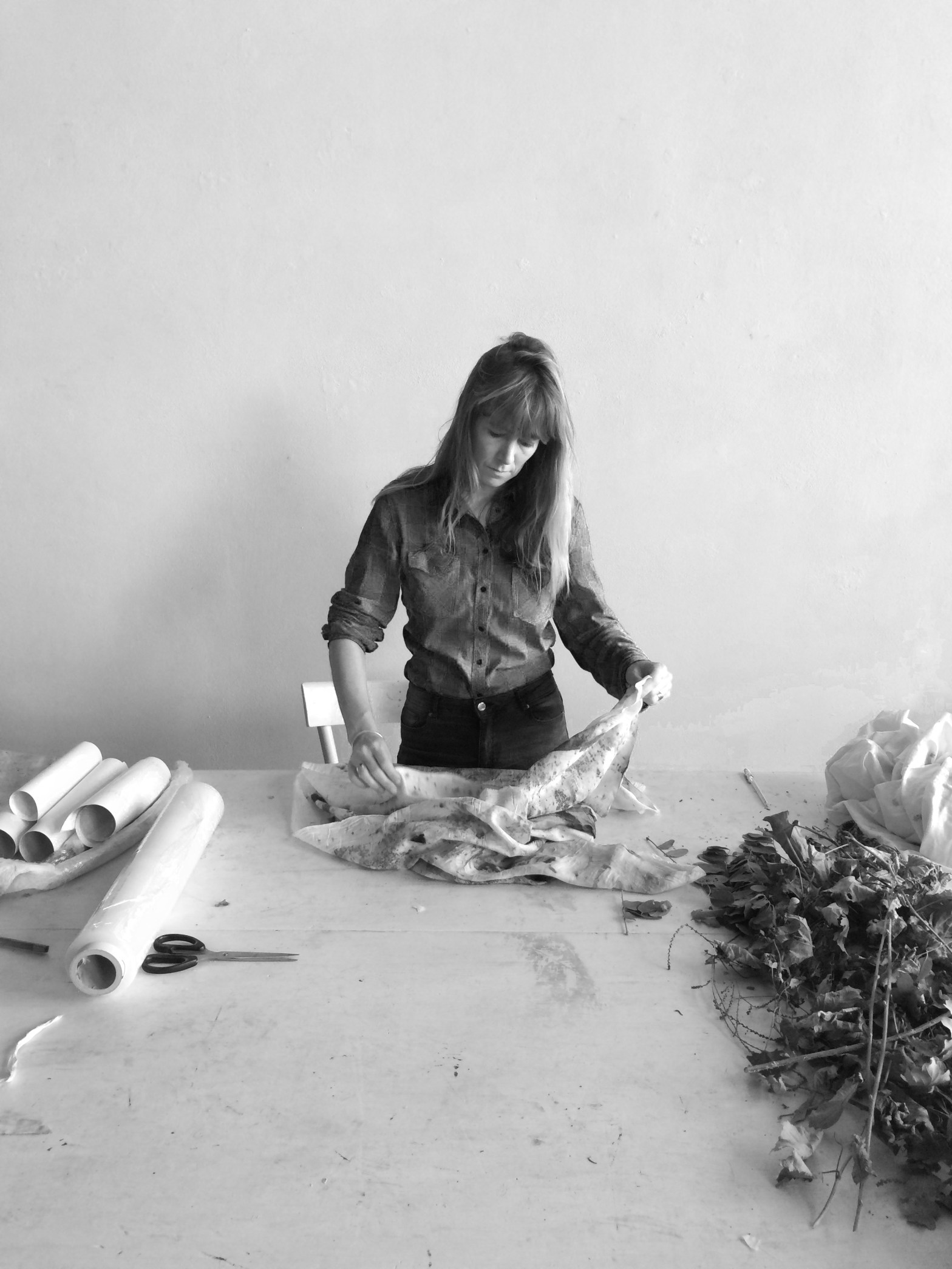
#paroladartista #intervistaartista #rachelmorellet
Parola d’Artista: Per la maggior parte degli artisti l’infanzia rappresenta l’età dell’oro, quella in cui cominciano a manifestarsi i primi sintomi di una certa propensione ad appartenere al mondo dell’arte. E’ stato così anche per te? Racconta?
Rachel Morellet : Esattamente, è stato cosi per me, e qui coesistono due fattori. Sono sempre stata una persona molto osservatrice, che fa poche domande ma che guarda, che sente, ascolta e percepisce il mondo e le persone. Ho sempre amato disegnare e da piccola mi ricordo di avere ricevuto complimenti davanti alle mie creazioni. Il mio bisnonno Charles Morellet era poeta e stimava molti pittori e scultori, spesso illustravano le sue pubblicazioni e credo che averli nel suo entourage gli piacevano di più della pittura stessa. L’influenza del mio nonno, l’artista François Morellet fu decisiva per la mia relazione sia con le multiple fasi della creazione, sia con il mondo dell’Arte. È considerato come uno dei maggiori attori dell’astrazione geometrica e precursore del minimalismo, tuttavia non ha mai cercato di indirizzarmi o suggerirmi una linea da seguire, mi lasciava totale libertà. Non ha mai cercato di convincermi a diventare un artista professionale e spesso, anche quando incontrava studenti, era più propenso a scoraggiarli d‘intraprendere una carriera d’artista, sapendo che è molto difficile vivere della propria arte. Poi l’influenza del mio padre e del mio zio, entrambi artisti, della mia madre che studiò storia dell’arte, è stato un valore aggiunto al clima artistico che mi piaceva tanto. Quindi sarò stata io a innamorarmi dell’arte, a scegliere di percorrere questa strada perché ho la vena artistica? Oppure sono artista perché fortemente indirizzata dal contesto familiare?
Saranno entrambe le cose.
Parola d’Artista: Nel tuo caso è proprio una questione che viene dal sangue. Sei riuscita a vivere questa eredità con leggerezza o qualche volta il suo peso si fa sentire?
Rachel Morellet : È un’eredità importante, infatti ha preso molto spazio nella mia vita, come dicevo prima. Nella piccola e media età ero prevalentemente ammirativa e curiosa di vedere tutta quest’arte intorno a me. Incontrai artisti famosi in Francia e a New-York dove vive il mio zio. Allo stesso tempo seguivo un corso di disegno e pittura in un atelier privato. Nelle classi più grandi, al liceo, ero fiera e cominciai a essere certa di voler fare un mestiere che avesse a che fare con l’arte. Una volta, collaborai con il mio nonno illustrando un suo catalogo che presentava una serie di opere realizzate con tubi al neon. Poi studiai storia dell’arte all‘università, un modo per lasciarmi del tempo per trovare la giusta via professionale da intraprendere, sapevo che non volevo entrare alla scuola di Belle Arti, dove formano artisti. Poi un pomeriggio, guardando la televisione, trasmettevano un reportage sul restauro e la riproduzione delle sculture di marmo. Mi venne allora l’idea di entrare alla scuola Nazionale di Restauro di Avignone. Lì imparai tante cose, oltre a non essere separata dagli artisti perché la scuola aveva la stessa sede dell’Accademia di Belle Arti. La scuola era famosa per aver al suo interno questa ricchezza di scambi tra il patrimonio artistico del passato da preservare, e quello di domani ancora da creare.
Un altro aspetto importante di quelli anni fu che, proprio accanto alla scuola, traslocò una parte della collezione privata del gallerista Yvon Lambert, uno dei maggiori promotori dell’arte contemporanea a Parigi dagli anni 70 ad oggi. Piu di quattrocento opere firmate dai più grandi artisti dovevano essere traslocate da Parigi a Avignone, e per me lavorare su questo materiale fu una chance formidabile. Quando arrivai a pensare alla tesi ero indecisa, mi sembrava un pò pretenzioso parlare del mio nonno, ma tanti mi convinsero dicendomi che nessuno meglio di me avrebbe potuto farlo. Decisi quindi di fare una ricerca, il più possibile esaustiva, sui materiali da lui usati durante gli anni, su tutti i processi di creazione nel suo atelier, su come sperasse che le sue opere fossero conservate, restaurate ecc. Questo mi era possibile grazie all’immenso archivio che aveva creato la mia nonna fin dall’inizio della carriera del suo marito, e perché avevo una relazione privilegiata con loro, cosa che un altro studente o un’altra studentessa non avrebbe potuto fare. Oggi che lui non c’è più, la sua opera va preservata in tutti i modi. Il posto che occupa in famiglia e nella storia dell’arte è molto importante e si può pensare che faccia ombra all’artista che sono, ma lo vivo più come una chance che bisogna saper cogliere e cosciente che da restauratrice e erede sono destinata a relazionarmi sempre di più con la sua opera.
Quindi per quanto riguarda la mia carriera artistica non mi sono mai fatta illusioni, la barra è molto alta. Una lezione importante che ho imparato è non prendersi troppo sul serio, è importante studiare, fare e perseverare il più a lungo che ci è possibile, perché creare ci procura del piacere. L’arte non è altro che il miscuglio del principio di realtà con il principio di piacere?
Parola d’Artista: Durante gli anni di studio oltre a quelli che hai già raccontato ci sono stati altri incontri importanti?
Rachel Morellet : Una persona importante per me è stato il mio professore di pittura, Michel Zevort. Mi ha insegnato molto sulla pittura a olio e le sue tecniche. Insieme realizzammo un progetto di finzione durante il festival di Avignone. Avevamo creato e aperto al pubblico il finto studio di un falsario scappato di fretta perché ricercato dalle autorità. Avevo allestito interamente una stanza in cui il falsario di nome Pierre Verlak viveva e lavorava. La finzione era stata studiata nei minimi dettagli per fare sembrare la storia vera; il suo diario, articoli di giornali, i dipinti che copiava, lo stato della stanza abbandonata di fretta, il suo ritratto, ecc…Il pubblico rimase molto colpito.
Parola d’Artista: Avignone è una città straordinariamente attiva sul piano culturale penso al Festival del Teatro per esempio questo contesto ha avuto delle ricadute sul tuo lavoro?
Rachel Morellet : Si, Avignone si trasforma durante il mese di luglio, diventa un groviglio di gente e spettacoli. Ne vidi parecchi in cinque anni ma non mi ha particolarmente influenzato credo. L’aspetto artistico performativo non si adegua alla mia personalità anche se lo apprezzo. Invece fui colpita dalle mostre che il Palazzo dei Papi ospitava. È un edificio incredibile per le sue dimensioni e la sua sobrietà. È unico nel suo genere, le opere allestite al suo interno acquistano un’aura diversa, la luce, l’acustica, tutto rende l’esperienza completa. Il pubblico viene avvolto dalle opere, le vive. Forse questo mi ha portato a essere ancora più esigente nel modo di allestire una mostra.
Fu anche importante per me l’anno 2000 in cui Avignone fu nominata Capitale Europea della Cultura grazie al progetto La Beauté in fabula curata da Jean De Loisy. Per questa occasione la città intera fu allestita da giugno a settembre con opere visive e progetti artistici degli artisti contemporanei più famosi o promettenti. Ovviamente noi studenti siamo stati i primi ad avere l’opportunità di partecipare agli allestimenti e ad assistere gli artisti. Tra queste opportunità e i montaggi delle mostre alla Collection Y. Lambert sono stati anni ricchi di incontri.
Parola d’Artista: Dopo gli studi come vanno avanti le cose?
Rachel Morellet : Prima di finire i cinque anni di formazione alla scuola di restauro il destino mi portò in Toscana, dove mi sono trasferita appena laureata. Avevo intenzione di proseguire la ricerca che avevo fatto sul mio nonno per la tesi, e applicarla all’opera di altri artisti affermati. Contattai Maurizio Nannucci e Giuseppe Penone, che risposerò molto gentilmente alla mia richiesta, ma poi il lavoro non fu terminato per ragioni di troppi impegni. Sul consiglio di Maurizio Nannucci contattai il Centro per l’Arte Contemporanea Luigi Pecci e nel giro di qualche mese incontrai l’allora direttore Daniel Soutif. Cominciò una collaborazione, che perdura ancora oggi. Con il Centro intervengo come restauratrice, per le mostre e la collezione permanente. Ad oggi lavoro in questo settore con istituzioni, gallerie e privati con sede in Francia, Svizzera, Italia, Lussemburgo e Stati Uniti.
In parallelo ho fondato e gestito dal 2014 al 2020, insieme a Pamela Gori, l’associazione culturale Artforms con sede a Prato, impegnata nella promozione di eventi legati alle arti visive. Cominciò quindi a organizzare eventi, a invitare artisti, a curare gli allestimenti e ad occuparmi della promozione dell’associazione stessa.
La mia attività come artista è cominciata nel 2005 qui in Toscana e da allora si è estesa in diversi paesi. Devo dire che negli ultimi anni cerco di ricollegarmi con la Francia, il mio paese di origine.
Oltre al mio percorso in solitario, amo molto collaborare e questo mi ha portato a realizzare diversi lavori a quattro mani o più, e ad entrare in collettivi di artisti come FAMA (Four Artists for a Metastable Art), Valentina Lapolla, Eva Sauer, Tatiana Villani e io stessa. Tema principale : la metastabilità o le forme aperte e in trasformazione, siano esse personali, collettive, politiche, tecniche o scientifiche.
Toccaunotoccatutti, un collettivo aperto, operativo soprattutto sul territorio Pratese, con l’intento di mettere in luce attraverso l’arte, le condizioni di sfruttamento dei lavoratori nelle fabbriche.
Imboscata, un progetto intento a promuovere l’arte contemporanea in ambienti boschivi a cura di Shilha Cintelli, Eva Sauer, Enrico Vezzi e me stessa.
Parola d’Artista: L’idea di comunità di scambio e di condivisione tra artisti non è affatto semplice da coltivare molti artisti preferiscono stare nel loro guscio senza uscire dalla loro “confort zone” e da li fanno la loro piccola strategia… Quali sono sulla base della tua esperienza i punti fondamentali per arrivare ad una buona pratica di condivisione ?
Rachel Morellet : Si, non è facile per tutti. Credo che sia una questione di carattere, per riuscire a collaborare è necessario non avere troppe aspettative e non amare la competizione. Collaborare è come collegarsi con la frequenza dell’altro o del gruppo, come fanno spesso gli animali in gregge e in branco; si tratta di sintonizzazione della specie. Ovviamente possono esserci dei momenti o periodi in cui siamo poco in sintonia o prevale l’io ma l’intesa si può ristabilire parlando. Oltre a questo è necessario che ci sia nel gruppo una certa libertà di presenza e di impegno pur mantenendo l’appoggio che richiede un lavoro di scambio.
Parola d’Artista: Ti volevo chiedere di parlare del tuo lavoro “En Forme” e di raccontare come è nato e come anche in questo caso tu abbia cercato una dinamica di relazione con un gruppo di persone.
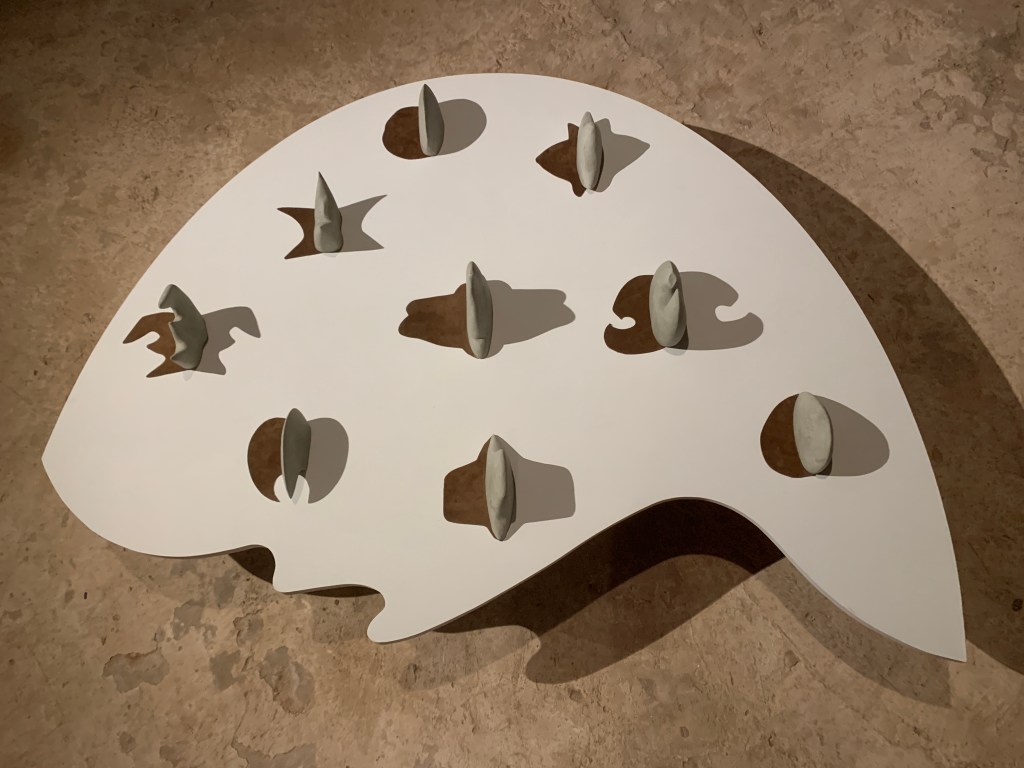
Rachel Morellet : L’opera esplora il confine tra la forma e la materia ed è nata durante l’anno 2020, mentre vigevano le regole di isolamento che conosciamo tutti. Decisi di prendere in mano qualche chilo di argilla che conservavo da mesi, e alcuni disegni che avevo fatto nel 2014. Mi misi ad inventare e a dare forma a diciassette sculture diverse, “per via di levare” la materia, processo che di solito in ceramica viene fatto “per via di porre”.
La situazione particolare mi portò a cercare un confronto esterno e allo stesso tempo a stimolare l’immaginario collettivo davanti alle forme astratte che producevo. Utilizzai a questo proposito i social media, chiedendo alle persone di darmi un titolo ogni volta che svelavo una scultura. Sono stati cosi raccolti 426 titoli in un libretto (edizione firmata di 20 esemplari numerati).
Date le condizioni di isolamento e non avendo un forno per cuocere le ceramiche, decisi di lasciarle crude.
La consistenza della terra cruda e liscia mi portò a inserire un altro elemento al lavoro: una pelle di mucca, che appesa al muro ripropone le forme delle sculture attraverso la loro assenza e con una leggera deformazione data dalla natura del materiale. Le forme in pelle, estratte e posizionate sotto le sculture, diventano invece le loro ombre, che poi si sdoppiano grazie a un gioco di luce.
L’insieme è accompagnato da una serie di disegni creati con acqua e residui di polvere di argilla che levai durante la creazione delle sculture. La serie si propone come la risposta grafica alla giustapposizione delle diciassette forme delle sculture con le altre restanti, in totale 136 combinazioni.
Parola d’Artista: Ti interessa l’aspetto ludico nel tuo lavoro?
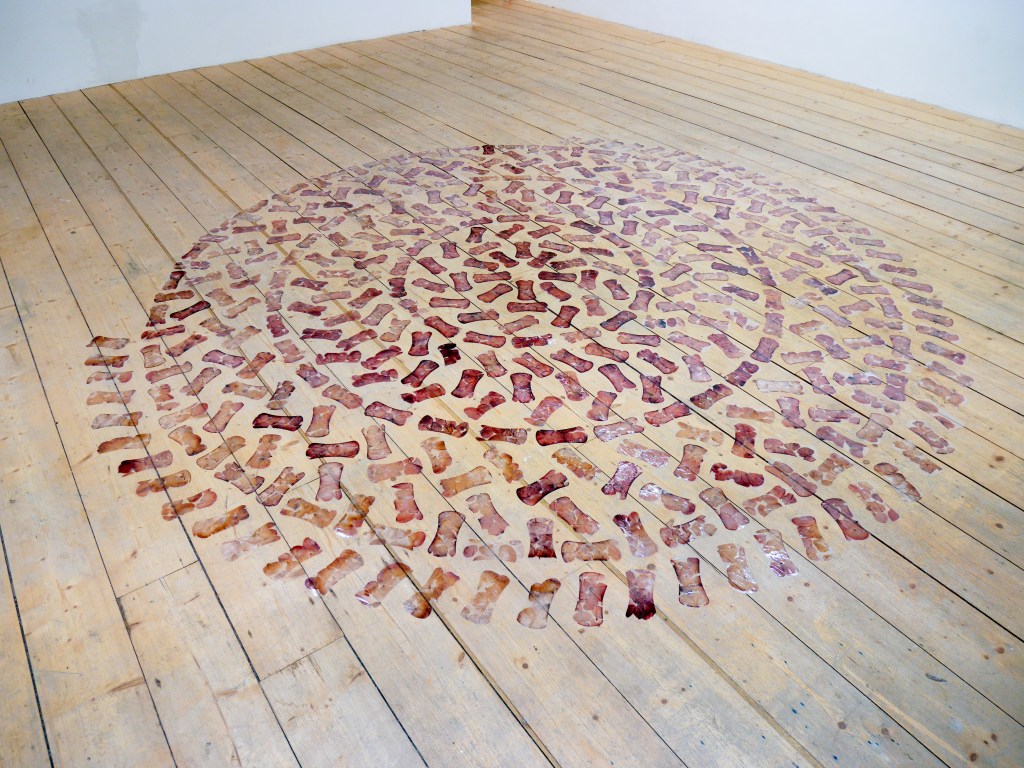
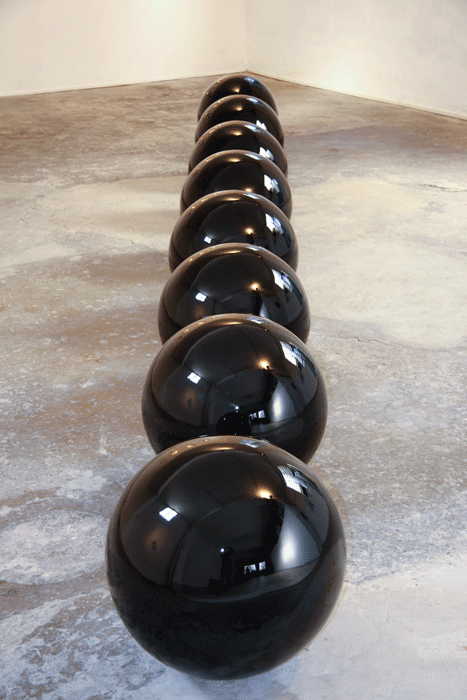
Rachel Morellet : Considerando la definizione della parola come il confronto tra la libera manifestazione della fantasia e la presenza di regole, mi interessa; però non è sempre presente nel mio lavoro. Mi interessa creare empatia con il pubblico, durante la fase di creazione come nel caso dell’opera En forme oppure in un secondo momento, attraverso il significato o il titolo. Quindi a volte il gioco è uno strumento che utilizzo a tal fine e a volte appare da se: per esempio nell’opera Password, composta di otto palle nere di 50 cm di diametro messe in fila. Ho sempre sognato di realizzarla in pietra dura così che si possa trasformare, oltre ad essere la rappresentazione materica di un componente grafico virtuale, nel gioco della cavallina. Il progetto Dessine-moi une blave, nato in collaborazione con l’ingegnere José Bréval e rivolto a chiunque, nasce con il proposito di stimolare la fantasia e l’immaginazione attraverso un gioco, e che in fin dei conti si rivela essere, per chi partecipa, un momento di auto-conoscenza e di scoperta del proprio mondo interno. L’ironia è per me un altro mezzo per creare una relazione tra l’opera e lo spettatore, mi piace parecchio farlo sorridere, come nell’opera Sweat-shirts o Wedding Performance. Amo lavorare sugli aspetti più banali o universali della vita di noi umani, come i gesti più comuni o i momenti ritenuti più importanti di una vita, che banalmente assomigliano a quelli di tante altre persone e quindi in qualche modo le comprende tutte. Aldilà dell’aspetto estetico che può piacere o no, cerco sempre un legame. I riti, le azioni quotidiane, la memoria collettiva, il mio vissuto, sono alcuni aspetti che amo interpretare e chi mi portano a inventare, a svelarne gli aspetti nascosti o a immaginare a volte un eventuale futuro.
Parola d’Artista: Alla luce di quello che mi dici ti volevo chiedere se la messa in scena di un lavoro ha una sua importanza per te?
Rachel Morellet : Totalmente, la ricerca dell’armonia o un atteggiamento sensibile verso il bello fa parte di me, e se non li trovo in un’opera o se questa ricerca è troppo spinta, mi disturba. L’installazione di un’opera o di una mostra deve essere studiata con cura, la messa in scena deve “funzionare”; ai fini di valorizzare il prodotto, evitando però di rubargli l’attenzione. Ci vuole sensibilità, in altre parole si tratta di comprendere bene cosa si ha tra le mani.
Rachel Morellet (1975, Francia)
Artista con formazione in conservazione e restauro di opere dipinte. Si è diplomata alla Scuola Nazionale di Restauro di Avignone dopo aver ottenuto la Licenza all’Università di Lettere e Lingue di Montpellier in storia dell’arte.
Il suo lavoro è stato esposto in centri d’arte, gallerie e istituzioni tra le quali :
Salon du dessin érotique. Parigi, Francia – Salon de la mort, Parigi, Francia – Triennale of Contemporary Graphic Arts, Novosibirsk, Russia – First international Festival of Manuports, Kohta, Helsinky – ULUS Triennale of Extended Media, Belgrade, Serbia – Domaine de la Garenne Lemot. Clisson. Francia – L’îlot sauvage, Niort, Francia – La Déviation, Marsiglia, Francia – La Station, Parigi, Francia – YIA Art Fair, Parigi, Francia – Villa Romana, Firenze – MOM Art Space, Amburgo, Germania – Les éditions extensibles, Parigi, Francia – Iconosmach, Palazzo Wagner-Fontana, Firenze – Vitraria Glass + Art Museum, Venezia – Consorzio Chianti Classico, San Casciano Val di Pesa (FI) – Palazzo Pretorio, Montelupo-Fiorentino (FI) – Fiera d’arte ArtVerona, Verona – Careof, Milano. Museo del Tessuto, Prato – Spazio Cu.Bo, Bologna – Museo del Novecento, Monsummano Terme – GAMC, Viareggio – Centro Franco Basaglia, Livorno – Accademia di belle Arti, Iasi, Romania.
I suoi lavori sono presenti nei volumi: n° 13,14 e 18 di BAU, Contenitore di Culture Contemporanea, GAMEC, Viareggio: e pubblicati nelle seguenti riviste: Gonzine n°7, Parigi. Francia, 2018 – Sur la page abandonnée vol.2, Les Editions Extensibles, Parigi, Francia 2017 – La revue des gens bien et pas bien du tout, Parigi, Francia, 2010.
Sito personale: www.rachelmorellet.com
English text
Interview with Rachel Morellet
#paroladartista #interviewartist #rachelmorellet
Parola d’Artista: For most artists, childhood represents the golden age, the one in which the first symptoms of a certain propensity to belong to the art world begin to appear. Was that the case for you too? Do tell?
Rachel Morellet : Exactly, it was like that for me, and two factors coexist here. I have always been a very observant person, asking few questions but looking, feeling, listening and perceiving the world and people. I have always loved to draw and as a child I remember receiving compliments on my creations. My great-grandfather Charles Morellet was a poet and held many painters and sculptors in high esteem, often illustrating his publications, and I think he liked having them in his entourage more than the painting itself. The influence of my grandfather, the artist François Morellet was decisive for my relationship with both the multiple stages of creation and the world of Art. He is regarded as one of the major players in geometric abstraction and forerunner of minimalism, yet he never tried to direct me or suggest a line for me to follow, he left me total freedom. He never tried to convince me to become a professional artist and often, even when he met students, he was more inclined to discourage them from pursuing a career as an artist, knowing that it is very difficult to make a living from your art. The influence of my grandfather, the artist François Morellet, was decisive for my relationship with both the multiple stages of creation and the world of Art. He is regarded as one of the major players in geometric abstraction and forerunner of minimalism, yet he never tried to direct me or suggest a line for me to follow, he left me total freedom. He never tried to convince me to become a professional artist and often, even when he met students, he was more inclined to discourage them from pursuing a career as an artist, knowing that it is very difficult to make a living from your art. Then the influence of my father and uncle, both of whom were artists, and my mother who studied art history, was an added value to the artistic climate that I enjoyed so much. So was it me who fell in love with art, who chose to pursue this path because I have the artistic vein? Or am I an artist because I am strongly driven by the family environment?
It will be both.
Parola d’Artista: In your case it is really a matter of blood. Have you managed to live this inheritance lightly or does its weight sometimes make itself felt?
Rachel Morellet : It is an important inheritance, in fact it has taken up a lot of space in my life, as I said before. In my early and middle life, I was mostly admiring and curious to see all this art around me. I met famous artists in France and in New-York where my uncle lives. At the same time I took a drawing and painting course in a private studio. In the older classes in high school, I was proud and began to be certain that I wanted to do a job that had something to do with art. Once, I collaborated with my grandfather by illustrating a catalogue of his that featured a series of works made with neon tubes. Then I studied art history at university, a way to give myself time to find the right career path to take, I knew I did not want to enter the school of fine arts, where they train artists. Then one afternoon, while watching television, they broadcast a report on the restoration and reproduction of marble sculptures. I then got the idea to enter the National Restoration School in Avignon. There I learned many things, as well as not being separated from the artists because the school had the same premises as the Academy of Fine Arts. The school was famous for having within it this wealth of exchange between the artistic heritage of the past to be preserved, and that of tomorrow yet to be created.
Another important aspect of those years was that, right next to the school, part of the private collection of the art dealer Yvon Lambert, one of the major promoters of contemporary art in Paris from the 1970s to the present day, was moved. More than four hundred works signed by the greatest artists were to be moved from Paris to Avignon, and for me to work on this material was a formidable opportunity. When I came to think about my thesis, I was undecided, it seemed a bit pretentious to talk about my grandfather, but many people convinced me by telling me that no one could have done it better than me. So I decided to research, as comprehensively as possible, the materials he used over the years, all the processes of creation in his workshop, how he hoped his works would be preserved, restored, etc. This was possible thanks to the immense knowledge he had acquired over the years. This was possible for me because of the immense archive that my grandmother had created from the beginning of her husband’s career, and because I had a privileged relationship with them, something that another student or student would not have been able to do. Now that he is gone, his work must be preserved in every way.
Its place in the family and in art history is very important and one might think that it overshadows the artist that I am, but I experience it more as a chance that one has to be able to take and aware that as a restorer and heir I am destined to relate more and more to his work.
So as far as my artistic career is concerned, I have never had any illusions, the bar is set very high. An important lesson I have learnt is not to take ourselves too seriously, it is important to study, do and persevere as long as we can, because creating gives us pleasure. Is art nothing more than the mixing of the reality principle with the pleasure principle?
Parola d’Artista : During your study years, apart from those you have already mentioned, were there any other important encounters?
Rachel Morellet : An important person for me was my painting teacher, Michel Zevort. He taught me a lot about oil painting and its techniques. Together we did a fiction project during the Avignon festival. We had created and opened to the public the fake studio of a forger who had escaped in a hurry because he was wanted by the authorities. I had entirely set up a room in which the forger named Pierre Verlak lived and worked. The fiction had been studied in great detail to make the story seem real; his diary, newspaper articles, the paintings he copied, the state of the room abandoned in haste, his portrait, etc. The public was very impressed.
Parola d’Artista : Avignon is an extraordinarily active city in terms of culture, I am thinking of the Theatre Festival, for example. Has this context had any impact on your work?
Rachel Morellet : Yes, Avignon is transformed during the month of July, it becomes a tangle of people and shows. I saw a lot of them in five years but it did not particularly influence me I think. The performance art aspect does not suit my personality even though I appreciate it. Instead I was impressed by the exhibitions that the Palazzo dei Papi hosted. It is an incredible building in terms of its size and sobriety. It is unique, the works set up inside it acquire a different aura, the light, the acoustics, everything makes the experience complete. The audience is enveloped by the works, they live them. Perhaps this led me to be even more demanding in the way I set up an exhibition.
Also important for me was the year 2000 when Avignon was named European Capital of Culture thanks to the project La Beauté in fabula curated by Jean De Loisy. For this occasion, the entire city was set up from June to September with visual works and art projects by the most famous or promising contemporary artists. Of course, we students were the first to have the opportunity to participate in the installations and assist the artists. Between these opportunities and the mounting of exhibitions at Collection Y. Lambert were years full of encounters.
Parola d’Artista : After your studies, how do things go?
Rachel Morellet : Before finishing my five years of training at the restoration school, fate took me to Tuscany, where I moved as soon as I graduated. I wanted to continue the research I had done on my grandfather for my thesis, and apply it to the work of other established artists. I contacted Maurizio Nannucci and Giuseppe Penone, who responded very kindly to my request, but then the work was not finished due to too many commitments. On Maurizio Nannucci’s advice, I contacted the Centro per l’Arte Contemporanea Luigi Pecci and within a few months I met the then director Daniel Soutif. A collaboration began, which continues to this day. I work with the Centre as a restorer, for exhibitions and the permanent collection. To this day, I work in this field with institutions, galleries and private individuals based in France, Switzerland, Italy, Luxembourg and the United States.
In parallel, I founded and managed from 2014 to 2020, together with Pamela Gori, the cultural association Artforms based in Prato, committed to promoting events related to the visual arts. I then began to organise events, invite artists, take care of installations and deal with the promotion of the association itself.
My activity as an artist started in 2005 here in Tuscany and has since spread to several countries. I must say that in recent years I have been trying to reconnect with France, my country of origin.
In addition to my solo career, I love to collaborate a lot and this has led me to create several works with four hands or more, and to join artist collectives such as FAMA (Four Artists for a Metastable Art), Valentina Lapolla, Eva Sauer, Tatiana Villani and myself. Main theme: metastability or open and transforming forms, be they personal, collective, political, technical or scientific.
Toccaunotoccatutti, an open collective, operating mainly in the Prato area, with the intention of highlighting, through art, the conditions of exploitation of workers in factories.
Imboscata, a project aimed at promoting contemporary art in woodland environments, curated by Shilha Cintelli, Eva Sauer, Enrico Vezzi and myself.
Parola d’Artista: The idea of a community of exchange and sharing between artists is not at all easy to cultivate Many artists prefer to stay in their shells without leaving their “comfort zone” and from there they make their own little strategy… Based on your experience, what are the key points for arriving at a good sharing practice ?
Rachel Morellet : Yes, it is not easy for everyone. I think it’s a question of character, to be able to collaborate you need to not have too many expectations and not like competition. Collaborating is like connecting with the frequency of the other or the group, as animals often do in flocks and herds; it is about tuning in to the species. Of course there may be times or periods when we are out of tune or the ego prevails but understanding can be re-established by talking. In addition to this, there must be a certain freedom of presence and commitment in the group while maintaining the support that exchange work requires.
Parola d’Artista: I wanted to ask you to talk about your work “En Forme” and tell us how it came about and how you also sought a dynamic of relationship with a group of people.
Rachel Morellet : The work explores the border between form and matter and was born during the year 2020, when the rules of isolation that we all know were in force. I decided to take in hand a few kilos of clay I had been saving for months, and some drawings I had made in 2014. I set about inventing and shaping seventeen different sculptures, ‘by levare’ the material, a process that is usually done ‘by porre’ in ceramics.
The particular situation led me to seek external confrontation and at the same time to stimulate the collective imagination in front of the abstract forms I was producing. I used social media for this purpose, asking people to give me a title each time I unveiled a sculpture. Thus, 426 titles were collected in a booklet (signed edition of 20 numbered copies).
Given the conditions of isolation and not having a kiln to fire the ceramics, I decided to leave them raw.
The consistency of the raw, smooth earth led me to add another element to the work: a cowhide, which hung on the wall, re-proposes the shapes of the sculptures through their absence and with a slight deformation given by the nature of the material.
The leather forms, taken out and placed underneath the sculptures, become their shadows, which then split thanks to a play of light.
The ensemble is accompanied by a series of drawings created with water and clay dust residues that I removed during the creation of the sculptures. The series is proposed as a graphic response to the juxtaposition of the seventeen forms of the sculptures with the remaining ones, a total of 136 combinations.
Parola d’Artista: Are you interested in the playful aspect in your work?
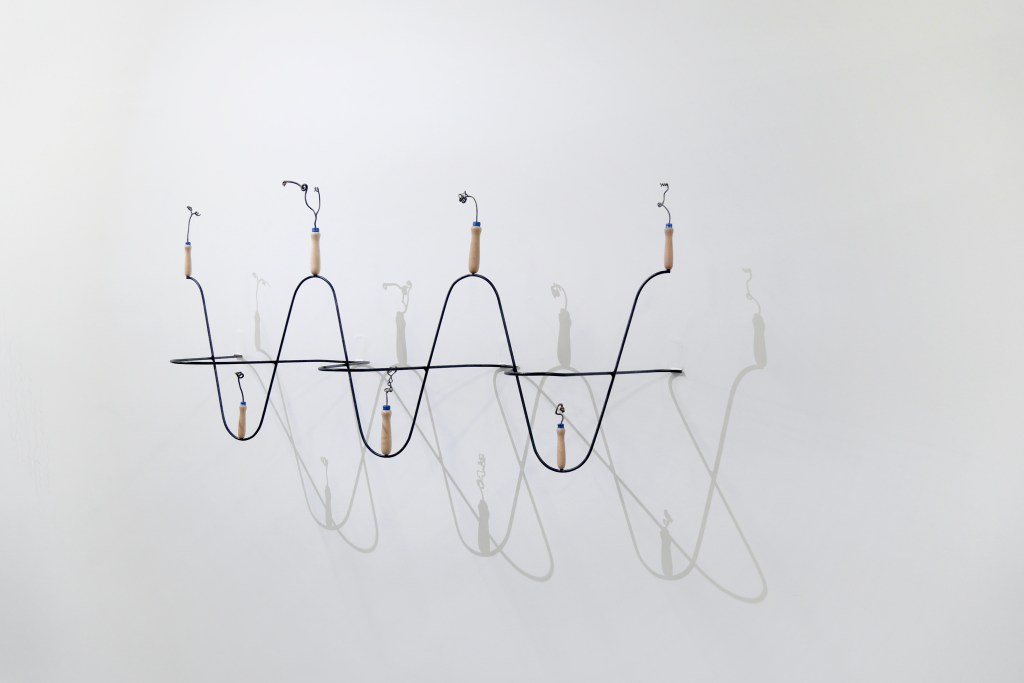
Rachel Morellet : Considering the definition of the word as the confrontation between the free manifestation of imagination and the presence of rules, it interests me; however, it is not always present in my work. I am interested in creating empathy with the audience, either during the creation phase as in the case of the work En forme or later, through meaning or title. So sometimes play is a tool I use for this purpose and sometimes it appears on its own: for example in the work Password, composed of eight black balls 50 cm in diameter placed in a row. I have always dreamed of making it out of hard stone so that it can be transformed into a material representation of a virtual graphic component as well as a game of leapfrog.
The project Dessine-moi une blave, created in collaboration with the engineer José Bréval and aimed at anyone, was created with the intention of stimulating fantasy and imagination through a game, and which ultimately proves to be, for those who participate, a moment of self-knowledge and discovery of their inner world. Irony is another means for me to create a relationship between the work and the viewer, I like to make him smile, as in the work Sweat-shirts or Wedding Performance. I love to work on the most trivial or universal aspects of our human life, such as the most common gestures or the most important moments of a life, which trivially resemble those of many other people and thus somehow encompass them all. Beyond the aesthetic aspect that one may or may not like, I always look for a connection. The rituals, the daily actions, the collective memory, my experience, are some aspects that I love to interpret and who lead me to invent, to unveil hidden aspects or to imagine sometimes a possible future.
Parola d’Artista : In the light of what you are telling me, I wanted to ask you if the staging of a work is important to you?
Rachel Morellet : Totally, the search for harmony or a sensitive attitude towards beauty is part of me, and if I don’t find them in a work or if this search is too extreme, it disturbs me. The installation of a work or an exhibition must be carefully thought out, the staging must ‘work’; in order to enhance the product, but without stealing attention from it. It takes sensitivity, in other words, it is a matter of understanding well what you have in your hands.
Rachel Morellet (1975, France)
Artist trained in conservation and restoration of painted works. She graduated from the National Restoration School in Avignon after obtaining a Licence from the University of Letters and Languages in Montpellier in art history.
Her work has been exhibited in art centres, galleries and institutions including :
Salon du dessin érotique. Paris, France – Salon de la mort, Paris, France – Triennale of Contemporary Graphic Arts, Novosibirsk, Russia – First international Festival of Manuports, Kohta, Helsinky – ULUS Triennale of Extended Media, Belgrade, Serbia – Domaine de la Garenne Lemot. Clisson. France – L’îlot sauvage, Niort, France – La Déviation, Marseille, France – La Station, Paris, France – YIA Art Fair, Paris, France – Villa Romana, Florence – MOM Art Space, Hamburg, Germany – Les éditions extensibles, Paris, France – Iconosmach, Wagner-Fontana Palace, Florence – Vitraria Glass + Art Museum, Venice – Chianti Classico Consortium, San Casciano Val di Pesa (FI) – Palazzo Pretorio, Montelupo-Fiorentino (FI) – ArtVerona Art Fair, Verona – Careof, Milan. Museo del Tessuto, Prato – Spazio Cu.Bo, Bologna – Museo del Novecento, Monsummano Terme – GAMC, Viareggio – Centro Franco Basaglia, Livorno – Accademia di belle Arti, Iasi, Romania.
Her works can be found in volumes: n° 13,14 and 18 of BAU, Contenitore di Culture Contemporanea, GAMEC, Viareggio: and published in the following magazines: Gonzine n°7, Paris. France, 2018 – Sur la page abandonnée vol.2, Les Editions Extensibles, Paris, France 2017 – La revue des gens bien et pas bien du tout, Paris, France, 2010.
Personal website: http://www.rachelmorellet.com



 paroladartista.com