
#paroladartista #intervistaartista #saveriomercati
▼Scrole for English text
Gabriele Landi: Ciao Saverio, spesso per gli artisti l’età dell’oro corrisponde con quella dall’infanzia. L’infanzia é l’età delle fantasticherie, quella in cui, per accumulo di esperienze, si inizia a creare un proprio modo di rapportarsi al mondo e in cui si manifestano i primi “sintomi” di appartenenza all’ arte è stato così anche per te? Racconta?
Saverio Mercati: Età dell’oro? Ma di diamante, di platino. L’età dei sensi spalancati, vedere senza saperlo dardeggiare la luce infuocata dell’ estate sopra i campi, essere invasi dagli odori e dai fetori che ti prendono lo stomaco ed il cervello, l’ incoscienza di percepire le cose solamente per come appaiono ed affidarsi al ricordo che mai sarà paragonabile a quegli attimi. Ho avuto una infanzia bellissima! Era tutto legato a quel tempo espanso che credo caratterizzi tutti noi. Non mi differivo in nulla dai miei coetanei e con quella bugia ho convissuto fino a circa diciassette anni. Ho iniziato a lavorare giovanissimo e la mia infanzia è finita li. Studiavo la sera e di giorno lavoravo in officina, iniziai così a collegare le mani al cervello, conoscere tecniche e materiali, incontrare persone, colleghi con tratti surreali, maestri assoluti. Poi in quel periodo correvo con le moto, ed in quel caso di artistico c’era solo la possibilità di divorare il mondo, abbattere confini, volare da un precipizio ad una scarpata. Un assaggio di quello che sarebbe stata la vera libertà. A diciassette anni circa come ricordavo prima, da un giorno all’ altro avviene un click, come una malattia improvvisa, qualcosa di inspiegabile, iniziai a vedere le cose in modo diverso, il mio modo. La capacità manuale appresa nel lavoro mi garantiva la possibilità di poter formalizzare ciò che immaginavo, era quella la libertà che cercavo e che ancora oggi custodisco gelosamente …. Ordinai a mia cugina di comprarmi una scatola di colori ad olio.
Gabriele Landi: Che cosa dipingevi?
Saverio Mercati: Bhe capisco la curiosità, con un inizio così fulminante, simile per certi aspetti ad una illuminazione, si sarebbe portati a credere a chissà quali talenti l’altissimo potesse aver affidato alle mie mani. In realtà scimmiottavo gli artisti che vedevo nelle riviste d’arte, mi serviva per affinare la tecnica, per meravigliare me stesso in questa nuova dimensione. Ma la cosa più utile era valutare lucidamente il mio operato, costruendo un po’ alla volta la consapevolezza per definire i miei limiti ed esplorarne degli altri. Altre tecniche, altri pensieri. Per rispondere alla domanda, ti dico che avrò realizzato una decina di quadri ad olio con le soggettive più disparate, i quadri di un ragazzino. Poi non ho più dipinto in vita mia fino ad un anno fa.
Gabriele Landi: Come sono proseguiti i tuoi studi?
Saverio Mercati: Come ti dicevo prima ho interrotto gli studi molto presto per poi riprenderli un paio di anni dopo ma non ho titoli specifici in arte. Ho iniziato cercando solo le informazioni che mi servivano, è sempre stato il mio metodo. Poi quando cerchi qualcosa è inevitabile che trovi anche altro a cui non pensavi e ti accorgi che ti serve è un modo di procedere simile a quello della ricerca scientifica. Questo per dire che lo studio da autodidatta della storia dell’arte mi ha permesso di incontrare ed approfondire con più libertà quello che sentivo vicino ai miei interessi …per me è stato così
Gabriele Landi: Hai avuto degli incontri importanti che in qualche modo hanno influenzato il tuo iter?
Saverio Mercati: A pensarci credo che tutte le persone, le cose, il mondo animato ed inanimato ci forniscano elementi di arricchimento, nasciamo come meccanismi magnetici che attraggono la vitalità delle cose, la luce delle persone. Questo processo di evoluzione continua è azionato da una energia costante che a sua volta prende forza nel nostro intimo e li diventa una faccenda morale. La peculiarità dell’incontro è valutata arbitrariamente, la nostra opinione su … è quello che ci compete e ci orienta, quanto quell’incontro ci stupisca o ci deluda è una questione di quantità e di qualità che misuriamo di volta in volta. C’è un sasso, lo schienale di una panchina in pietra nel giardino “Piero Della Francesca” a Sansepolcro dove giocavo da bambino, che ha per me un valore evocativo e sentimentale molto superiore ad incontri avvenuti nella mia vita …. Ecco il sasso è lui il più importante.
Gabriele Landi: Evocativo nel senso dell’appartenenza ad un luogo che diventa fondate per la tua identità d’artista?
Saverio Mercati: Si certo se rimaniamo nel paragone del sasso l’evocazione è garantita, se torno al giardino anche oggi quell’elemento simbolico, personalissimo, agisce su di me come macchina del tempo e mi riporta a quei pomeriggi interminabili in quel paese dove sono nato e che per forza devo farci i conti. Piero Della Francesca è ovunque, è come un cavo di alta tensione che parte dal museo civico e si snoda per le strade, se ne avverte l’energia razionale e la pericolosità intrinseca. Per noi Biturgensi è come vivere a ridosso di una centrale nucleare. Quanto questo luogo abbia influenzato il mio procedere come artista non mi è del tutto chiaro, di certo devo ammettere che la ricerca di una eleganza, di un qualcosa di logico e perfetto me la porto dietro perché qua l’ho sempre respirata. Il “contenitore” , un tema ricorrente, fondamentale del mio lavoro; l’oggetto che contiene l’idea e che ne entra a far parte ha origine e si giustifica in questo luogo dove tutto è proteso ad un equilibrio armonico e razionale. Per me è indispensabile nelle arti visive approcciare con garbo, usare un linguaggio complesso con riferimenti all’arte concettuale non spiega una trascuratezza estetica. Questa è l’eredità che mi lascia Sansepolcro.
Gabriele Landi: Ti interessa l’idea di messa in scena?
Saverio Mercati: Si certo mi interessa molto, sotto tutti i punti di vista, da quello teatrale a quello narrativo della “mise en abyme” di André Gide, al cinema, a tutto ciò che per esprimersi passa attraverso un simbolo, un’immagine o una azione. Anche il mio lavoro è una messa in scena. Se prendiamo ad esempio i light box, oppure i light plain, ma anche le carte piegate, le stratificazioni delle immagini che vanno a formare l’opera hanno un carattere performativo e narrativo. I layer fotografici che nascono dalla realtà sottostante e alla quale ritornano non rappresentando altra cosa se non se stessi all’infinito, mettono in atto una storia senza soggetto, la possibilità di esistere su un nulla espressivo, su una dimensione ambivalente tra realtà e finzione. La luce sottostante “vera” accendendosi si integra con l’immagine che la rappresenta, in questo modo viene chiamato in causa il supporto fotografico per un tempo di accensione definibile come tempo performativo. Ecco allora che nella più totale staticità dell’opera si percepisce una messa in scena che ha volontà significante, un annullamento del tempo.
Gabriele Landi: Il tuo lavoro procede per cicli?
Saverio Mercati: Ho lavorato per cicli diversi anni fa, non so neanche se chiamarli cicli, avevano più l’aspetto di infatuazioni momentanee legate ad un aspetto letterario. Stavo per mesi interi a riflettere su un argomento ovviamente di carattere artistico visuale, prendevo appunti ovunque, in macchina, al ristorante poi la sera trasferivo gli scritti al computer e facevo correzioni. Nel frattempo formalizzavo in maniera visuale quel pensiero attraverso le fotografie o dei video, insomma con quello che ritenevo più adatto nella più totale libertà. E’ stato un periodo che definirei di orientamento e di studio. Gli appunti si stratificavano fino a far intravvedere la possibilità di una storia, poi forse un racconto. La complementarietà di queste due discipline mi permetteva di portare avanti in maniera parallela entrambe le passioni utilizzando la scrittura per fornire senso alle immagini e le immagini come testimonianza visiva dell’argomento trattato. Poi con il tempo ho potuto constatare che quelle opere visive non erano affatto le copertine dei racconti, ma che vivevano una loro dimensione autonoma, come del resto i racconti potevano avere una vita propria. A tutt’oggi non sono sicuro nemmeno che queste due esperienze possano auto potenziarsi a vicenda, del resto lo scopo non era quello. Il vero intento era di chiarirmi quell’urgenza e trasferirla in maniera formalmente corretta, dare esatta leggibilità ai miei pensieri. Tutto ciò può sembrare un modo algido, quasi chirurgico di fare arte ma non è così banale la questione. Non mi sono mai piaciuti gli scarabocchi, le cose che nascono per similitudine forzata. Quindi non potendo fare di più o di meglio il mio esercizio era tenere la schiena dritta e parlare solo di ciò che ritenevo veramente importante, senza fraintendimenti, senza ego. Se si ha la fortuna di riuscire a concedersi questa libertà, la mente può entrare in discussione con tutto, accettando solo interrogativi di valore. Credimi si fanno delle scoperte … per esempio quella che se non hai nulla da dire puoi anche tacere, va bene lo stesso. Poi magari una sera che sei a pesca e ti stai quasi addormentando, può capitare che abbocchi all’amo qualcosa che senti enorme che non che non ti immagini, qualcosa che devi portare alla luce e devi lavorarci duro per manifestarla. Ma è reale, vera incarnazione, la tua ricompensa il tuo compito! Di certo è però che non puoi aspettare che accada con le esche sbagliate. Mi accorgo di aver troppo divagato! Per rispondere alla domanda dirò che si ho lavorato per temi diversi e che procedevo secondo una logica ciclica legata alla stesura di racconti e all’immagine.
Gabriele Landi: I pesci grossi stanno in acque profonde per pescare li non bastano le esche giuste, ci vuole anche la canna da pesca adeguata e tante altre cose, la più importante è sicuramente la predisposizione di spirito. Hai dei metodi tuoi per entrare in questo stato di ipersensibilità? Ci sono dei luoghi che favoriscono queste dinamiche?
Saverio Mercati: Con questo paragone si potrebbe giocare all’infinito. Potremo anche immaginare di essere noi i pesci, di abboccare a qualcosa che ci attrae. L’esca che nasconde l’amo. Qualcuno tenterà di domare la nostra indole che fu solo quella di rimanere pesci. La paura di non sapere con che tipo di efficacia potremo avviare la lotta, con che genere di attrezzature (quelle che dicevi tu) ci andremo a scontrare. Se osserviamo la questione da questo punto di vista non ci sono molte differenze. Se sono il pescatore, vorrò prendere il pesce per mostrarlo agli amici, farci delle foto e poi magari una mostra, così per rimanere in tema. Teorizzarci un po’ su e poi infine mangiarlo. Se sono il pesce invece vorrò rompere le famose “attrezzature” e tornarmene da dove venivo. Egoico, ostinato e totalmente pesce. Salvarsi o abdicare. Se sono il pescatore vorrò qualche cosa per me, ma anche se sono pesce aspirerei avere la possibilità di andarmene per i fatti miei e cioè totalmente disinteressato all’arte, alla cultura , appassionato solamente di acque scintillanti e di piccoli crostacei . Nessuno dei due sbaglia, non c’è ne meglio e ne peggio; tanto uno si emoziona e si spertica su di una nuova intuizione, quanto l’altro nuota tranquillo e si fa i fatti suoi. Pur essendo dalla parte di chi crea sono sempre molto attento a chi guarda, e tendo pure a dare giustificazione a tale distacco, mi interessa molto chi non vuol vedere e perché. Parlavi di predisposizione di spirito, ecco credo l’atteggiamento di ascolto possa fare la differenza, come l’ha sempre fatta in realtà. In questo caso però non è l’ascolto amorevole cristiano, amicale finto buono, ne i pareri eccellenti oppure quelli sempre graditi, scazzati e menefreghistici. Si tratta più che mai di ascoltare un rumore di fondo, un fruscio che fa scintillare delle cose e ne mette in ombra delle altre
Gabriele Landi: In che posizione ti collochi rispetto al tuo lavoro?
Saverio Mercati: Una risposta precisa non ce l’ho, non so in che posto mi trovo rispetto al mio lavoro. Potrei provare a replicare evidenziando alcune particolarità della mente, responsabili di una scissione per classi che collaborano insieme alla formalizzazione di un pensiero. Per un artista visivo la condizione del reale, del quotidiano è quasi una tortura! In questo ambito di percezione la mente esercita un compito di trasferimento dei dati dall’occhio al cervello, inserendoli in una funzione speciale che lavora quasi esclusivamente alla modifica e la comparazione con i dati della memoria principale. In questa fase della lavorazione si confronta e si esclude tutto ciò che si sovrappone e appare come noto, cercando di isolare quello che ha una costante di senso e si propone come significante. Sempre in questa area si campionano dei primi progetti che strutturandosi vengono selezionati per passare ad altro laboratorio. E questo è un luogo dove potrei trovarmi! Oppure nello spazio della mente successivo dove i dati precedenti della scrematura dei progetti flash vengono trasmessi e presentati ad una commissione di esperti che lavora per me da un sacco di tempo. Potrei trovarmi anche qui! E anzi dovrei essere anche un pezzo grosso! Più che mai perché sono io che pago le conseguenze e quindi spetta a me l’ultima parola. La valutazione che viene eseguita in questo ambito è di carattere estetico, storico e morale, alcuni eruditi di area filosofica, orientaleggiante sollevano spesso la questione se l’opera migliorerà il mondo o lo abbruttirà. Senza avere appreso che alla prima crisi di lavoro saranno i primi ad essere licenziati. Poi ci sono i competenti chic che sono quelli con cui mi trovo meglio alla fine. Siamo convinti che nella forma ci sia molta sostanza, è gente con grandi inquietudini ben celate, a me aiutano a non strafare. Ancora molti altri generi e sottoclassi da ascoltare e valutare fino a quando non si profila un progetto da portare a termine . A questo punto parte la telefonata diretta al terzo stato mentale e qui quasi sempre rispondo io è l’ufficio acquisti dei sapienti che vuol sapere eventualmente i costi per un light box due metri per due. Io li mi incazzo parecchio perché lo sanno benissimo che è roba che non si vende, capirai loro fanno i filosofi no? Tanto poi a fare i lavori inutili ci pensa lo scemo! Più di una volta gli ho detto che mi sono stancato, gli ho presentato anche il conto dell’ultima cantonata che mi hanno fatto prendere e loro dicono “tranquillo la ricompensa non è in questo mondo”ma dico, ma si può rispondere così?
Gabriele Landi: Ecco visto che ne parlavi sopra mi piacerebbe sapere qualcosa di più dei light box?
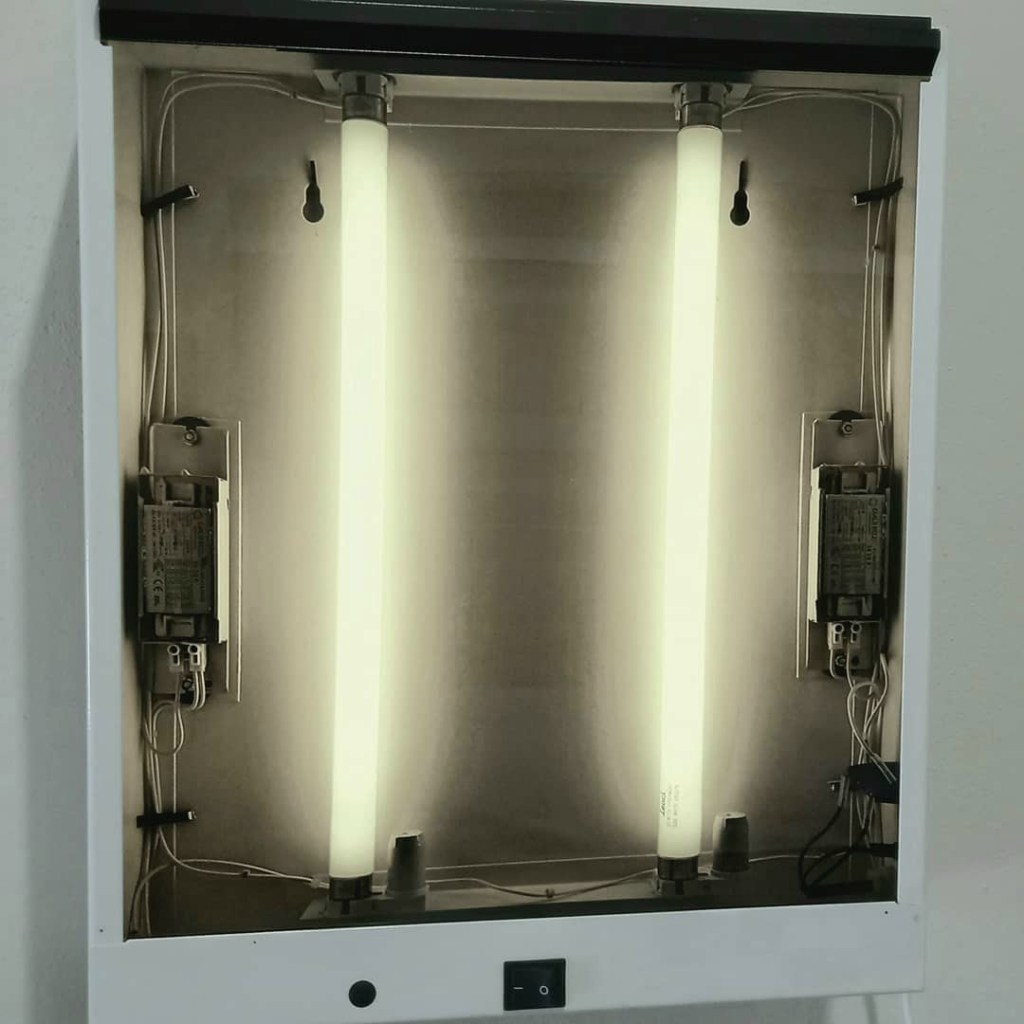
Saverio Mercati: I light box insieme ai light plain sono le opere che mi caratterizzano perché è il lavoro esposto più volte e quindi più conosciuto. Proverò a spiegare! Cerchiamo di analizzare per un attimo questo aspetto della realtà oggettiva, tentando di raccontare una “verità” che ha a che fare con il carattere tecnico dell’opera. Soffermiamoci un istante sul congegno elettrico cioè sul contenitore, sull’impianto delle luci al neon costruito ed applicato al pannello retrostante l’opera. Questo è quanto generalmente serve per retro illuminare una foto, la parte pratica che insieme ad altri elementi va a formare la tecnica definita “light box”. L’oggetto in questione, il supporto attrezzato, non rappresenta nulla. Non esprime niente altro che la propria funzione cioè esaltare qualsiasi immagine fotografica ne venga a contatto. Il pannello appena descritto diventa parte del soggetto e viene fotografato per poi ottenerne una stampa grande quanto il pannello stesso. La foto raffigurante l’ impianto con i neon accesi è la parte “contenuto” del lavoro e viene alloggiata nella “cornice contenitore”. La variazione tonale prodotta dalle luci accese sottostanti ed interne al box garantisce la veridicità del supporto fotografato. Questa operazione di recupero dell’oggetto/soggetto all’interno dell’opera stessa annulla la volontà di una immagine retorica e rappresentativa. Quando ho immaginato l’utilizzo di questa macchina per retro illuminare cioè il metodo quello classico di ravvivare luce e colori di una fotografia, non sono mai riuscito a trovare un soggetto che fosse sufficientemente interessante per poterla usare. Non riuscivo a trovare bellezza se non nella sua natura di macchina fine a se stessa. Se osserviamo le possibilità che ci offre la tecnologia per la riproduzione del reale, se proviamo ad immaginare quante apparecchiature, dai telefoni alle videocamere ai satelliti trascrivano costantemente ciò che ci circonda e ne tengano memoria, ci renderemo conto che questa ipertrofia fotografica finirà col generare domande di carattere filosofico. Cioè se tutto sempre di più diventa soggetto rappresentato, quanto la specificità delle immagini sarà ancora distinguibile? Quanta robotica entrerà di diritto nel campo delle figurazioni e quanto la scelta umana, artistica riuscirà ancora a fare la differenza? Quali saranno gli intenti propri e le peculiarità di chi utilizza una fotocamera che è un robot a tutti gli effetti? Questi sono alcuni aspetti sui quali mi piace riflettere, non ho soluzioni ma non vedo neanche problemi, si tratterà di informarci costantemente e adeguarci gradualmente alle nuove tecnologie, come del resto abbiamo sempre fatto. I light box nascono con l’idea di esistere come immagini senza esserlo assolutamente. Il loro soggetto è niente più di ciò che li contiene. La fotografia si specchia nel reale sottostante e con l’integrazione della luce il supporto si arricchisce di senso e di una nuova verità. L’opera nella fase di accensione sottolinea uno spazio di durata, un inizio e una fine che potremo definire un tempo performativo. A questo punto non è corretta nemmeno la definizione di supporto fotografico, è riduttiva. Potremo parlare di una membrana luminescente che rappresenta un se speculare molto ravvicinato e ne entra a far parte. Attivando un loop continuo tra realtà oggettiva e finzione rappresentativa, annullando di fatto il normale processo di invecchiamento della fotografia, diventando contenuto e contenitore.
Gabriele Landi: Ti volevo chiedere come mai senti la necessità di ripetere con forme diverse (variazioni di formato, composizione…) lo stesso lavoro?
Saverio Mercati: Credo di capire cosa vuoi dire. Se si arriva a scoprire il funzionamento della macchina come spiegavo prima, si prende atto di un pensiero applicato alla pratica e quindi anche una sola ed unica “macchina light box” può essere sufficiente a spiegare i passaggi, le stratificazioni che compongono questa opera. Da subito mi sono accorto che si trattava di lavori tecnicamente molto difficili e che la loro complessità derivava da una estetica sottile che soffriva delle minime variazioni di luce, di stampa, di supporto. Ogni light box porta al suo interno quel messaggio bastante a se stesso che può definirsi unico e assoluto e quindi di inutile serialità. Tuttavia non ho mai pensato di fermarmi subito dopo le prime esperienze. Primo perché credo fermamente all’interrogativo che queste opere propongono e voglio continuare a parlarne, poi perché l’estetica che li riguarda passa attraverso una reale concentrazione di competenza artistica e questo giustifica la ricerca di un continuo equilibrio. Pensa che anni or sono ho iniziato utilizzando i tubi neon a fluorescenza e la stampa su carta fotografica, adesso da qualche tempo uso tubi led e stampa direttamente su plexiglass, ma credi che i problemi tecnici siano finiti? Quindi capisco la tua domanda e ne apprezzo l’acutezza, ma posso dirti che alla luce di oggi, con tante opere realizzate che dicono la stessa cosa in maniera sempre diversa e con la ferma convinzione di aver indagato e approfondito un aspetto della fotografia a mio avviso molto delicato e importante. Mi fa dire che si, ne valeva la pena.
Gabriele Landi: Ti volevo chiedere di parlare della serie “fotografia piegata di un foglio piegato” ?
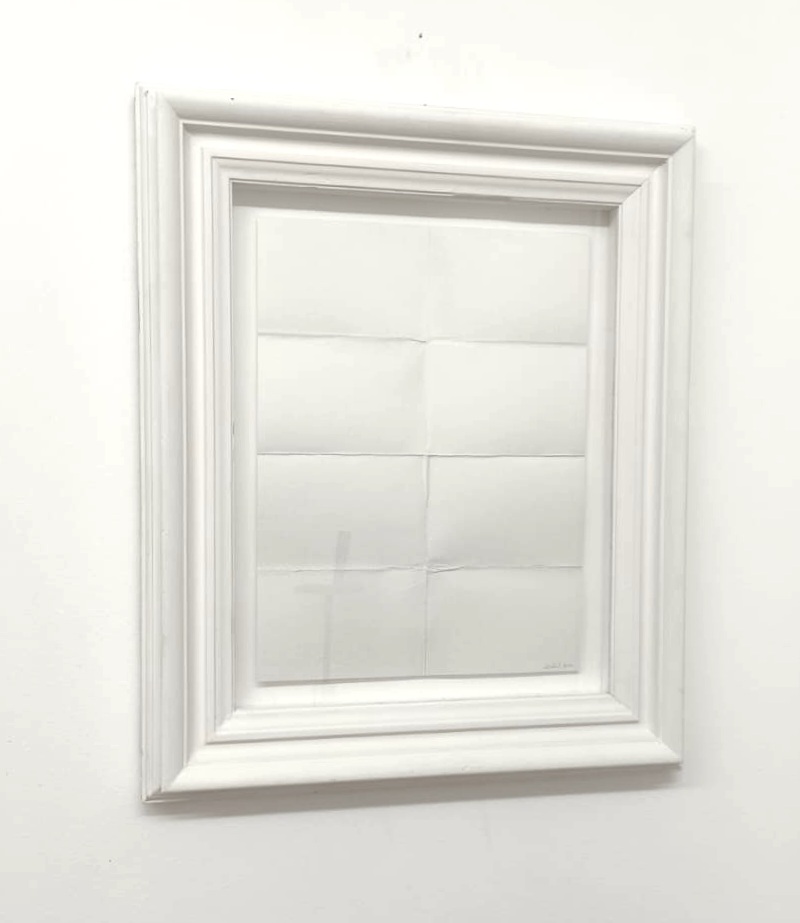
Saverio Mercati: Attraverso tecniche di riproduzione dell’immagine sempre più evolute, il soggetto definito come “contenuto” viene costantemente rappresentato e spalmato su supporti di ogni genere. Schermi pubblici o privati trasmettono ovunque l’ovunque, protagonisti di un presente sempre più intercettabile, minuziosamente descrittivo e sovrumano. Le carte piegate fotografate e ripiegate riflettono su un’attualità che ha già esaurito il suo soggetto esclusivo. La visione globale e robotica, fornita da tecnologie capaci di una raffigurazione invasiva e capillare, producono una propagazione continua di immagini dove tutto diventa soggetto ma nulla lo è più in realtà. Le carte ripiegate chiamano ad esempio la fotografia per portarla ad un punto di non ritorno, costringerla ad un vero “nulla” altamente significativo. La carta, il contenitore della “non immagine” rappresenta fotograficamente solo ciò che è accaduto a se stessa precedentemente, senza che ci sia stata altra volontà espressiva. Coscienti, come dicevamo, che qualsiasi raffigurazione del presente sia vana, o comunque già prodotta da strumenti di acquisizione di immagini che continuamente generano memoria consultabile. La fotografia, in questo caso, l’opera stampata e ripiegata, si amalgama a quanto avvenuto al soggetto “contenitore” Si ripete nella carta la stessa esperienza fisica del gesto che lo ha generato; normalizzandosi ad esso in una ritrovata interpolazione di luce ed ombre. Si genera così una interdisciplinarietà tra fotografia e bassorilievo che rende l’opera unica, perché in base alla sua collocazione sarà sempre diversa, e al variare della luce che incontrerà, sarà sempre mutevole e performativa.
Gabriele Landi: Saverio ti interessa nel tuo processo lavorativo l’intelligenza artificiale?
Saverio Mercati: No non sono interessato, non centra nulla con quello che faccio. Precedentemente ho parlato di robotica nel mondo della fotografia, della ampia riproduzione del reale, per evidenziare un progresso tecnologico che ci riguarda tutti da vicino. Le immagini di cui già disponiamo nelle memorie digitali e quante ne incameriamo costantemente con una sempre maggiore frequenza e qualità, ma soprattutto con la facilità con cui possiamo accedervi, creano inevitabilmente un mondo parallelo in continua definizione. Se mi avessero chiesto a dieci anni, cioè circa agli inizi degli anni settanta, come sarebbe stato il mondo nel duemilaventitre, di certo avrei parlato di piccole astronavi per gli spostamenti sopra le città. Oppure di cibo in pillole, uomini e donne con la testa glabra vestiti con tute aderenti in plastica, insomma questa era più o meno l’idea che avevamo del futuro. Se vado a comparare quella visione all’oggi è intuibile che qualcosa non ha funzionato. Ci troviamo nel traffico, con una vettura che si muove su ruote e brucia gasolio, con del cibo del contadino sul sedile, con una camicia di lino e dei pantaloni di cotone. Strade bianche polverose, uccelli che prendono il volo da terra, unica vera differenza è il telefonino. Uno scenario molto diverso da come ce lo immaginavamo dai tempi dei films di fantascienza, con i quali abbiamo costruito la nostra idea di futuro. Dobbiamo prendere atto che la tendenza ad enfatizzare la scienza ce la portiamo dietro dall’illuminismo. C’è una voglia inconfessabile negli umani di trasferire le proprie responsabilità ad una macchina, forse per sentirsi più umani in fondo. Riguardo l’intelligenza artificiale è curioso come tutti noi sorpresi e spaventati la usiamo da cinquanta anni e nessuno se ne sia accorto. La “Fuzzy logic technology” ha iniziato negli anni settanta ad essere applicata a progetti dove era utile che il funzionamento della macchina si adeguasse al pensiero umano decisionale. Questi sistemi trovarono spazio negli elettrodomestici, nelle grandi centrali termiche, ovunque fosse favorevole far ragionare una macchina. Poi con l’arrivo del digitale i dati di informazione transitavano con velocità istantanea e questo ha arricchito tutti i data base, permettendo alla scienza progetti sempre più sofisticati. Fino all’antipaticissimo assistente di google che sonnecchia nella parte bassa dello schermo del tuo telefonino. Attivalo, prova a chiedergli di spiegarti “fotografia piegata di un foglio piegato”, fosse pure che ha messo lo zampino su questa intervista, non capirà e non riuscirà a dirti proprio nulla. Ci sono questioni che attengono esclusivamente agli umani.
SAVERIO MERCATI
Nasce a Sansepolcro (AR) nel 1961
Il suo lavoro di orientamento tipicamente concettuale, affronta diversi aspetti della comunicazione, esprimendosi attraverso la scrittura, la scultura, la fotografia , il video e l’istallazione. Dagli anni novanta è autore di lavori che cercano una relazione di senso tra realtà oggettiva e finzione descrittiva, tralasciando la funzione di opera d’arte univoca e tradizionale. Scopre all’interno di essa altri contenuti, altre possibilità di significato, con il tentativo persistente di approfondire in maniera filosofica una condizione estetica più autentica. Con la realizzazione dei “ Light boxes” e delle “Carte piegate fotografate e ripiegate” si evidenzia ancora meglio il concetto di “Opera nell’opera”. Ovvero la consapevolezza di dover ricostruire un’immagine sulla base di un’altra.
Mercati ha al suo attivo un considerevole numero di mostre personali e collettive, ha esposto in spazi pubblici e privati.
English text
Interview with Saverio Mercati
#wordartist #interviewartist #saveriomercati
Gabriele Landi: Hi Saverio, often for artists the golden age corresponds with childhood. Childhood is the age of reverie, the one in which, through accumulation of experiences, you begin to create your own way of relating to the world and in which the first ‘symptoms’ of belonging to art manifest themselves. Was this also the case for you? Do you narrate?
Saverio Mercati: Golden age? But of diamond, of platinum. The age of wide-open senses, to see the fiery summer light darting unknowingly over the fields, to be invaded by the smells and smells that take hold of your stomach and brain, the unconsciousness of perceiving things only as they appear and relying on the memory that will never be comparable to those moments. I had a beautiful childhood! It was all about that expanded time that I believe characterises us all. I differed in nothing from my peers and I lived with that lie until I was about seventeen. I started working very young and my childhood ended there. I studied in the evenings and worked in the workshop during the day, and so I began to link my hands to my brain, learn about techniques and materials, meet people, colleagues with surreal traits, absolute masters. Then at that time I was racing motorbikes, and there was only the possibility of the artistic to devour the world, break down borders, fly from a precipice to a cliff. A taste of what true freedom would be. When I was about seventeen, as I remembered before, from one day to the next there was a click, like a sudden illness, something inexplicable, I began to see things differently, my way. The manual skills I had learnt at work ensured that I could formalise what I imagined, that was the freedom I was looking for and which I still jealously guard today …. I ordered my cousin to buy me a box of oil paints.
Gabriele Landi: What did you paint?
Saverio Mercati: Well, I understand curiosity, with such a dazzling start, similar in some respects to an enlightenment, one would be led to believe who knows what talents the Most High might have entrusted to my hands. I was actually aping the artists I saw in art magazines, I needed to refine my technique, to amaze myself in this new dimension. But the most useful thing was to lucidly evaluate my work, gradually building the awareness to define my limits and explore others. Other techniques, other thoughts. To answer the question, I can tell you that I will have done about ten oil paintings with the most disparate subjectivities, the paintings of a young boy. Then I did not paint any more in my life until a year ago.
Gabriele Landi: How did your studies continue?
Saverio Mercati: As I told you before, I stopped my studies very early and then resumed them a couple of years later but I have no specific qualifications in art. I started by just looking for the information I needed, that has always been my method. Then when you look for something, it is inevitable that you find something else that you were not thinking about and you realise that you need it is a way of proceeding similar to that of scientific research. This is to say that the self-taught study of the history of art allowed me to encounter and delve more freely into what I felt was close to my interests …for me it was like this.
Gabriele Landi: Have you had any important encounters that have somehow influenced your process?
Saverio Mercati: Thinking about it I believe that all people, things, the animate and inanimate world provide us with enriching elements, we are born as magnetic mechanisms that attract the vitality of things, the light of people. This process of continuous evolution is driven by a constant energy that in turn draws strength from within us and becomes a moral affair. The distinctiveness of the encounter is arbitrarily assessed, our opinion of … is what it is up to us and orients us, how much that encounter amazes or disappoints us is a matter of quantity and quality that we measure from time to time. There is a stone, the back of a stone bench in the ‘Piero Della Francesca’ garden in Sansepolcro where I used to play as a child, which for me has an evocative and sentimental value far superior to encounters that have taken place in my life …. Here the stone is the most important one.
Gabriele Landi: Evocative in the sense of belonging to a place that becomes fundamental to your identity as an artist?
Saverio Mercati: Yes, if we stay with the stone the evocation is guaranteed, if I go back to the garden even today that symbolic, very personal element acts on me like a time machine and takes me back to those interminable afternoons in that town where I was born and which I have to deal with. Piero Della Francesca is everywhere, it is like a high-tension cable that starts from the civic museum and winds its way through the streets, you can feel its rational energy and intrinsic danger. For us Biturgensi, it is like living next to a nuclear power plant. How much this place has influenced my progress as an artist is not entirely clear to me, but I must admit that I carry with me the search for elegance, for something logical and perfect, because I have always breathed it here. The ‘container’ is a recurring, fundamental theme in my work; the object that contains the idea and becomes part of it originates and is justified in this place where everything is aimed at a harmonious and rational balance. For me it is indispensable in the visual arts to approach with grace, to use a complex language with references to conceptual art does not explain an aesthetic neglect. This is the legacy that Sansepolcro leaves me.
Gabriele Landi: Does your work proceed in cycles?
Saverio Mercati: I worked in cycles several years ago, I don’t even know if I should call them cycles, they looked more like momentary infatuations related to a literary aspect. I would stay for months on end thinking about an obviously visual artistic subject, I would take notes everywhere, in the car, in the restaurant, then in the evening I would transfer the writings to the computer and make corrections. In the meantime, I would formalise that thought in a visual manner through photographs or videos, in short, with what I considered most suitable in total freedom. It was a period of what I would call orientation and study. The notes were layered until I glimpsed the possibility of a story, then perhaps a narrative. The complementary nature of these two disciplines allowed me to pursue both passions in parallel, using writing to provide meaning and images as visual evidence of the subject matter. Then with time I was able to see that those visual works were not the covers of the stories at all, but that they lived an autonomous dimension of their own, just as the stories could have a life of their own. To this day, I’m not even sure if these two experiences can be mutually reinforcing; after all, that was not the purpose. The real intent was to clarify that urgency and transfer it to me in a formally correct manner, to give my thoughts exact legibility. All this may seem like an algid, almost surgical way of making art, but the matter is not so trivial. I have never liked doodles, things that come about by forced similarity. So not being able to do more or better, my exercise was to keep my back straight and only talk about what I thought was really important, without misunderstandings, without ego. If one is lucky enough to be able to allow oneself this freedom, the mind can enter into discussion with everything, accepting only valuable questions. Believe me, you make discoveries … for example, that if you have nothing to say, you can keep quiet, that’s fine too. Then maybe one evening when you’re fishing and you’re almost falling asleep, it may happen that you take the bait on something that you feel is huge that you can’t imagine, something that you have to bring to light and you have to work hard to manifest it. But it is real, true embodiment, your reward your task! What is certain, however, is that you cannot wait for it to happen with the wrong bait. I realise I have digressed too far! To answer the question I will say that yes I have worked with different themes and that I proceeded according to a cyclic logic related to storytelling and image.
Gabriele Landi: The big fish stay in deep water to fish there, you don’t just need the right bait, you also need the right fishing rod and many other things, the most important of which is definitely the predisposition of spirit. Do you have your own methods for getting into this state of hypersensitivity? Are there places that favour these dynamics?
Saverio Mercati: One could play endlessly with this comparison. We could also imagine that we are the fish, that we are biting into something that attracts us. The bait hiding the hook. Someone will try to tame our nature that was only to remain fish. The fear of not knowing with what kind of effectiveness we will be able to start the fight, with what kind of equipment (the kind you were talking about) we will come up against. If we look at it from this point of view, there is not much difference. If I am the fisherman, I will want to catch the fish to show my friends, take pictures of it and then maybe an exhibition, so to stay on topic. Theorise about it a bit and then finally eat it. If I am the fish, on the other hand, I will want to break the famous ‘equipment’ and go back to where I came from. Selfish, stubborn and totally fishy. Save myself or abdicate. If I am the fisherman I will want something for myself, but even if I am a fish I will aspire to be able to go my own way, i.e. totally disinterested in art, culture, passionate only about shimmering waters and small crustaceans. Neither of us is wrong, there is no better or worse; one gets as excited and excited about a new insight as the other swims along quietly and minds his own business. Although I am on the side of the one who creates, I am always very attentive to the onlooker, and I also tend to give justification to that detachment, I am very interested in who does not want to see and why. You spoke of a predisposition of spirit, here I think the attitude of listening can make a difference, as it always has. In this case, however, it is not the loving Christian, faux-good listening, nor the excellent opinions or the always-pleasing, dumbed-down and menefrecious ones. It is more a matter of listening to a background noise, a rustling that makes some things sparkle and overshadows others.
Gabriele Landi: Where do you stand in relation to your work?
Saverio Mercati: I don’t have a precise answer, I don’t know where I stand in relation to my work. I could try to reply by pointing out certain peculiarities of the mind, responsible for a split into classes that work together to formalise a thought. For a visual artist, the condition of the real, of the everyday is almost torture! In this realm of perception, the mind performs a task of transferring data from the eye to the brain, putting them into a special function that works almost exclusively on modification and comparison with the data of the main memory. In this phase of processing, one compares and excludes everything that overlaps and appears as known, trying to isolate what has a constant meaning and is proposed as significant. It is also in this area that the first projects are sampled and, as they become structured, are selected to move on to other workshops. And this is a place where I could find myself! Or in the next space of the mind where the previous data from the skimming of flash projects are passed on and presented to a committee of experts who have been working for me for a long time. I could find myself here too! And indeed I should be a big shot too! More than ever because I am the one paying the price and therefore I have the final say. The evaluation that is carried out in this area is aesthetic, historical and moral, some scholars from the philosophical, orientalist area often raise the question of whether the work will improve the world or debase it. Without having learned that at the first labour crisis they will be the first to be fired. Then there are the competent chic who are the ones I end up with best. We are convinced that in the form there is a lot of substance, they are people with well-concealed anxieties, they help me not to overdo it. Still many more genres and subclasses to listen to and evaluate until a project is on the horizon. At this point the direct phone call to the third mental state starts, and here I almost always answer it is the purchasing office of the wise men who want to know the possible costs for a two by two metre light box. I get really pissed off at them because they know very well that it’s stuff that doesn’t sell. Anyway, the idiot does the useless work! More than once I’ve told them that I’m tired of it, I’ve even presented them with the bill for the last blunder they made me take, and they say ‘don’t worry, the reward is not in this world’, but I say, can you answer like that?
Gabriele Landi: Since you mentioned it above, I would like to know more about the light boxes?
Saverio Mercati: The light boxes together with the light plains are the works that characterise me because it is the work that is exhibited most often and therefore most well-known. I will try to explain! Let us try to analyse this aspect of objective reality for a moment, attempting to tell a ‘truth’ that has to do with the technical character of the work. Let us dwell for a moment on the electrical device, that is, on the container, on the neon light system built and applied to the panel behind the work. This is what is generally needed to backlight a photo, the practical part that together with other elements forms the technique known as the light box. The object in question, the equipped support, represents nothing. It expresses nothing other than its own function, which is to enhance whatever photographic image it comes into contact with. The panel just described becomes part of the subject and is photographed and then a print as large as the panel itself is obtained. The photo depicting the installation with the neon lights on is the ‘content’ part of the work and is housed in the ‘container frame’. The tonal variation produced by the lit lights below and inside the box guarantees the truthfulness of the photographed medium. This operation of recovering the object/subject within the work itself cancels the desire for a rhetorical and representative image. When I imagined using this machine to backlight, that is, the classic method of brightening the light and colours of a photograph, I could never find a subject that was interesting enough to use. I could not find beauty except in its nature as an end in itself. If we look at the possibilities that technology offers us for the reproduction of reality, if we try to imagine how many devices, from telephones to video cameras to satellites are constantly transcribing what surrounds us and keeping memory of it, we will realise that this photographic hypertrophy will eventually generate philosophical questions. That is, if everything increasingly becomes a represented subject, how much of the specificity of images will still be discernible? How much robotics will enter the field of figurations by right, and how much will human, artistic choice still be able to make a difference? What will be the proper intentions and peculiarities of those using a camera that is a robot to all intents and purposes? These are some aspects I like to reflect on, I have no solutions but I don’t see any problems either, it will be a matter of constantly informing ourselves and gradually adapting to new technologies, as we have always done. Light boxes are born with the idea of existing as images without being images at all. Light boxes are born with the idea of existing as images without being images at all. Their subject is nothing more than what contains them. The photograph is mirrored in the underlying reality and with the integration of light the medium is enriched with meaning and a new truth. The work in the lighting phase emphasises a space of duration, a beginning and an end that we could call performative time. Not even the definition of a photographic support is correct at this point, it is reductive. We could speak of a luminescent membrane that represents a very close mirror image and becomes part of it. It activates a continuous loop between objective reality and representational fiction, effectively annulling the normal ageing process of photography, becoming both content and container.
Gabriele Landi: I wanted to ask you why you feel the need to repeat the same work in different forms (variations in format, composition…)?
Saverio Mercati: I think I understand what you mean. If you get to discover the workings of the machine as I was explaining before, you take note of a thought applied to practice and therefore even a single and unique “light box machine” can be sufficient to explain the steps, the stratifications that make up this work. Right from the start I realised that these were technically very difficult works and that their complexity stemmed from a subtle aesthetic that suffered from the slightest variations in light, print and support. Each light box carries within it that message sufficient to itself that it can be defined as unique and absolute and therefore of useless seriality. However, I never thought of stopping immediately after my first experiences. Firstly because I firmly believe in the questioning that these works propose and I want to continue to talk about them, and secondly because the aesthetics involved in them pass through a real concentration of artistic expertise and this justifies the search for a continuous balance. Think that years ago I started out using fluorescent neon tubes and printing on photographic paper, now for some time I have been using LED tubes and printing directly on plexiglass, but do you think the technical problems are over? So I understand your question and I appreciate its acuity, but I can tell you that in today’s light, with so many works made that say the same thing in ever different ways, and with the firm conviction that I have investigated and deepened an aspect of photography that I consider very delicate and important. It makes me say that yes, it was worth it.
Gabriele Landi: I wanted to ask you about the ‘folded photograph of a folded sheet’ series ?
Saverio Mercati: Through increasingly advanced image reproduction techniques, the subject defined as ‘content’ is constantly represented and smeared on all kinds of media. Public or private screens transmit the everywhere, protagonists of an increasingly intercepted, minutely descriptive and superhuman present. Photographed folded papers reflect on a topicality that has already exhausted its exclusive subject. The global and robotic vision, provided by technologies capable of invasive and capillary depiction, produce a continuous propagation of images where everything becomes a subject but nothing really is any more. The folded papers call for photography to be brought to a point of no return, forcing it to a highly significant ‘nothingness’. The paper, the container of the ‘non-image’ photographically represents only what has happened to itself previously, without any other expressive intention. Aware, as we said, that any depiction of the present is in vain, or in any case already produced by image-acquisition tools that continually generate consultable memory. The photograph, in this case, the printed and folded work, amalgamates with what happened to the “container” subject It repeats in the paper the same physical experience of the gesture that generated it; normalising itself to it in a rediscovered interpolation of light and shadow. This generates an interdisciplinarity between photography and bas-relief that makes the work unique, because depending on its location it will always be different, and as the light it encounters changes, it will always be changeable and performative.
Gabriele Landi: Saverio are you interested in artificial intelligence in your work process?
Saverio Mercati: No I am not interested, it has nothing to do with what I do. I spoke earlier about robotics in the world of photography, of the extensive reproduction of reality, to highlight a technological advancement that affects us all closely. The images we already have in our digital memories and how many we are constantly taking in with increasing frequency and quality, but above all with the ease with which we can access them, inevitably create a parallel world in continuous definition. If I had been asked when I was ten years old, i.e. around the beginning of the seventies, what the world would be like in two thousand and three, I would certainly have talked about small spaceships for travelling over cities. Or food in pills, men and women with glabrous heads dressed in tight plastic suits, in short that was more or less the idea we had of the future. If I compare that vision to today, it is clear that something has gone wrong. We are in traffic, with a car moving on wheels and burning diesel, with farmer’s food on the seat, wearing a linen shirt and cotton trousers. Dusty white roads, birds taking flight from the ground, the only real difference is the mobile phone. A very different scenario from how we imagined it from the days of science fiction films, with which we built our idea of the future. We must realise that the tendency to emphasise science has been with us since the Enlightenment. There is an unmentionable urge in humans to transfer their responsibilities to a machine, perhaps to feel more human after all. Regarding artificial intelligence, it is curious how all of us surprised and frightened have been using it for fifty years and nobody has noticed. Fuzzy logic technology began in the 1970s to be applied to projects where it was useful for machine operation to adapt to human decision-making thinking. These systems found a place in household appliances, in large thermal power plants, wherever it was favourable to make a machine think. Then, with the arrival of digital, information data flowed with instantaneous speed and this enriched all data bases, allowing science to design ever more sophisticated projects. Right down to the obnoxious google assistant dozing at the bottom of your mobile phone screen. Activate it, try asking it to explain to you ‘folded photograph of a folded sheet’, even if it has put its finger on it, it will not understand and will not be able to tell you anything at all. There are matters that pertain exclusively to humans.
SAVERIO MERCATI
Born in Sansepolcro (AR) Italy in 1961
His work, which is typically conceptual in orientation, addresses various aspects of communication, expressing himself through writing, sculpture, photography, video and installation. Since the 1990s, he has been the author of works that seek a meaningful relationship between objective reality and descriptive fiction, leaving aside the function of a univocal and traditional work of art. He discovers within it other contents, other possibilities of meaning, with the persistent attempt to philosophically explore a more authentic aesthetic condition. With the realisation of the ‘Light boxes’ and the ‘Photographed folded papers’, the concept of the ‘Work within a work’ becomes even more evident. That is, the awareness of having to reconstruct one image on the basis of another.
Mercati has a considerable number of solo and group exhibitions to his credit, and has exhibited in public and private spaces.

Photocolor su plexy, luci neon su legno, cm 72x72x10
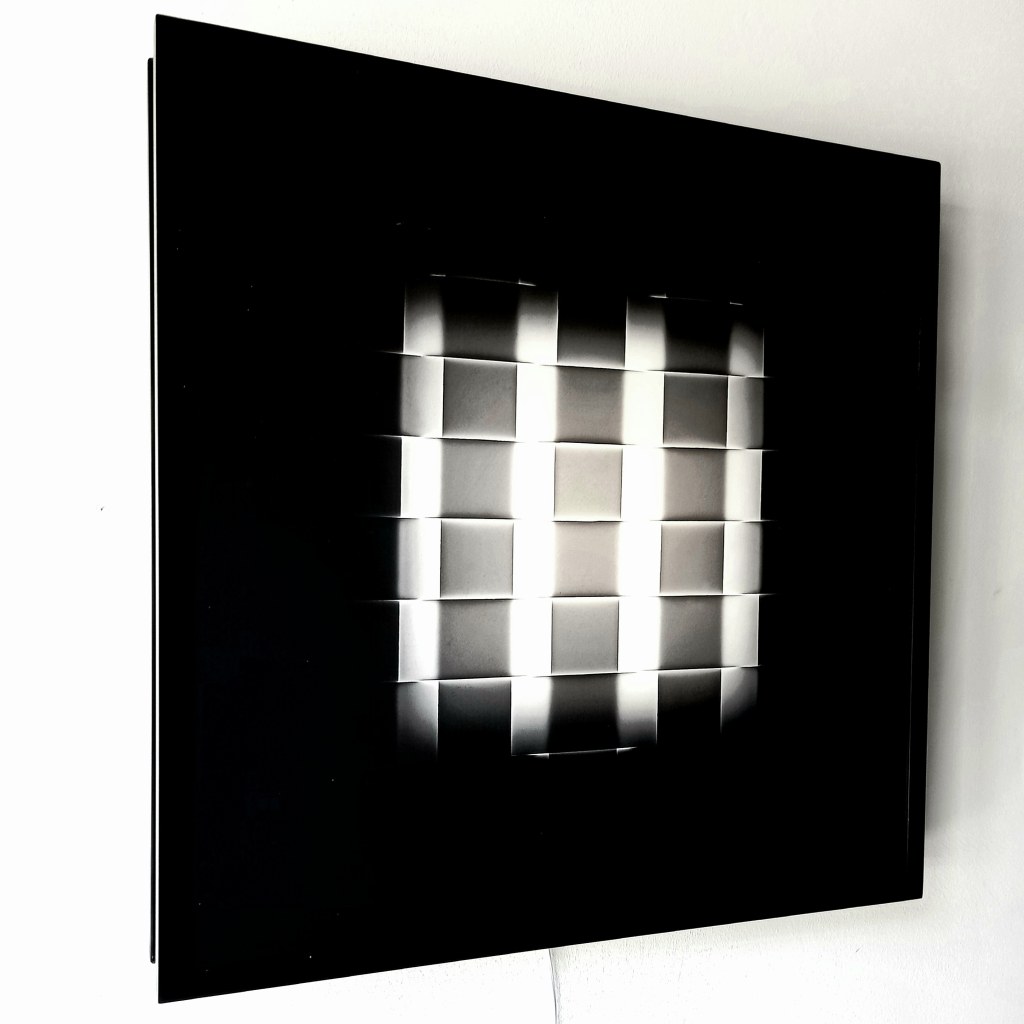
Alluminio, policarbonato intrecciato, luci led, foto su plexy
Cm 70,5×70,5×10
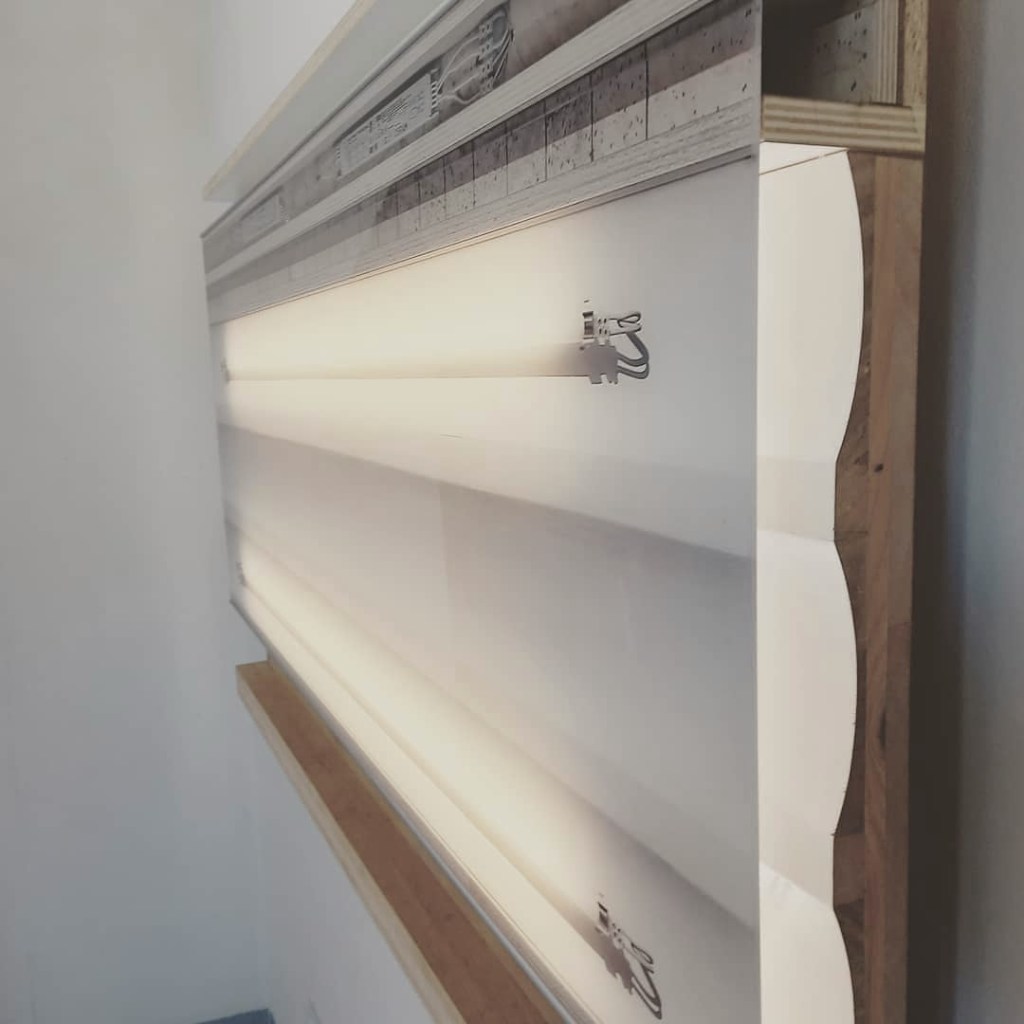
Foto su plexy e melaminici, luci al neon
Cm 146x95x13
Legno, metalli, smalti, stampa su plexy e legno
Cm 60x60x9

DIAFANOSCOPIO light box-2022
Metalli,luci neon, stampa su plexy
Cm 43×50,13,5
 paroladartista.com