
#paroladartista #intervistagallerista #caterinagualco
▼Scrole for English text
Gabriele Landi: E allora Fluxus?
Caterina Gualco: Nel riguardare tutto l’elenco delle manifestazioni promosse da Unimedia prima e da UnimediaModern poi (elenco che una bravissima stagista, Gloria Ragnoli, ha redatto nell’ambito della sua Laurea Magistrale) mi sono imbattuta in quella che, secondo me, è stata il vero ponte verso l’arte contemporanea internazionale. All’elenco di manifestazioni proposte con la rassegna “Nuove Relazioni” io avevo immaginato ancora un tema: un confronto tra l’immagine aniconica del concettuale e l’immagine figurativa della pittura che stava riemergendo dopo anni di esilio. Avevo allora interpellato Filiberto Menna, conosciuto attraverso Rossana Bossaglia che in quel periodo insegnava all’Università di Genova. E avevo scoperto una coincidenza incredibile! Menna stava pubblicando con Einaudi il libro diventato poi indispensabile per chi si interessa di questi temi “La linea analitica dell’arte moderna”. La proposta di Menna era stata veramente interessante, una mostra con artisti internazionali, con lavori molto difficili da trovare e la presentazione del suo libro all’Università… una vera e propria sfida! Gli artisti erano: Vincenzo Agnetti, Adriano Altamira, Diane Arbus, Valentina Berardinone, Victor Burgin, Mario Cresci, Ralph Goings, Joseph Kosuth, Emilio Isgrò, Ken Josephson, Renato Mambor, Carlo Maria Mariani, Ugo Mulas, Mimmo Paladino, Giulio Paolini, Claudio Parmiggiani, Giuseppe Penone, Vettor Pisani, Michelangelo Pistoletto, Antonio Trotta.
Il lavoro è stato enorme, difficile, ma alla fine ce l’abbiamo fatta. Il 20 gennaio 1976 la mostra è stata inaugurata, alla presenza di alcuni artisti, e del regista Emidio Greco, perché, ciliegina sulla torta, all’ultimo momento Menna aveva proposto la proiezione dello straordinario film “L’invenzione di Morel” e, altra incredibile coincidenza, il cineforum dell’Arecco lo aveva in programma per la stagione.
Ho tanti ricordi della mostra… alcune amicizie che sono durate negli anni (con Trotta e con Mambor e Valentina Berardinone, per esempio)… il multiplo di Paolini “Mimesi” arrivato in frantumi perché male imballato, ma essendo il primo ad essere spedito Paolini aveva potuto salvare la tiratura. Un’altra amicizia durata negli anni è stata quella con Emidio Greco, venuto a presentare il suo capolavoro, e naturalmente quella con Menna. Del suo arrivo in galleria a mostra allestita, e avevamo lavorato una settimana, ricordo
che aveva cominciato a criticare l’allestimento … dicendo “sposterei l’Isgrò qui, metterei il Trotta là…” io lo avevo ascoltato per un po’, poi avevo preso le chiavi della galleria e gliele avevo date.. . chiedendogli di avvertirmi quando il suo allestimento sarebbe stato pronto. Fortunatamente tutto finì con una risata e il giorno dopo inaugurammo quella che per me resta una delle mostre più belle che ho fatto!!!
E la prossima, sarà Fluxus!!!
G.L.: Aspetta Caterina, ora sono io a frenare. Visto che nella risposta precedente hai parlato di Filiberto Menna volevo sapere se con lui hai fatto anche delle mostre sulla Pittura Analitica uno dei sui cavalli di battaglia?
C.G.: Ho guardato il catalogo che accompagnava la mostra “La Somiglianza” e ho riletto il testo di Menna per vedere se c’era già un accenno alla “Pittura analitica”… Qui Menna mette in rilievo con tutta la sua energia la somiglianza tra le immagini “… perché l’artista, dopo aver sbandierato a dritta e a manca i diritti dell’immaginazione, sembra cedere in maniera così clamorosa, finanche provocatoria, alla violenza del reale? E lo spettatore, nutrito di cultura classica, potrà anche pensare che questi artisti vogliano riproporre addirittura l’antichissima disputa tra Zeusi e Parrasio sulla efficacia del trompe-l’oeil. In realtà tutte queste domande poste dal senso comune sono pienamente legittime, in quanto l’intera mostra gioca all’inganno, promette ciò che non dà, muovendosi tra gli estremi del trompe-l’oeil e del trompe-l’esprit….”. E le opere sono quanto di più “figurativo “ si possa immaginare… addirittura molte sono tautologie. Sicuramente dietro a questa lettura che pare esasperata c’era già un’indicazione verso la “Pittura analitica”… sostenuta anche dalla presentazione del libro. E l’11 novembre 1975 avevamo presentato una mostra di Antonio Passa, il catalogo della quale riportava una conversazione tra l’artista e Menna stesso.
G.L.: A questo punto come prosegue la tua attività?
C.G.: La mostra curata da Menna, con tutte le difficoltà che avevo dovuto superare, mi aveva fatto capire che ormai ero pronta a lanciarmi in avventure piuttosto spericolate… Avevo scoperto la performance che a Genova aveva trovato terreno fertile in anticipo su altre città italiane… avevo scoperto l’Azionismo viennese, la Body Art… tutte alternative straordinarie alla pittura figurativa che inesorabilmente continuava a riemergere.
Durante la stagione 1976/1977 avevo presentato una perfomance/installazione di Massimo Menoncin presso il monumento dei Mille allo scoglio di Quarto. Avrebbe dovuto essere un’azione della durata di 24 ore, con l’artista sempre presente sul posto a fotografare il monumento spostando la macchina fotografica su cavalletto ogni 15 minuti, con la visita di tutti gli amici, gli artisti, i critici e gli interessati a questo genere di arte che avrebbero dovuto arrivare con cibi e bevande, chitarre e tamburelli, una specie di performance collettiva… In realtà fu una 24 ore di diluvio universale, con pioggia, tuoni, fulmini e raffiche di vento che impedivano quasi di stare in piedi. In questa notte di tormento vicino al monumento si vedeva solo l’artista, intabarrato e turpiloquiante e la sua amica gallerista, vestita come per un viaggio sulla luna… Ma tutto questo non mi aveva scoraggiato, anzi, aveva stimolato in me il desiderio di altre avventure.
Ho un ricordo molto più sereno e poetico della seconda performance… “Serenata e tentativo di volo” di Angelo Pretolani. Angelo, che si presentava come l’Angelo Azzurro era giovanissimo, molto bello e sempre vestito di azzurro. Tutte le ragazze ne erano innamorate, ma lui era soprattutto innamorato del suo lavoro.
Nel marzo e aprile del 1976 avevamo organizzato “Domanda & Risposta – Serie di manifestazioni su ipotesi alternative di comportamento, in collaborazione con la Galleria Diagramma/Luciano Inga-Pin, Milano, così presentate:
- “One lonzage to be sucked slowly” performance di Gegi Tagliafico
- “Per conoscenza: ipnosi” performance di Sandra Sandri
- “Rituale d’identità” performance di Michel Journiac
- “Medicamenta” performance di Beppe Dellepiance
- “Body + Body Art “ proiezione di un film di Günther Brus, incontro-dibattito con Luciano Inga-Pin
I ricordi più vivi di questa manifestazione? Gegi Tagliafico che aveva rischiato di incendiare la galleria e Michel Journiac che avrebbe voluto farsi prelevare il sangue con una siringa da me…
Ancora un lavoro enorme e un’enorme soddisfazione… E i soldi? Di là da venire
G.L.: La performance a Genova… veramente una grande fioritura negli anni ’70…
C.G.: Effettivamente in quel momento sembrava che questa città, sempre molto conservatrice e sonnacchiosa si fosse svegliata. Era tutto un fiorire di nuovi gruppi, con spazi dedicati e con manifestazioni in gallerie private e in spazi pubblici. Ho già raccontato come io stessa avessi presentato “Domanda & Risposta” nel mio spazio di Vico di Garibaldi, in collaborazione con La Galleria Diagramma Inga-Pin di Milano…
Erano nate nel giro di pochi anni tre realtà molto attive e interessanti:
l’ Anagalleria nel 1975
il Performing Art Center nel 1977
il Centro Uh nel 1979
Questi gruppi erano animati da artisti allora giovanissimi, come Angelo Pretolani, Geggi Tagliafico, Roberto Rossini, tutti genovesi, assieme ad altri che arrivavano da diverse città, come Augusto Concato da Milano, Luigi Viola e Fabrizio Plessi da Venezia e così via…
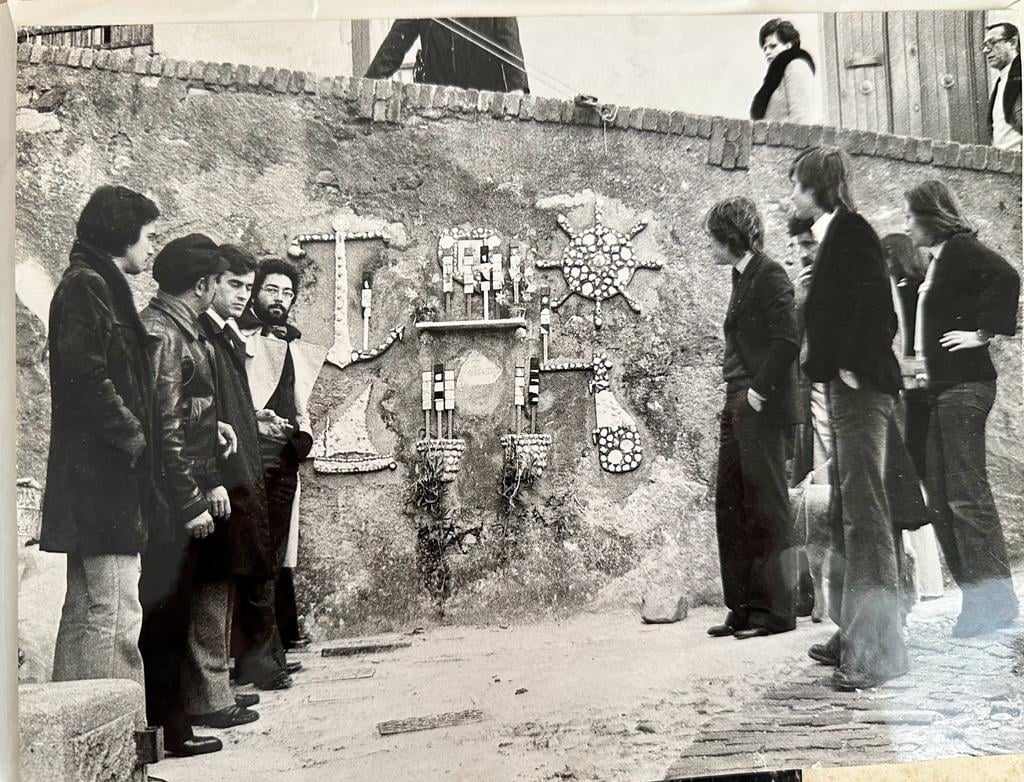
Intanto anche Aurelio Caminati aveva temporaneamente abbandonato cavalletto e tavolozza per presentare le sue azioni, un misto di immagini pittoriche che erano volate via dalla tela per animare serate teatrali, spazi pubblici e persino arene. Plinio Mesciulam, anche lui transfuga dalla pittura e dalla fotografia e con grande attenzione ai problemi della comunicazione del segno, il giorno del’ Epifania del 1976 propose il suo principio di arte ostensoria con le Epifanie ostensibili portate in corteo da giovani attraverso il porticciolo di Boccadasse a Genova. Significativa sarà poi la sua partecipazione alla Settimana Internazionale della Performance a Bologna nel 1977.
Se qualcuno mi chiedesse cosa può essere stata la molla che ha fatto scattare tutto questo, io non saprei rispondere… Genova è una città strana, nella quale per lungo tempo non succede niente e poi scocca una scintilla e diventa il centro del mondo. Basta ricordare uno dei primi teatri d’avanguarda, La Borsa d’Arlecchino, nato proprio a Genova, la scuola dei cantautori, le prime riviste d’arte come Il 3 Rosso e il Marcatre. A Genova nascono avventure interessanti… ma se vogliono continuare a vivere devono essere esportate
G.L.: E’ curioso tutto questo e forse è insito nella natura geografica della città e nella sua vocazione portuale… difficile da dire con esattezza. Intanto tu hai continuato in questa strada, con questi artisti ha fatto altre avventure? Sul piano mercantile era difficile vendere queste opere?
C.G.: Era praticamente impossibile. Mi rendo conto ora, proprio redigendo queste note in risposta alle tue domande, che la mia scelta degli artisti e degli eventi era sempre orientata dal mio interesse culturale e non da quello economico… Eppure io vivevo del mio lavoro, facendo delle fatiche incredibili… sempre con la paura che il cielo mi cadesse sulla testa, proprio come Vercingetorix, il Re dei Galli di adolescenziale memoria.
Ormai la passione per la performance, per l’evento, per tutto quello che allontanava l’arte dalla tela dipinta, era entrata con prepotenza nella mia attività.
Nel gennaio del 1977 avevo presentato “Arcobaleno” performance e installazione di Augusto Concato, nell’aprile dello stesso anno ancora Angelo Pretolani con una performance dal titolo molto poetico “Serenata e tentativo di volo” e Miro Polacci con “La maschera”.
Proprio nel 1977 avevo cominciato a presentare delle rassegne importanti sui grandi movimenti più attuali.
La prima era stata una manifestazione dal titolo “La Scrittura” curata da Filiberto Menna, Italo Mussa e Lamberto Pignotti, un’indagine sui diversi movimenti di Poesia Visiva, Concreta, Sonora, un ampliamento della “Visione Fluttuante” del 1975.
Nell’ottobre 1977 avevo inaugurato la stagione con una mostra veramente difficile da realizzare, ma secondo me ancora oggi molto importante, “Un cardine storico, il Concettuale”, con opere di Art Language, Victor Burgin, Burn, Joseph Kosuth, Mel Ramsdem, Bernard Venet, Vincenzo Agnetti, Robert Barry, Douglas Huebler, On Kawara, Giulio Paolini, Lawrence Wiener. Un depliant con un testo di Enrico Pedrini accompagnava la mostra e sue erano molte delle opere esposte.
Il 15 dicembre dello stesso anno, incoraggiata dalla creatività di Claudio Costa, con il quale era nato un sodalizio di lavoro e di vita, avevo (e dovrei dire avevamo) inaugurato una mostra sulla “magia” come referente linguistico attraverso i secoli. Una mostra straordinaria… partendo dal paradosso del titolo “Il fecondo ritratto di Onan”, dal testo di Carlo Romano “Le oscure evidenze”, dall’installazione incredibile e dalle opere degli antichi maestri. Per tutti basta ricordare i quattro dipinti anamorfici della fine del ‘700, citati nel libro di Baltrusaidis, che avevo avuto in prestito dal grande mercante Mario Tazzoli. Proprio in casa sua, a Milano, avevo visto per la prima volta dal vero lo splendido trittico di Bacon “La condition humaine”! L’installazione in galleria mostrava tra l’altro una culla/fioriera con piante acquatiche (come metafora della nascita) e due inginocchiatoi del ‘600 davanti a quattro incisioni “”secondo stato dei Caprichos di Goya. Gli artisti contemporanei che completavano questa “Magnifica Festa” erano Aurelio Caminati, Claudio Costa, Giannetto Fieschi, Osvaldo Licini, Fausto Melotti… A completare il tutto una carrellata di diapositive riproducenti opere sul tema dal Rinascimento a oggi. Chi non sarebbe felice di rifare una simile esperienza?
Ritornando all’indagine sul contemporaneo nel marzo del 1978 si era inaugurata una mostra sulla Land Art con opere di Christo, Walter De Maria, Jan Dibbets, Barry Flanagan, Hamish Fulton, Michael Heizer, Richard Long, Max Oppenheim, Robert Smithson, Eliseo Mattiacci, Germano Olivotto, Luca Maria Patella, Giuseppe Penone. Per il depliant di accompagnamento avevo chiesto a Germano Celant l’autorizzazione a stampare una parte del suo testo per la mostra alla Galleria d’Arte Moderna di Torino ”Conceptual Art, Arte Povera, Land Art”, ma Celant mi aveva risposta che “per ragioni metodologiche” non voleva più collaborare con gallerie private… Proprio in quei giorni avevo letto sulla rivista Data un magnifico articolo di Ettore Sottsass Jr., con un titolo straordinariamente affascinante “Graffi d’amore sulla pelle del pianeta”! Avevo chiesto un appuntamento a Sottsass e dopo una conversazione davvero divertente nella sua casa di Milano, ero tornata a Genova con il titolo e il testo per la mostra…
Il 9 maggio 1978 Robert e Marianne Filliou erano all’Unimedia con il loro “The Eternal Network presents”.
Ma per stasera basta “perché la minestra si fredda” (cit. Leonardo).
(continua…)
English text
Interview with Caterina Gualco (part two)
Gabriele Landi: So Fluxus?
Caterina Gualco: In reviewing the entire list of events promoted first by Unimedia and then by UnimediaModern (a list that a very talented intern, Gloria Ragnoli, drew up as part of her Master’s degree), I came across what, in my opinion, was the true bridge to international contemporary art. In the list of events proposed with the ‘New Relationships’ exhibition, I had still imagined a theme: a confrontation between the aniconic image of the conceptual and the figurative image of painting that was re-emerging after years of exile. I had then approached Filiberto Menna, whom I had met through Rossana Bossaglia, who at that time was teaching at the University of Genoa. And I had discovered an incredible coincidence! Menna was publishing with Einaudi the book that would later become indispensable for anyone interested in these topics ‘The Analytical Line of Modern Art’. Menna’s proposal had been really interesting, an exhibition with international artists, with works that were very difficult to find, and the presentation of his book at the University… a real challenge! The artists were: Vincenzo Agnetti, Adriano Altamira, Diane Arbus, Valentina Berardinone, Victor Burgin, Mario Cresci, Ralph Goings, Joseph Kosuth, Emilio Isgrò, Ken Josephson, Renato Mambor, Carlo Maria Mariani, Ugo Mulas, Mimmo Paladino, Giulio Paolini, Claudio Parmiggiani, Giuseppe Penone, Vettor Pisani, Michelangelo Pistoletto, Antonio Trotta.
The work was enormous, difficult, but in the end we did it. On 20 January 1976, the exhibition was inaugurated, in the presence of a number of artists, and the director Emidio Greco, because, icing on the cake, at the last moment Menna had proposed the screening of the extraordinary film ‘The Invention of Morel’ and, another incredible coincidence, the Arecco film club had it scheduled for the season.
I have so many memories of the exhibition… some friendships that have lasted over the years (with Trotta and with Mambor and Valentina Berardinone, for example)… Paolini’s multiple ‘Mimesis’ that arrived shattered because it was badly packaged, but as it was the first to be sent Paolini was able to save the print run. Another friendship that lasted over the years was the one with Emidio Greco, who came to present his masterpiece, and of course the one with Menna. Of his arrival at the gallery after the exhibition had been set up, and we had worked for a week, I remember
that he started to criticise the set-up … saying “I would move the Isgrò here, I would put the Trotta there …” I listened to him for a while, then I took the keys to the gallery and gave them to him. . asking him to let me know when his installation would be ready. Fortunately everything ended with a laugh and the next day we inaugurated what for me remains one of the most beautiful exhibitions I have ever done!
And the next one will be Fluxus!!!
G.L.: Wait, Caterina, now I’m holding back. Seeing that in your previous answer you spoke of Filiberto Menna, I wanted to know if you also did exhibitions with him on Analytical Painting, one of his workhorses?
C.G.: I looked at the catalogue that accompanied the “La Somiglianza” exhibition and I reread Menna’s text to see if there was already a mention of “Analytical Painting”… Here Menna emphasises with all his energy the similarity between images “… why does the artist, after having flaunted the rights of imagination left and right, seem to give in so resoundingly, even provocatively, to the violence of reality? And the viewer, nourished by classical culture, may even think that these artists want to reintroduce the ancient dispute between Zeusis and Parrasius on the efficacy of trompe-l’oeil. In reality, all these questions posed by common sense are fully legitimate, as the entire exhibition plays at deception, promises what it does not give, moving between the extremes of trompe-l’oeil and trompe-l’esprit….”. And the works are as ‘figurative’ as one can imagine… even many are tautologies. Surely behind this apparently exaggerated reading there was already an indication towards ‘Analytical Painting’… also supported by the presentation of the book. And on 11 November 1975 we had presented an exhibition by Antonio Passa, the catalogue of which contained a conversation between the artist and Menna himself.
G.L.: How is your activity continuing at this point?
C.G.: The exhibition curated by Menna, with all the difficulties I had to overcome, made me realise that by then I was ready to launch myself into rather reckless adventures… I had discovered performance art, which had found fertile ground in Genoa ahead of other Italian cities… I had discovered Viennese Actionism, Body Art… all extraordinary alternatives to figurative painting that inexorably continued to re-emerge.
During the 1976/77 season I had presented a performance/installation by Massimo Menoncin at the monument of the Thousand at the Quarto rock. It was supposed to be a 24-hour action, with the artist always present on site to photograph the monument, moving the camera on a tripod every 15 minutes, with visits from all the friends, artists, critics and those interested in this kind of art, who were supposed to arrive with food and drink, guitars and tambourines, a kind of collective performance… In reality it was a 24-hour universal deluge, with rain, thunder, lightning and gusts of wind that almost made it impossible to stand up. During this night of torment, only the artist could be seen next to the monument, dressed in disguise and turpiloquizing, and his gallerist friend, dressed as if for a trip to the moon… But all this did not discourage me, on the contrary, it stimulated in me the desire for other adventures.
I have a much more serene and poetic memory of the second performance… Angelo Pretolani’s ‘Serenata e tentativo di volo’. Angelo, who presented himself as the Blue Angel was very young, very handsome and always dressed in blue. All the girls were in love with him, but he was above all in love with his work.
In March and April 1976, we organised ‘Question & Answer – A series of events on alternative hypotheses of behaviour, in collaboration with Galleria Diagramma/Luciano Inga-Pin, Milan, presented as follows:
1. “One lonzage to be sucked slowly” performance by Gegi Tagliafico
2. “Per conoscenza: ipnosi” performance by Sandra Sandri
3. “Ritual of Identity” performance by Michel Journiac
Medicamenta” performance by Beppe Dellepiance
5. “Body + Body Art” projection of a film by Günther Brus, meeting-debate with Luciano Inga-Pin
The most vivid memories of this event? Gegi Tagliafico who risked setting fire to the gallery and Michel Journiac who wanted to have his blood drawn with a syringe by me…
Still an enormous job and an enormous satisfaction… And the money? Yet to come
G.L.: The performance in Genoa… really a great flowering in the 70s…
C.G.: Actually, at that time it seemed that this city, always very conservative and sleepy, had woken up. It was all a blossoming of new groups, with dedicated spaces and with events in private galleries and public spaces. I have already recounted how I myself had presented ‘Question & Answer’ in my space in Vico di Garibaldi, in collaboration with the Diagramma Inga-Pin Gallery in Milan…
Within a few years, three very active and interesting realities had sprung up:
1 the Anagalleria in 1975
2 the Performing Art Centre in 1977
3 the Uh Centre in 1979
These groups were animated by artists who were very young at the time, such as Angelo Pretolani, Geggi Tagliafico, Roberto Rossini, all from Genoa, together with others who came from different cities, such as Augusto Concato from Milan, Luigi Viola and Fabrizio Plessi from Venice, and so on…
Meanwhile, Aurelio Caminati had also temporarily abandoned easel and palette to present his actions, a mixture of pictorial images that had flown off the canvas to animate theatre evenings, public spaces and even arenas. Plinio Mesciulam, also a transfugee from painting and photography and with great attention to the problems of sign communication, proposed his principle of ostensible art on Epiphany 1976 with the Ostensible Epiphanies carried in a procession by young people through the small port of Boccadasse in Genoa. His participation in the International Performance Week in Bologna in 1977 was significant.
If someone were to ask me what could have been the spring that triggered all this, I would not know the answer… Genoa is a strange city, where nothing happens for a long time and then a spark ignites and it becomes the centre of the world. It is enough to remember one of the first avant-garde theatres, La Borsa d’Arlecchino, born in Genoa, the school of singer-songwriters, the first art magazines like Il 3 Rosso and Il Marcatre. Interesting adventures are born in Genoa… but if they want to continue to live they must be exporte
G.L.: It is curious about all this and perhaps it is inherent in the geographical nature of the city and its port vocation…. difficult to say exactly. In the meantime, did you continue along this path, did you have other adventures with these artists? Was it difficult to sell these works commercially?
C.G.: It was practically impossible. I realise now, as I am writing these notes in response to your questions, that my choice of artists and events was always oriented by my cultural interest and not by economic interest… Yet I lived off my work, making incredible efforts… always afraid that the sky would fall on my head, just like Vercingetorix, the King of the Gauls of adolescent memory.
By then, the passion for performance, for the event, for everything that distanced art from the painted canvas, had entered my business with overbearance.
In January 1977 I had presented ‘Arcobaleno’ (Rainbow), a performance and installation by Augusto Concato, in April of the same year again Angelo Pretolani with a performance with the very poetic title ‘Serenata e tentativo di volo’ (Serenade and attempt at flight), and Miro Polacci with ‘La maschera’ (The mask).
It was precisely in 1977 that I had started to present important exhibitions on the most current major movements.
The first had been an event entitled ‘La Scrittura’ (The Writing) curated by Filiberto Menna, Italo Mussa and Lamberto Pignotti, a survey of the different movements of Visual, Concrete, Sound Poetry, an extension of ‘Visione Fluttuante’ of 1975.
In October 1977, I opened the season with a very difficult exhibition, but in my opinion still very important today, ‘A Historical Hinge, the Conceptual’, with works by Art Language, Victor Burgin, Burn, Joseph Kosuth, Mel Ramsdem, Bernard Venet, Vincenzo Agnetti, Robert Barry, Douglas Huebler, On Kawara, Giulio Paolini, Lawrence Wiener. A brochure with a text by Enrico Pedrini accompanied the exhibition and many of the works on display were his.
On 15 December of the same year, encouraged by the creativity of Claudio Costa, with whom a partnership of work and life had been born, I had (and I should say we had) inaugurated an exhibition on ‘magic’ as a linguistic referent through the centuries. It was an extraordinary exhibition… starting from the paradox of the title “The fruitful portrait of Onan”, from Carlo Romano’s text “Le oscure evidenze”, from the incredible installation and from the works of the ancient masters. For all of them, it is enough to remember the four anamorphic paintings from the end of the 18th century, mentioned in Baltrusaidis’ book, which I had borrowed from the great merchant Mario Tazzoli. It was in his house in Milan that I had seen Bacon’s splendid triptych ‘La condition humaine’ for the first time in real life! The installation in the gallery showed, among other things, a cradle/flower bed with aquatic plants (as a metaphor for birth) and two 17th-century kneelers in front of four ‘second state’ engravings of Goya’s Caprichos. The contemporary artists who completed this ‘Magnifica Festa’ were Aurelio Caminati, Claudio Costa, Giannetto Fieschi, Osvaldo Licini, Fausto Melotti… The whole thing was rounded off with a slide show of works on the theme from the Renaissance to the present day. Who wouldn’t be happy to have such an experience again?
Returning to the investigation of the contemporary, an exhibition on Land Art had opened in March 1978 with works by Christo, Walter De Maria, Jan Dibbets, Barry Flanagan, Hamish Fulton, Michael Heizer, Richard Long, Max Oppenheim, Robert Smithson, Eliseo Mattiacci, Germano Olivotto, Luca Maria Patella and Giuseppe Penone. For the accompanying brochure, I had asked Germano Celant for permission to print part of his text for the exhibition at the Galleria d’Arte Moderna in Turin entitled ‘Conceptual Art, Arte Povera, Land Art’, but Celant replied that ‘for methodological reasons’ he no longer wanted to collaborate with private galleries… In those very days I had read a magnificent article by Ettore Sottsass Jr. in Data magazine, with the extraordinarily fascinating title ‘Love Scratches on the Skin of the Planet’! I had asked Sottsass for an appointment and after a truly amusing conversation at his home in Milan, I returned to Genoa with the title and the text for the exhibition…
On 9 May 1978 Robert and Marianne Filliou were at Unimedia with their ‘The Eternal Network presents’.
But that’s enough for tonight ‘because the soup is getting cold’ (quoting Leonardo).
(to be continued…)



 paroladartista.com